As previously posted, Samhain is an important holy day in modern Druidry, Wicca, and some other witchcraft traditions. While a Gaelic festival, some modern witches have incorporated the meaning of this night with the worship of the Goddess Hekate. I say “worship” rather than “work with.” I hate the latter phrasing, making it seem as though the Gods and spirits are toys to be trifled with. One minute they are useful, and the next to be put away in some neat package of your mind until They are useful later on again. I consider that disrespectful. I’ll write a blog post on worship later on, but for now let’s return to the task at hand: Samhain and Hekate.
The Underworld
Below the soil of our world, where trees take root and caverns open wide, lies a place known as the Underworld. Many societies and tribes had their own versions of an Underworld, presided over by a God or Goddess that dealt with death, if not death itself. In ancient Greece it was Hades, who was later joined by Persephone: both were not a God and Goddess of Death so much as Those who reigned over the Underworld which held the dead and a host of spirits. Hekate is known by many names (called epithets). One of those epithets is Khthoniê, or “Of the earth,” aka “Underworld.” The world was seen to be divided into 3 separate realms: the land, the sea, and the sky. The land, or beneath it, was the residency of the Underworld, hence “Of the earth.” Khthoniê is another name for other Goddesses, such as Demeter and Persephone. Unfortunately, because some have matching names people tend to think that They are the same God/dess but in a different guise. They aren’t. It just means they share similar functions but perhaps differently. For example, when I worked as a bank teller, I was a teller. Other people there had the same title: bank teller. It didn’t mean we were related in some way or the same person. It just meant we shared the same functions. So when someone says Hekate is Demeter or Hekate is Artemis, the answer is “Nope.” We’ll be going through this in another post about polytheism. So for now let’s focus (again) on the nature of this post.
Queen of the Dead
Another epithet of Hekate was Anassa eneroi, or “Queen of those Below [Dead].” Again, Her Underworld status is well established. This means that Hekate is the ruling monarch of those who dwell there. This was an epithet which Medea, priestess of the Goddess Hekate, called on when doing some magic. Apollonios Rhodios writes the following: (1)
To make the ointment, Medea, clothed in black, in the gloom of night, had drawn off this juice in a Caspian shell after bathing in seven perennial streams and calling seven times on Brimo, nurse of youth, Brimo, night-wanderer of the underworld, queen of the dead (Anassa Eneroi)…
“Anassa” is rooted in the Greek word “anax.” It has variously been translated as [tribal] chief or leader. The title of “Anax” was used in the Iliad for rulers such as Agamemnon. It was also a title, not just for monarchs, but for those of “lesser station” within the ruling household. Examples include the master of slaves, the lord of the stables, and the house-lord. (2). So while Hades and Persephone are the overall King and Queen of the Underworld, Hekate is also Queen; just with a shared influence and possibly that of a lesser station in the Underworld. “Lesser” is not synonymous with “less powerful.” Hekate is Lady of the 3 Realms of Land, Sea, and Sky. She is favored by Zeus and can do so much within Her power. If you want to know more, read the Theogony by the Greek writer Hesiod. Any copy can be obtained from Amazon cheaply. Hekate does have a lot to give, but when it comes to the Underworld, She doesn’t make the final say-so.
All of the Gods are limited within Their scope, as it should be. The only deity who claims to be omnipresent, omniscient, and omnipotent is the God of the Christians, Jews, and Muslims. I don’t need my Gods and spirits to be all of that. They aren’t and I am fine with it.
The Role of Hekate
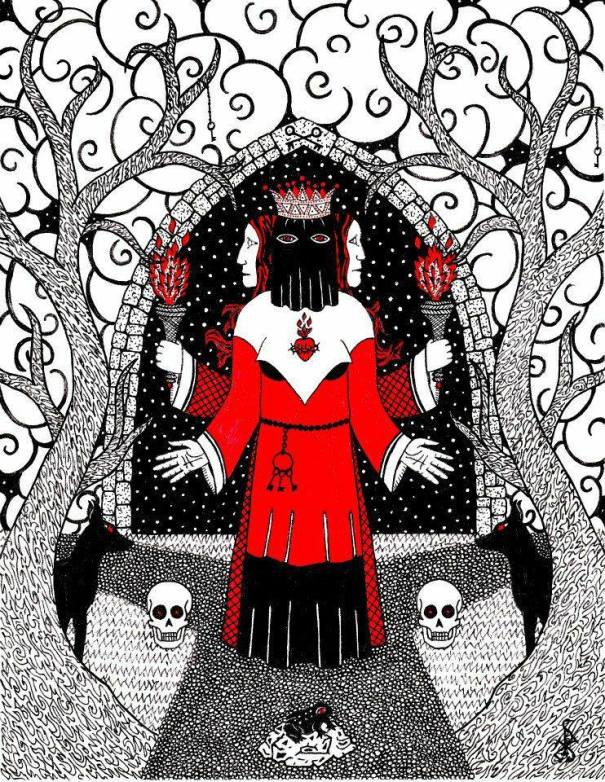
As can be seen by two of Her epithets, Hekate has a great deal to do with the dead. Since Samhain is a night or festival devoted to them, it is only right that many modern witches and even some Druids have called on Her to help them with ancestral workings. She is the Guide of the Dead, after all. They walk with Her and behind Her. She is the Lady to be called on, and from my experience She is only too happy to oblige.
Hekate has helped me in my ancestral workings. I’ve called on Her aid to open the gates between this world and the Otherworld: to guard them and then close them when I am finished. She keeps evil and restless spirits at bay. I often propitiate these spirits on the dark moon, leaving behind food and offerings at a local crossroads. I don’t look back. I believe the spirits witness it. Although no dogs have barked, they don’t need to. I practice my rites and I have seen results to this type of working by veneration and honor. I haven’t had any issues with wandering dead in my home. The only spirits in my house are those which I and my household have welcomed.
Conclusion
I think a connection between Samhain and Hekate are inevitable. Wicca, Druidry, and some modern witchcraft traditions have introduced Samhain to the Neopagan communities at large. This makes it a communal festive. The Goddess Hekate is no longer confined to Greece or ancient Anatolia (modern-day Turkey). Her worship has been revived and spread.
To combine the two isn’t cultural appropriation in my opinion. I say this because I’ve had a couple of people message me about Samhain and cultural appropriation of a Gaelic feis. I’m sorry, but that hasn’t been the case since the Celtic Revival of the late 19th – early 20th century, when Samhain customs were introduced to the States. If you would like to celebrate it your ancestral way then do so. I can see what you’re saying, but Samhain is a public festival now. I only hope that Neopagans can continue to bring honor to that holy day with respect and love, which happens. It is such a reverential day. Yes, some people do mix it with Halloween, and that’s just as fine.
The question comes about Dia de los Muertos: is it cultural appropriation to celebrate it? I’ll write that in a later blog post. Cultural appropriation and respect are important during this time (i.e. honoring the ancestors). Blessings to you and yours. May the Infernal Lady guard the gates and keep the restless and evil spirits at bay this Samhain. Hail Hekate!
~Oracle~
(1) Apollonios of Rhodes. (1989). Argonautica: Book III: 828. R. Hunter (Ed.). UK: Cambridge University Press. Original Work Published in the 2nd century BCE.
(2) Deger-Jalkotzy, S., Prof. & Lesmos, I. (Eds). (2006). Ancient Greece: From the Mycenaean Palaces to the Age of Homer. Edinburgh: Edinburgh University Press.
 The Cave of Oracle
Reblogged this on Die Goldene Landschaft.