The Afterlife

Charon
Charon

Conceptualizing what happened to people once they had passed turned out to be a matter of debate (nothing has changed). In ancient Greece, there seems to have been a difference between what everyday people thought and what the literature mentioned. Poets had their own imaginations, yet it did spread to the populace. There were also hypotheses as to what awaited initiates into Mystery Traditions. What made it different? How was it envisioned? And what is taught by the Strix?

Shades of the Dead
In ancient Greece, the understanding of what happened with the dead was pretty much well established by about 8th – 6th centuries BCE. In the Odyssey, the poet Homer wrote of the dead wandering throughout the Underworld as shadows: gloomy and poor. It was not something to aspire too. It was so bad that when the spirit of Achilles was raised from the dead temporarily, he mentioned how he would rather be a slave than the king of the Underworld. 

The Dead weren’t creepy, scary, or evil. They were just sad. Their life in the Underworld depended on the constant memory of their descendants who were charged with maintaining their tombs and celebrating their milestones. Offerings such as cakes and wine were given to them. In this, the Dead continued to have hope, because the inevitable was oblivion.

Paradise and Tartarus
By about the 5th century BCE, the image of the Underworld was going about a change. Instead of just some gloomy place, there were levels. Socrates, the famed philosopher, was probably taught this by the witch and prophetess Diotima, who was his mentor. It passed to Plato who, in his “Gorgias” (a dialogue featuring Socrates), mentions it as a place where the wicked receive judgement.

Originally a place where the Titans who fought against Zeus and the Gods went after their defeat, it was this place of wickedness which has filled the imagination of many people. This imagery even passed into Christianity, where a section of Hell is known as Tartarus. The punishments towards the wicked fit the crimes they committed.

On the other spectrum, we have Paradise, also known as Elysium (or the Elysian Fields). It was said to be located in the West, and also called the Blessed Isles. Originally a place for demigods and Heroes, it was expanded in later imagery to those who lived out of Piety, performed heroic deeds, and/or were specifically chosen by the Gods. The Elysian Fields even made it to the New Testament as “Abraham’s Bosom,” also called “Paradise.”

The Mystery Traditions
The Mystery Traditions had a different account of the afterlife than those mentioned above. Initiation into the Mysteries guaranteed one a different afterlife. The Eleusinian Mysteries were believed by some to grant them a happy reunion. The Orphic Mysteries, on the other hand, promulgated the belief in reincarnation – more accurately metempsychosis, a form of reincarnation. What’s the difference? Metempsychosis refers to the spirit leaving the body at death and working its way through the Wheel of Fate in order to break the cycle and be one with the Divine. When a soul is reincarnated, they may choose to be human or animal. It is a choice devoid of karma, which is an Asian concept belonging to a specific religious practice. In the Orphic Mysteries when one passed, they were given instructions to follow a certain path and overcome obstacles. Orphic initiates were faced with a path that led to two springs: one named Lethe (Forgetfulness) and the other named Mnemosyne (Memory). They said a password to allow them to enter, and drink from the Well of Memory. From here they would reincarnate with their past life memories intact.

StrixCraft
In the StrixCraft as I teach it, the Ophic Strix initiates are promised deliverance from their former selves by Dionysos. It is Dionysos who intercedes on behalf of the initiate as they stand before Persephone. Claimed by Dionysos, the initiate will then walk upon the Starry Road to Memory, drink from the Moon Well, and continue to their next life. Once an initiate, always an initiate.

There is a Fourfold scheme to our bodies as we teach it:

  • The Physical Body
  • The Lunar Body
  • The Solar Body
  • The Starry Body

Our etheric anatomy is something I’ll touch on in another blog. For now, I would like to say that for us as Strix, our multiple bodies each have a destination. The physical body returns to Ge, from whose energy we borrowed to live. We now return that energy back to Earth Mother.

The Lunar Body remains attached to the physical body. Upon death, there is a separation between the two, and the Lunar Body is the active principle which either remains intact because of Memory, or may dissolve and return to the Earth Mother if nothing is there to keep it alive and fed.

The Solar Body, upon death, separates from the Lunar Body and reincarnates along family lines. In the form of a bird the Solar Body reaches the Sun and travels the road to the Underworld where it will meet Persephone. This is the entity which interacts with other beings and carries emotions, intelligence, and awareness.

The Starry Body, upon death, is the ruling God-Self which guides the Solar Body to remember the initiations and past life deeds. The Starry Body carries the “True Name” imprinted with the Solar Body that will allow the chain of initiations to continue throughout the rest of that individual’s lives. The Starry Body is the Higher Self which connects us to the Gods and the Cosmos. One day the Starry Body will become a part of Nyx, carrying our memories to her.

Conclusion
The Underworld’s geography often changed depending on the time period and the knowledge acquired by those who returned from the dead in near-death experiences. I believe that the concept of the Underworld came about because our ancestors felt there must be somewhere that we travel to while we sleep. Dreams are portals to other realities, and it may have seemed that while we were sleeping, another part of us was awake. That’s just my belief though. My hypothesis.

The revelation of the different bodies and their destinations in StrixCraft as I teach it is pulled from contemplation and communing with the spirits. They may not be orthodox insofar as Hellenic Reconstructionism is concerned, but they make sense for us and our initiates. We look forward to our lives continuing, and allowing Nyx to use us so she may know herself even better.

Eirene kai Hugieia!
(Peace and Health!)
Oracle


Hekate and Samhain

Red Hekate
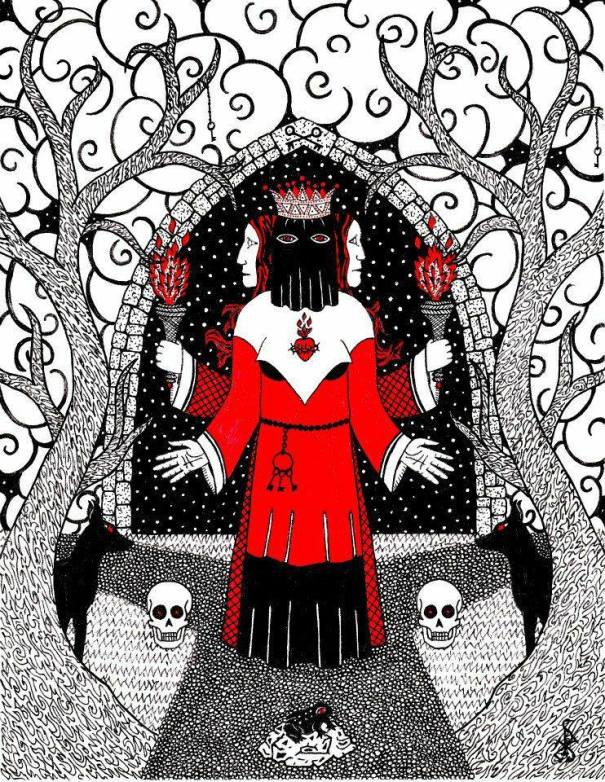
Hekate by Patrick John Larabee

As previously posted, Samhain is an important holy day in modern Druidry, Wicca, and some other witchcraft traditions. While a Gaelic festival, some modern witches have incorporated the meaning of this night with the worship of the Goddess Hekate. I say “worship” rather than “work with.” I hate the latter phrasing, making it seem as though the Gods and spirits are toys to be trifled with. One minute they are useful, and the next to be put away in some neat package of your mind until They are useful later on again. I consider that disrespectful. I’ll write a blog post on worship later on, but for now let’s return to the task at hand: Samhain and Hekate.

The Underworld
Below the soil of our world, where trees take root and caverns open wide, lies a place known as the Underworld. Many societies and tribes had their own versions of an Underworld, presided over by a God or Goddess that dealt with death, if not death itself. In ancient Greece it was Hades, who was later joined by Persephone: both were not a God and Goddess of Death so much as Those who reigned over the Underworld which held the dead and a host of spirits. Hekate is known by many names (called epithets). One of those epithets is Khthoniê, or “Of the earth,” aka “Underworld.” The world was seen to be divided into 3 separate realms: the land, the sea, and the sky. The land, or beneath it, was the residency of the Underworld, hence “Of the earth.” Khthoniê is another name for other Goddesses, such as Demeter and Persephone. Unfortunately, because some have matching names people tend to think that They are the same God/dess but in a different guise. They aren’t. It just means they share similar functions but perhaps differently. For example, when I worked as a bank teller, I was a teller. Other people there had the same title: bank teller. It didn’t mean we were related in some way or the same person. It just meant we shared the same functions. So when someone says Hekate is Demeter or Hekate is Artemis, the answer is “Nope.” We’ll be going through this in another post about polytheism. So for now let’s focus (again) on the nature of this post.

Queen of the Dead
Another epithet of Hekate was Anassa eneroi, or “Queen of those Below [Dead].” Again, Her Underworld status is well established. This means that Hekate is the ruling monarch of those who dwell there.  This was an epithet which Medea, priestess of the Goddess Hekate, called on when doing some magic. Apollonios Rhodios writes the following: (1)

To make the ointment, Medea, clothed in black, in the gloom of night, had drawn off this juice in a Caspian shell after bathing in seven perennial streams and calling seven times on Brimo, nurse of youth, Brimo, night-wanderer of the underworld, queen of the dead (Anassa Eneroi)…

“Anassa” is rooted in the Greek word “anax.” It has variously been translated as [tribal] chief or leader. The title of “Anax” was used in the Iliad for rulers such as Agamemnon. It was also a title, not just for monarchs, but for those of “lesser station” within the ruling household. Examples include the master of slaves, the lord of the stables, and the house-lord. (2). So while Hades and Persephone are the overall King and Queen of the Underworld, Hekate is also Queen; just with a shared influence and possibly that of a lesser station in the Underworld. “Lesser” is not synonymous with “less powerful.” Hekate is Lady of the 3 Realms of Land, Sea, and Sky. She is favored by Zeus and can do so much within Her power. If you want to know more, read the Theogony by the Greek writer Hesiod. Any copy can be obtained from Amazon cheaply. Hekate does have a lot to give, but when it comes to the Underworld, She doesn’t make the final say-so.

All of the Gods are limited within Their scope, as it should be. The only deity who claims to be omnipresent, omniscient, and omnipotent is the God of the Christians, Jews, and Muslims. I don’t need my Gods and spirits to be all of that. They aren’t and I am fine with it.

The Role of Hekate 
As can be seen by two of Her epithets, Hekate has a great deal to do with the dead. Since Samhain is a night or festival devoted to them, it is only right that many modern witches and even some Druids have called on Her to help them with ancestral workings. She is the Guide of the Dead, after all. They walk with Her and behind Her. She is the Lady to be called on, and from my experience She is only too happy to oblige.

Hekate has helped me in my ancestral workings. I’ve called on Her aid to open the gates between this world and the Otherworld: to guard them and then close them when I am finished. She keeps evil and restless spirits at bay. I often propitiate these spirits on the dark moon, leaving behind food and offerings at a local crossroads. I don’t look back. I believe the spirits witness it. Although no dogs have barked, they don’t need to. I practice my rites and I have seen results to this type of working by veneration and honor. I haven’t had any issues with wandering dead in my home. The only spirits in my house are those which I and my household have welcomed.

Conclusion
I think a connection between Samhain and Hekate are inevitable. Wicca, Druidry, and some modern witchcraft traditions have introduced Samhain to the Neopagan communities at large. This makes it a communal festive. The Goddess Hekate is no longer confined to Greece or ancient Anatolia (modern-day Turkey). Her worship has been revived and spread.

To combine the two isn’t cultural appropriation in my opinion. I say this because I’ve had a couple of people message me about Samhain and cultural appropriation of a Gaelic feis. I’m sorry, but that hasn’t been the case since the Celtic Revival of the late 19th – early 20th century, when Samhain customs were introduced to the States. If you would like to celebrate it your ancestral way then do so. I can see what you’re saying, but Samhain is a public festival now. I only hope that Neopagans can continue to bring honor to that holy day with respect and love, which happens. It is such a reverential day. Yes, some people do mix it with Halloween, and that’s just as fine.

The question comes about Dia de los Muertos: is it cultural appropriation to celebrate it? I’ll write that in a later blog post. Cultural appropriation and respect are important during this time (i.e. honoring the ancestors). Blessings to you and yours. May the Infernal Lady guard the gates and keep the restless and evil spirits at bay this Samhain. Hail Hekate!

~Oracle~

(1) Apollonios of Rhodes. (1989). Argonautica: Book III: 828. R. Hunter (Ed.). UK: Cambridge University Press. Original Work Published in the 2nd century BCE.

(2) Deger-Jalkotzy, S., Prof. & Lesmos, I. (Eds). (2006). Ancient Greece: From the Mycenaean Palaces to the Age of Homer. Edinburgh: Edinburgh University Press.