The entrance of psychological concepts into Witchcraft and Occulture in general has not gone unnoticed. For example, interpretations on certain Tarot decks or explaining the existence of Gods and spirits in a mental way (that is, that these forces are merely constructs within our subconscious). These psychological explanations seem to soften our religious practices and attune them to the “educated,” rather than others. But how did it begin? What forces were invoked to dilute the Occult in this manner?
Occultism
The word “occultism” (things that are hidden) came about in the 19th century among French metaphysical orders. Prior to that the groups of Natural Magic, Astrology, and Alchemy were referred to as the “occult sciences,” in an attempt to make them compatible with modern science. Many scientists and philosophers in the late Middle Ages, Renaissance, and Baroque periods held onto occult beliefs and practices such as Sir Isaac Newton, Marsilio Ficino, Paracelsus, Leonardo da Vinci, Johann Friedrich Schweitzer, and Franz Kessler (among others).
Occult sciences were studied in Arabic, Italian, French, German, Spanish, and English countries. The spread of the occult sciences to these regions blossomed from its roots in Near Eastern sources such as Egypt, Iran, Iraq, and the Byzantine period prior to its conquest by the Islamic Turks. Yet it was the work of the Islamic Caliphate Empire that provided the means to copy and preserve occult writings from the past and protect them in their libraries. It was the passing on of certain Hermetic, Neoplatonic, and Gnostic works into Italy by way of the Islamic Empire that spawned the Italian Renaissance. This Renaissance in turn took root in the countries aforementioned.
The German Occult Revival and Theosophy
The Austrian Empire, Germany, Prussia, and the German States had their own Occult Revival beginning in the 19th century but with roots going back to the 12th century Knights Templar. A movement known as the Rosicrucian (“Rose Cross”) Movement flourished in the 17th and 18th centuries. Later in 1884 a branch of Theosophy was established. Theosophy (“Divine Wisdom”) is a non-sectarian philosophical branch which has influenced the works of many Occult authors and esoteric orders. This organization’s founders saw themselves as investigators of Truth and also a bridge between West and East.
Note: It was during this time – and earlier – that India was under the dominion of the British Empire. British spiritual seekers traveled to India and Sri Lanka to gain “older” occult currents into their spiritual and magical systems. India was a fascinating place. Keep in mind that Church and State were (are) inseparable in the Empire, and therefore the history the English learned was that of a literal Bible interpretation for history. When indigenous tribes were “discovered” in the Americans, Australia, the Pacific Islands, East Asia, and the Indian Subcontintent, British scientists and travelers wanted to know how these “exotic and noble savages” lived their loves with morals and yet without the Bible. There were also discoveries that these lands had civilizations older than the 6,000 year history the British Church taught; many of these were later hidden from the general public until the late 20th century.
As the German Occult Revival went underway, an unfortunate turn of events slowly changed the direction of German Occultism from one of openness to one of nationalism, misinterpreting Gnostic texts – such as that the Jews were evil because their God, Yahweh (the Demiurge) was also evil. As well, early anthropological studies began using the term “Aryan” for the ancestors of Europeans, Iranians, and Indians. This word was ingrained as a call for nationalism among “White Aryans” to band together and restore “the superior race.”
The French Occult Revival
As the German Occult Revival was underway, another movement was being birthed in France during the mid-19th century. One of the men (or perhaps the main one) responsible for the revival of Occultism was a gentleman by the name of Alphonse Louis Constant; better known by his esoteric name Eliphas Levi.
Eliphas was a Qabalist and socialist. His magical studies helped him to see how socialism – as a reaction against an empire of monarchs – was also a place one could easily discuss magical subjects. His Qabalistic ideals and magical inquiries were shaped by his socialist circles. Levi began to work in Dream Magic, Qabala, Magnetism, and Ceremonial Magic. He published his “History of Magic” in 1861. Levi attempted to define just what Magic was/is. His work with the Tarot was influential with other Occult Orders, such as the Esoteric Order of the Golden Dawn. It was also Levi who gave us the modern and most famous image of Baphomet, the “Sabbatic Goat” of Witchcraft and the utmost symbolism of the Absolute:

The Libido and the Psychoanalysis of the Mind and of Magic
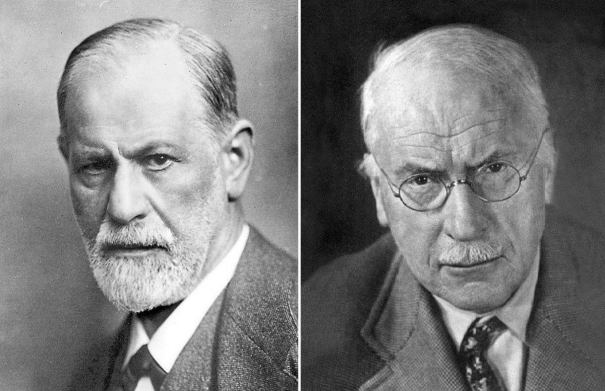
Enter Sigmund Freud in all of this hullabaloo. The atmosphere was rife with occult imagery, orders, and philosophies. Freud had a hatred for the occult sciences. However, the psychoanalysis he gave to women and other patients at the time made sexual energy (“libido”) the main focus of their diagnosis and subsequent treatment. He interpreted otherwise paranormal phenomenon as nothing more than expressions of the libido. For example, in a conversation with his student Carl Jung, he said:
You see, we must make a dogma of it, an unshakable bulwark…Against the black tide of mud, of occultism.
And although he said this and expressed hatred for the occult sciences, nonetheless Freud did have some interest in it himself. For example, Freud and a friend visited a German psychic named Frau Seidler who lived in Berlin.
Although Freud was following his school of thought, it was his pupil Carl Jung who really made an impact on Occulture. He had a lifelong fascination and even wrote treatises on his alleged theories. He departed from the sexual hypotheses of Freud and embraced a more spiritual connection. Jung believed in the paranormal and Occult. He participated in seances and spent time with prominent spiritualists such as Douglas Home, the renowned Spiritualist who could levitate his body.
But what Jung is most famous is for is his theories on the Collective Unconscious, Archetypes, and transpersonal psychology (he coined the term transpersonal). He studied dreams in individuals and noted that there was a collective thought. This collective, he hypothesized, spoke in “universal symbols” and fashioned what he called archetypes. For example, there was the “universal meaning” of mother-child, father-child, the Shadow, the wise old man, the hunter, and the Hero. These, he felt, were important additions to occult psychology: how correspondences in Magic were seen as the same as the Collective.
Magic as a Psychological Pursuit
Due to these discoveries, many occultists adopted these Jungian tropes and transferred it over to Magic. Instead of ritual and personal growth in Magical skills such as astral projection, summoning spirits, interacting with the spirits of our world, worshiping deities, and making inner connections to other Magical endeavors, people began writing and saying that these performances were all in the Mind: the Mindscape where all repositories of Dream Symbol and Dream Language exist. This has caused a lot of chaos in Magic, most especially for people who desire a spiritual connection, not just a mental exercise.
Spirits and Gods began to be viewed as constructs of the Mindscape, and therefore did not need worship or careful precautions. Exorcisms were explained as the individual forming a negative image in their mind and then using that image and psychological language to “force the Shadow out,” and integrate the lesson with the positivity of Light. In fact, the New Age Movement has incorporated so much of this information.
“Pathworkings” with fantastical meditations were used. Also, the introduction of “What does this mean to you,” rather than Mystery Traditions who kept a common framework for their own meaning in order to secure the egregore. The egregore is a psychic elemental who watches over the coven, lodge, or grove and steers it and its people towards the Work. It comes from the word Grigori, or “Watcher.”
Accountability in spiritual and Magical matters were thrown aside, and more people joined Witchcraft and Neopagansim because of its penchant to not be heavy in doctrine and be an “anything goes” scenario. While I encourage individual workings because we are all different, and we all engage with spirits and deities differently, nonetheless the influence of Jung and psychology into the Craft and Polytheism really made a disservice. People no long wanted to be taught the Old Ways, opting instead for personal flavorings of deities and spirits who “they liked.”
Conclusion
Magic is not psychological. Divination is not psychological. The Mysteries are not psychological. They will have an impact on the Mind (psyche), but it isn’t the same thing. It is for these reasons that many Occultists and polytheists are returning to the ways which predate the psychological intervention of our worship and Magics. Neopagans as a whole have adopted many New Age concepts and language, focusing on self-development as opposed to seeing self-development as an effect of Magic, and not the reason for it.
Magic is real. It takes time and training. Correspondences are for knowing the realm of each spirit, not for you to build up your mind so you can feel better about what you’re doing. Magic is dark and light. Worship is a must. Training and passing on the ways of our people to the next generation are important. Education is fundamental.
Eirene kai Hugieia!
(Peace and Health!)
Oracle

 The Cave of Oracle