Patron Deities

Horned-God-Moon-Goddess-Herm-Altar-Statue
The Goddess and the Horned One

I often get asked about patron deities a lot. Who has chosen me? How do I start? How can I find out my God and Goddess? What do I do once I know? Allow me to delve into this topic a bit more.

Wicca
In the 1950s a religion cropped up which became known as Wicca, although it was simply known as Witchcraft at the time. It was spearheaded by a man by the name of Gerald Gardner. In his writings (and those of later authors), Wicca as a whole had two patron deities: the Horned God and the Goddess. The Horned God is the embodiment of the Sacred Masculine, an archetype consisting of an amalgamation of Pan, Cernunnos, Gwyn ap Nudd, Donn, among others. The Horned God is a God of the Underworld, the sacred hunt, Nature, Sex, and the Wild, the Sun, and sacrifice.

The Goddess is the other half of the Craft’s deities. She is the embodiment of the Sacred Feminine. She is the Lady who is the Triple Goddess of Maiden, Mother, and Crone. She is connected to the green earth, the stars, the Moon, fertility, and the sea.

Both the Horned God and the Goddess are viewed as a pair which invoke the power of polarity; that is, as opposites, the Sacred Masculine and the Sacred Feminine come together for the purposes of creation, Magic, death, rebirth, and fertility. Wicca is viewed as being duotheistic: only two deities who embody all of the Gods and Goddesses. Some Wiccans take the occultist Dion Fortune’s words literally:

All of the Gods are one God, and all of the Goddesses, and there is but one Initiator.

This imagery has lasted in Traditional Craft for a very long time. It works for some Wiccans. However, I am a polytheist; I believe in the existence of all individual Gods and Goddesses, each with their own story and personality. They exist outside of ourselves, and so therefore I am not a duotheist.

When Traditional Initiatory Wicca spread here in the States from England in the 1960s, many Wiccans began to create their own covens because the demand for initiations and the eagerness of wanting to join a coven outnumbered how many covens actually existed. Many began to find whatever they could and started to “self-initiate” to the Gods. They started their own covens and sacred Traditions. They copied what they could from existing writings written by Wiccan initiates, and started their spiritual path.

However, this Wicca was do-it-yourself, and as a result the oral lore which was passed down in Traditional Initiatory Wicca was missing. DIY Wiccans took hold of the Horned God and the Goddess and insisted (in a way) that their witches individually had a patron God and a patron Goddess.

Side note: Some today use the word “matron” for the Goddess, but this is incorrect. Use patron, which is equally valid for both deities.

The Rise of Polytheism
Many polytheists then and now feel uncomfortable in Wicca, with its seemingly duotheistic philosophies. They yearn to experience connections with more than one deity. This is where I am at.

Early on in my studies I read the books which informed me of the need to pick a God and Goddess. I tried to think of some, and I couldn’t. When I started learning Druidry, the idea of a patron God and Goddess were foreign; other paths I followed didn’t have this duotheistic concept, such as Sicilian-Continental Craft and StrixCraft.

When I became initiated into Alexandrian Wicca (a “denomination” of Wicca, for lack of a better term), I already had Hekate and Dionysos whom I followed. Hekate was my original Goddess, and it just so happened that she led me to Dionysos, with whom I devoted myself to. So the presentation of being encouraged to have a God and Goddess was not necessary for me. That being said, others were exhorted to do so as a fundamental part of their training. But how would they find out? Some just picked a couple at random who they felt made sense. Others just didn’t have them.

Polytheism in Wicca
I am involved in Hellenic Polytheism as well as Wicca. I have also had the privilege to meet other Wiccan polytheists who didn’t follow the dying-and-rising God mythos. The Sabbats – celebration holidays for Wiccans – are dedicated to multiple deities who represented the cycles of Nature during that time. This contrasts with your average Wiccan Sabbat (whether DIY or Trad Craft), where usually Sabbats are routinely dedicated to a specific God or Goddess, or else follow a story of the God and Goddess throughout the year.

For polytheism, rituals have a different meaning. Sabbats can be for any number of deities and daimons. This isn’t limited to Hellenic Polytheism in Wicca mind you. There are Celtic Polytheists, Norse Polytheists, and Germanic Polytheists in Traditional Initiatory Craft who are changing the face of Wicca from being duotheistic to polytheistic.  Duotheism may continue to exist on some level since the Horned God and the Goddess may be viewed as the default patron deities of the Craft itself. Individuals, however, may have their own which aren’t limited to two.

Patron Deities
So how do you find out your patron deities? The answer is that you don’t have to know that. Some witches and other spirit workers stick to working with their ancestors and their daimons, not worrying about deities except MAYBE to worship. I say maybe because I know some people who do not acknowledge deities period.

But if you are so inclined, I’d suggest perhaps looking at what you do and who can become a patron that matches your vocation. For example, artists may turn to Athena; doctors and health professionals to Asklepios or Apollo; metal workers to Hephaistos; sailors to Poseidon or Manannan Mac Lyr; and so forth. When in doubt, I also recommend seeking out a competent diviner who will be able to guide you.

However, do not be surprised if more than one deity or daimon calls you to their attention. While now DIY Wicca is more duotheistic in teaching than Traditional Initiatory Craft, one does not need to approach Wicca as merely a gateway to a God and Goddess. If you are drawn to two patrons, there isn’t anything wrong with that, so don’t feel like you need multiple ones as well. I just want you to know that you never need to limit yourself to be called by one or two deities or daimons. Keep in mind that this is an individual journey, and where you walk may ultimately find you journeying with more than two companions.

Devotions
Once you find out who your patrons are, I suggest beginning to worship them. One can do this by simply talking to them. Pray. If you have the space, build a small altar. You can use a flat surface or a cabinet. Light a candle; write your own poetry or hymns; light some incense; print out imagery if you can’t afford a statue; pray. As you research more, I’m sure your imagination will take over and you’ll be able to add stuff as you wish. These are devotional examples which will draw you closer to your deities.

Conclusion
Discovering your patrons is an individual journey. Some people have only one deity. Others have two or more. That’s fine. But don’t feel pressured that you need to have exactly two to reflect the Masculine and the Feminine. For many, this polarity is outdated as more intersex and transgender folks join our Craft and ways. They, too, are on a path and follow it wherever it may lead. Sacred Androgyny is also paramount. Some traditions of the Craft are reflecting these changes in their philosophies and thealogies as it continues to meet the needs of more people. Some continue the polarity schema, but again it isn’t the end all be all. Just be open to your intuition and research as your walk continues. May the blessings of the Gods be with you.

Eirene kai Hugieia!
(Peace and Health!)
Oracle

My book is now available for pre-order!
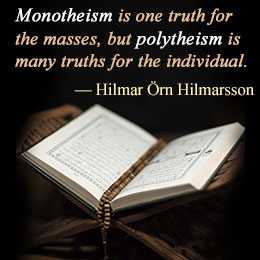
 

Against the Monotheists

M v P

Apologetics (Gk. “Speaking in Defense”) is something which I love. When I was a Christian, apologetics were taught in an effort to justify our beliefs as opposed to that of “sinners.” Witchcraft, Satanism, Jehovah’s Witnesses, Muslims, Roman Catholics: it didn’t matter. I enjoyed lively debates which, I hoped, would have led to conversions. I read the works of some of the Church Fathers who wrote constantly of the defense for Christianity as opposed to the “pagans.” With that in mind, I’d like to write this post as an attack on monotheism and the defense of polytheism.

Monotheism in the West: A Brief History
Many of you will be made uncomfortable by this topic. After all, we lot tend to be very tolerant of other religions and religious practices. The last thing many of us want is vitriol. However, I feel this is important, not least because of how much monotheism around the world and throughout history has been violent.

Monotheism means “One God.” It first arose with the Hebrew tribes who united to create a single nation. It was not without violence and theocrasia, or the blending of different deities into one main one. The Canaanites as a whole were all polytheists. They worshiped deities named Asherah (a female Goddess), El, or El Elyon (the Most High), El Shaddai, Elohim, and others. Eventually, the Israelites compounded the El of the Canaanites and their YHWH to became a single deity. The inspiration there was one single omniscient and omnipotent Creator was unique. The Goddess, Asherah, was worshiped alongside YHWH for centuries. In fact, you can read about the condemnation of her worship by the Hebrew prophets in the Bible, so popular was she.

In Egypt, the Pharaoh Amenhotep IV raised a solar deity into the Supreme Deity named Aten.  By his orders, all idols were forbidden and so was polytheism. He changed his name to Akhenaten, and declared that Aten was the sole deity of Egypt with him as the intermediary between the God and the people of Egypt. In fact, Amenhotep IV wrote a hymn which states:

O sole God, like whom there is no other!
Thou didst create the world according to thy desire…

After Amenhotep IV’s death, polytheism returned and cartouches of the Pharoah were destroyed.

When Christianity began as a religious movement, it was divided into different sects which all had various views on God. The New Testament makes it seem like there has been a good stream of monotheism throughout the early history of Christianity, but that wasn’t the case. Christian groups like the Arians (popular among the Germanic tribes), believed that there was one God, and that Jesus did not exist until he was born. This effectively undermined the work of the Trinitarians, who espoused the belief that the Christian God was 3-in-1.

In the year 325 CE, when the Roman Emperor Constantine I (the Great) assumed the throne, he was baptized by an Arian bishop. Hoping to bring the different groups together, Constantine called for the first Ecumenical Council held in Nicaea (a town in modern day Turkey). Everyone argued about which doctrines were correct. Christianity pushed doctrine rather than practice, something the polytheistic religions were known for.

Christian bishops wanted a clear orthodox (“right teaching”) which defined their creed. As a side note, they also argued when to celebrate Easter. Anyway, the Council of Nicaea came up with what is now known as the Nicene Creed; a creed which represents Christian orthodoxy. Among the most important beliefs was where Jesus stood in regards to God: was he non-existent before being born? In other words, not God? Was he God always and just merely an essence, or extension, of God? And what of the Holy Spirit?

At the Council, these questions were answered by declaring that God the Father, Jesus, and the Holy Spirit, were all in eternal existence and made of the same substance. The Trinitarian view was subsequently affirmed in later Councils as well. However, the Trinitarian teaching was rejected by Judaism and later Islam as proof that Christianity was not monotheistic, but polytheistic.

In Islam, monotheism is believed to set this religion apart from Christianity. This teaching is known as a tawhid, or “oneness of God.” A central tenet in Islam, God is the only being in the Cosmos; submission is to him alone. Islam recognizes Judaism as a fellow monotheistic religion. However, Islam as a whole rejects Christianity for their doctrine of the Trinity, which smacks of polytheism. God in Islam is fully transcendent; that is, God is separate from his creation.

Why Monotheism Fails
As you can see, the definition and defense of monotheism by Judaism, Christianity, and Islam has a long a sordid history. The teaching that there is as single, transcendent deity who is all pervasive creates in the mind of humans a strict dyad, the fallacy of everything in black and white. That there can only be two choices for a human, one resulting in punishment and the other in a paradise. This feeds into a narrative in which judgement reigns supreme, a superiority complex that upholds a monotheist’s emotional connection to their strong beliefs, rather than an understanding of multiple viewpoints.

Monotheism, by introducing the singular Divinity, erases critical thinking skills, a pluralistic worldview, and contradictions in the functions and thoughts of that deity. For example, a singular divinity is said to be omniscient, omnipotent, omnipresent, and omnibenevolent. But these cannot co-exist with the reality of our world and Cosmos. In truth, our world is a violent one: earthquakes, tsunamis, volcanic eruptions, venomous animals, limited resources, and extinction level events.

Can monotheism explain evolution? Can monotheism explain why for millions of years no humans existed, and yet we are meant to believe that we are the only animal in need of salvation? The transcendent God – the one removed from the world after Creation – is by default unconcerned. They cannot be omnibenevolent and still allow violence to overtake and cause pain, misery, and suffering for humans from natural events. I use the Nature argument as opposed to the fanatical Human argument, which places the blame of murder and genocide squarely on humans. Monotheists will claim that we did this to ourselves by falling from grace. Then again, the Nature argument will also be debated by a monotheist stating that all violence in this world is the effect of falling from grace and out of favor with the single God.

In human history, monotheism has been the singly greatest cause for murder and genocide. It is a tenant which must be believed, rather than allowing the mind to see the beauty of plural truths in our world. By taking this belief system and fighting over which one is the true doctrine, differences of opinions have led dissenters of these monotheistic teachings to harass and kill these “heretics,” while destroying their relics, statues, and committing cultural genocide.

Modern examples include the burning of women and children in Uganda, where Pentecostal churches are making a major political impact with support from American Pentecostal megachurches. In the United States, religion in right-wing Christian groups have been pushing to take away the rights of LGBTQIA people, along with pushing holy wars with the Islamic Middle East. In Brazil, Pentecostal churches lead the way as cultural genocide and murder are committed against Afro-Diaposric religions such as the adherents of Palo. In the Islamic Middle East, Wahhabi (orthodox) Muslims wage violent jihad against Baha’i and other Islamic sects for being heretical. The Yazidi people are called Satan worshipers and murdered.

There are of course also the historical narratives of Christians, Jews, and Muslims committing atrocities against polytheistic peoples. Canaanites, Arabic polytheists, Germanic polytheists, and others have faced the sword of monotheistic belief systems. Indigenous peoples have suffered under the might of monotheistic belief systems invading their lands.

In Favor of Polytheism
Wars were committed under polytheistic societies, this is fact. However, wars were fought over land and resources, not belief systems. When we are born and we grow, we discover the wonders of diversity in our world: multiple colors, multiple shapes, multiple ethnicities, multiple animals, etc. The world is an enchanted place. We all carry different opinions, truths, and a myriad of different experiences. This diversity is naturally going to be applied to how we view deity and spirits.

In some beliefs such as those of folk Catholics, saints replace the Old Gods as people seek out different beings over different influences. Polytheism is realistic in its approach to the world: there are separate peaceful and violent spirits which exist in our world. Yes, polytheists have faith and prayers to their deities and spirits, and oftentimes they are not answered just like in monotheism. But that is a human issue, not a divine one. Polytheists make no mistake that the world is a giant contradiction in its diversity, and so therefore our spirits are extensions of how the world and the Cosmos work.

Our deities and spirits are also limited. They are not omniscient, omnipotent, omnipresent, or omnibenevolent. They are limited in their scope. That is fine. We humans are also limited, and Nature is as well. Some people assert that polytheism is merely a primitive way to explain the world prior to the “truth of [insert monotheistic religion here].” But one can also argue that point with monotheism. So that argument, in my opinion, is moot.

But an all-powerful deity cannot be all good and all knowing and all powerful at the same time. That is a contradiction. So monotheists will inform their followers that they must rely on faith, because those contradictions make no sense to the human mind. Polytheists, on the other hand, also have faith, but are more concerned with Right Behavior, Right Choice, and Right Action. It is an orthopraxy (“right practice”). Atheists existed in the ancient world as they do now. Rational thought is a positive approach. As a polytheist and a person of Reason, I am not ashamed to say that those go hand-in-hand. Parmenides, the Father of Western Rationalism, was presented with the rules of Reason by his Underworld journey to the Goddess Persephone. Secular Reason and polytheism can co-exist side by side.

Conclusion
I am glad that there are many Jews, Christians, and Muslims who have rationally and honestly looked at their religion’s past and have adapted over the ages, becoming more secular and progressive. They don’t allow their facts to deprive them of their faith. At the same time, this poses a danger to many strict monotheists whose worldview only allows for one way and one truth. The perennial problem of evil in the world has no justifiable answer in monotheism, because their God is supposed to be all good. In polytheism, however, we face this issue with knowing our Gods and Nature can be inseparable (not that our Gods and spirits are sole expressions of natural phenomenon).

In the end, we view the history of humankind and that of evolution as an issue for human thought. However, monotheistic loyalty to their “true God” continues with more questions for the ages. Who is the true God? Which heretic was right? Which one was wrong? It is only a human’s authority which proclaims such things, along with the belief that the “right people” are in sole possession of knowing the Mind and Will of God. They KNOW. But in polytheism, there is nothing wrong with philosophical contemplation. We worship, we practice: we CHOOSE. The Gods and spirits will not rain down wrath because we choose not to worship. It comes down to that simplistic of teachings: free will.

Our free will is in danger when monotheism is permitted to define our national frame of mind. We can exercise it without the fear of being punished, whether here or in the hereafter (which is again a choice to believe in polytheism). I encourage my “soft” monotheistic friends to hold their monotheistic comrades, churches, and masjids (mosques) accountable when their ways endanger our fellow polytheists, such as in Australia, Africa, India, South America, and here in the United States. When our allies do so, we can then face the world together.

Eirene kai Hugieia!
(Peace and Health!)
Oracle


The 6 Steps of Our Arrangements with Gods

1000

There are times when we, or rather I, do not feel the presence of the Gods or spirits. There is a quiet emptiness which pervades the entire atmosphere of my existence. I feel as though I have plateaued in my spiritual journey. Have you ever felt like that?

Observing human nature and the tangled web of relationships, I have noticed there tends to be certain steps we are inclined to all take. Mind you, this is a generalization, not a scientific study. It’s just my observations. Yours will vary.

Step 1: Connection
The first step is connection. It’s not easy, and oftentimes just because one party feels that bond towards someone, it doesn’t mean that the other one feels the exact same way. When it comes to Neopaganism, Polytheism, and Witchcraft in general, I get the sensation that newbies (and this even happens with long timers) want to experience this entire open avenue of the Gods. They want to connect with something, or Someone. So they go looking for who might be the most interesting towards their endeavors. Is it Hekate? Apollon? Athena? Brighid? Pan? Lugh? The list goes on and on. Connection can be precarious, because if we are not careful in our approach, we may miss the mark on who is really trying to contact us.

I encourage folks to look at their main activities and seek out who may be their patron (matron is applicable to humans, not deities). For example, are you a mechanic or someone who works with welding? Hephaestus, Brighid, or Goibniu might do. Are you a student in the arts? Athena, the Muses, Dionysos, Isis, Hathor, Bast, or even Bragi are choices. The medical field? Apollon, Asklepios, Airmid, Dian Cecht, Isis, and Sekhmet are also possibilities.

Be that as it may, sometimes even a seeming connection you want with a certain deity won’t happen. Your prayers may feel hollow. You may get a gut instinct that something is blocking you from engaging with that deity. You won’t get any affirmations or dreams (which are tricky to begin with so don’t always rely on them). The solution? Usually seeking out a skilled diviner can help guide you a certain way. But once a connection is made, now we move on to the next step of the process.

Step 2: Enthusiasm
The honey moon phase. The time when we are excited to research our deity. We set up an altar or shrine. We look eagerly for icons and want to tell the world about the goodness of our deities. You make up your own prayers and/or use pre-written ones. You give offerings weekly…daily even. There is much to learn and you want to connect with others of like mind to share your excitement. There is nothing inherently wrong with this. Everyone deserves to feel loved, affirmed, and bonded with a higher power, if they believe it that is.

NOTE: There is nothing wrong with agnosticism or atheism. We all have our own journey.

Step 3: Dedication
This may or may not happen around Enthusiasm time. Usually it will blend, but not always. Dedicating yourself to the worship and work of a deity or spirit comes with responsibilities. In the human parallel, we decide to get to know our partner(s) and affirm our desires and listen to theirs. Still, you may live separately. Each one’s annoyances and clashes may be at a minimum. Things may not bother you as much. Dedicating yourself to a deity, to become their priest/ess, is fraught with danger. It is a major step, like you making the decision to move in with your partner(s). Now you’ve done it. It’s there. You are a partner. It’s real.

Step 4: Separation
I use the term “Separation” not just in the physical sense, but also the metaphysical. You may feel like there is a plateau: stable, but perhaps the little things are beginning to get to you and one another. In the human analogy, corporate stress between you two may lead to further disagreements. Growing anger may come between you two (or more), and it is up to each of you to make the step in reconciling. How does this translate to your growing relationship with a deity? Simple. At this stage, whether or not you have made a formal dedication to serve your deity or spirit, you get into a lot of problems. You’ll feel lost for a moment. You try to make offerings and prayers, but the words seem empty. You’re going through a lot of trials and tribulations. You feel this may be a test from your deity or spirit, and you begin to be afraid: will you fail and the deity will leave you? You’re having nightmares possibly. Your anxiety and depression come back. In short, the Enthusiasm is gone. You fear your spirituality was just a farce. A phase.

Step 5: Plateau 
This will probably blend in with Separation, but for simplicity’s sake, I categorize it separately. Plateauing takes place when our sadness turns inward at ourselves. Our altars or shrines begin to collect dust, or they are removed entirely. We become bored. Bored with life. And then the worst part can sneak in…apathy. We’re just tired. Why continue our worship and work when nothing is happening? There are no positive changes in our life? It’s just not worth it, we think. In addition, life is giving us enough issues and we don’t have the time to dedicate to them as much as we want. It just sounds even more exhausting. Whether we realize it or not, this is the part where we have to understand that when we are going through issues, their presence may be overwhelming. That’s right: the emotional thrill of the Gods’ presence may in fact be too dominating, and may turn our attention away from the work that needs to be done in our life towards seclusion. Our Gods are usually not ones to force seclusion or an ascetic lifestyle (certain ones may vary). We live. We breathe. We work. We survive. That is our lot. It isn’t a test. It’s life. We have to know how we are going to deal with these issues. Feeling an emotional and mental connection is great, but we can’t stay there. We have to know that we are not alone in our endeavors.

Step 6: Commitment
When we realize that life must go on, we then become more mature in how we deal with our religious obligations to the Gods and spirits while balancing life’s challenges. This leads to Commitment. Commitment is when we should now decide if we are going to be a priest/ess or a simple devotee. We shouldn’t make decisions when Enthusiasm is the predominating force in our lives. Like human marriage relationships in which there is a mature, mutual agreement to be committed to one another no matter the cost, that is the level of maturity we should explore. Ancient and modern folks, unless they were part of an established priesthood which was funded by the State (a different blog for another time), don’t always have time for private devotions lasting an hour or so. We have to rectify that. Gods and spirits tend to understand this situation way more than we care to admit. Some don’t, and that’s when we can let them know what the situation is and that’s that. Don’t be afraid to talk to your Gods or spirits. Despite what I have written, oftentimes we have to let them know that we are living a life, and they may need to back off from further responsibilities (which, ironically, may be the ones we put on ourselves in Enthusiasm stage).

Lesson: Be careful with your words.

Conclusion
These 6 steps may not always be perfectly separated, and may even bleed into one another. Nonetheless, it is important to examine our motives, our responsibilities, and our growth. It may take some time. Maybe months. Maybe years. Possibly decades. But these steps are pretty near-universal when it comes to our worship and our work. When we make do, we realize in the end that we aren’t abandoned by the Gods, but we are walking with them still, just on a different plane. We are never alone. We have moments of bliss, and others of boredom. But they are there. And our journey will only enlighten us further.

Eirene kai Hugieia!
(Peace and Health!)
Oracle


Polytheism, or Do We Really Need to Elaborate?

polytheism_button-rc580f64b5bb640a88c3f6292be7025b5_x7j3i_8byvr_324

So, I went and reread John Halstead’s blog wherein he discussed Pantheacon’s “Wiccanate Privilege Discussion,” and something caught my attention. Having a TBI, it takes my brain a while to process what I am reading and interpreting that information. So while some will say “Duh,” it’s not for me. Yeah, I don’t get the obvious. Anyway, moving forward…at the bottom of the article, John has a subsection entitled “Polytheistic with a Hyphen.” In the article he referred to Lupus’ discussion of the word polytheism and the nuances which can cause confusion and, thus, conflict when using a word which may mean different things to different people. John encourages people within the Greater Pagan Communities who identify as “polytheists” to perhaps use prefixes which differentiate their particular polytheist thealogy (i.e. devotional, hard, soft, Jungian, etc.). Galina responded to John’s suggestion of the hyphen usage here, and it’s a great write-up. I strongly suggest reading those articles before reading my own thoughts on the entire matter below.

Theos
Let’s start with the basics. Polytheism is rooted in two Greek words:

Polu – “Many”
Theos/Theia – “Divinities.”

But there is much more than just the simple definition given above. Ancient Greek carried with each word an entire cultural milieu that had a specific set of visual associations which pertained to the semiotics of the word. Thus, “theos” came with a shared cultural understanding of a phenomenon. That phenomenon sharply contrasts with our modern Western Christian-infused concept of “God.” For modern people within our Christian-majority environment, “theos” or “God” comes with a specific set of synonyms and adjectives including the notion that the Sacred is separated, or transcendent from, the mundane. Humanity, as part of the mundane sphere, cannot be privy to the sphere wherein lies the Divine Concept but through the sacrificial acknowledgement and belief in the expiation of Jesus. But more than this, “theos” has come to insistently mean “One.”

One God, One Being, One Power, One Force.

And even where the Christian Trinity can be clearly cited as an example of Polytheism, yet the Christian doctrine emphasizes repeatedly that the paradox is that it is “3-in-1.” So, no matter how separated the various Beings are, invariably They are One. The monistic concept of the Trinity has bled into our Pagan/Polytheist outlooks, with evidence around that people simply have trouble abandoning their Christian doctrines in the face of even the apparent contradiction that the Church enforces its believers to adopt. When we say that the world is filled with spirits and a host of Celestial Immortals, those still entrenched in Christian philosophy cry out “No! They are not independent Beings but simply ‘Many-in-One!'” The plurality of polytheism is surrendered for a desired homogenous state that exists only within the utopic minds of its adherents. The works of Joseph Campbell in his “Monomyth” and Frazer’s “Archetypal Sacrificed God” have also served many modern Pagans to give notice to the “Mono” over the “Many.” While the works of both have brought many people a wonderful foundation into modern Paganism, the unfortunate side effect is that people try to find in our practices how the variety of Temples, Cults and Traditions are similar before meriting an agreement of “Hey look! We can have a festival together!” The differences are excluded in favor of false conformity.

A World of Spirits and Beings
To the ancient Greek mind (and, cross-cultural comparatively other pre-Christian cultures both ancient and modern) there existed no word like “religion.” Instead, a concept that comes closest to that word is theon timai “Honors to the Theoi.” The honors given to the Theoi are encapsulated within the ethos in how we live, what we practice, how we serve cultus, and the festivals which we celebrate. In other words, polytheism is not simply about faith, but it is more so directly tied into action and works. Again, our Christian culture has bled its teachings of “By faith and not by works” wherein people have tons of altars and shrines without ever feeding or giving attention to the Deities in question. Statues are mere decorations, and rituals are more concerned with the participants attending and the facilitator’s skill at drama and timing (so as not to interfere with the feasting!) over the specific acts which touched our ancestors with the spirit world. But Polytheism is about honoring the Theoi (or insert pantheon here) with action and works which ripple into our very lives. These actions and works are important because “theos” itself implies a “third objective power.” (L.A. Wilkinson, Socratic Charis: Philosophy Without the Agon). It refers to a specific presence that carries a weight and validity to the people who are within Their sphere.

Otiose
“Otiose” is a word that means “Leisure,” or even “Serving No Practical Purpose.”  The word has come to be used in anthropology circles to describe polytheistic faiths such as Hinduism, some sects of Buddhism, and aboriginal tribal beliefs that do espouse a “One” Spirit that created everything or was responsible for creating the host of Beings and Spirits that inhabit a particular Cosmos, but the One itself is Unknowable, Untouchable, and Unconcerned with the world as-is. That’s why He/She created the Spirits in the first place: to run things. Think of a CEO playing golf and away from the company, never visiting or knowing what’s going on even with the daily worker. No, it’s the lead workers, the department managers, the operation supervisors and such within the company’s hierarchy that are concerned with the daily welfare of the corporation and its people. That’s us folks: we humans are the people at the bottom of the Cosmic rung in many ways. My Tradition’s teachings have a “One” as well: an otiose Protogonoi that cannot be touched or fathomed because S/He is everywhere. Yet S/He is unconcerned with anything at all except Hirself, and in the Grand Cosmic Scheme of things that’s all that matters really. So just because we have a “One” concept doesn’t mean we’re monotheistic. No, we’re Polytheistic. We work with the Divine Beings and Spirits that inhabit this world, and our temple’s power rests upon the honors that we bestow upon Them through our ritual actions and works.

Emic vs. Etic
Abundant evidence of polytheistic practices demonstrates that for many in both the ancient and modern world, rituals are tied specifically to a spirit or Divinity. As Jan Bremmer writes, “It is neither practical nor advisable to study the two entities separately.” (J. Bremmer, Ed., The Gods of Ancient Greece: Identities and Transformations). But the problem with modern Polytheism in general is that arguments against Polytheism are coming from those who are outside the Polytheistic scope. They are brandishing themselves “polytheists” without the complex understanding that the word in and of itself entails: the honoring, through ritual action and works, of many individualized and supra-powered Beings. In cultural anthropology, the contrasting view between studying the innards of a paradigm from a person within that culture as opposed to an objective observer who is an alien to that paradigm is known as emic vs. etic, respectively. The problem with etic observers is that they come with a template of biases which cloud what they are attempting to document and understand. They have a limited background that is not rooted within the Polytheist Model. If you want to approach Mythology and the Theoi (or insert pantheon here) via the Jungian School of Thought, you are not a Polytheist. You are a lay psychologist, a Jungian, or perhaps a Pan-Deist. But you are not a Polytheist.

It surprises me that we even need to have this argument of “hyphens” and prefixes. Polytheism is what it is. I reverence the Ancestors, the Heroes, and the Theoi of my Temple. I am a Polytheist. They are independent of me, and ritual is my lifeline to Them. It is also how I feed my spirits, those to whom I am aligned to. I probably could have just come out straightforward and made these statements, thus making the blog shorter. But honestly, I think some backstory was needed; research, if you will. Polytheism is not a term for anyone to use – in my opinion (lest I get angry messages about being too authoritative and…ah fuck it!) ….

Polytheism is NOT a term for ANYONE to use unless they are serving Spirits and Beings which are viewed as independent and volitional Beings in Their own right – NOT figments of the imagination or caricatures of the human psyche.

Go ahead, send the e-mails.

Eirene kai Hugieia!
(Peace and Health!)
~Oracle~

Sources:

Bremmer, J., and Erskine, A. (Eds). (2010). The Gods of Ancient Greece: Identities and Transformations.

Wilkinson, Lisa A. (2013). Socratic Charis: Philosophy Without the Agon.

Stars Clothed in Flesh

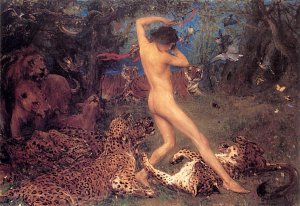
Orpheus (1896) by John Macallan Swan

Our traditions may have been broken, but our Visions are renewed.

Our ways may have become historically lost, but our Memory is strong.

Our customs may have become nearly eradicated, but our Spirit is eternal.

Our languages may have become dead, but our Tongue can still speak the Sacred Names.

Polytheism is not just a return to plurality. It is not limited to reconstructionism, revivalism, or solitary devotees of any path. It is a word which encapsulates the responsibility and obligations with which our Elders are returning from their home in the stars to come down in flesh and bring back the worship and cultus of the Old Gods and Heroes. Many years ago as I sat in contemplation, I was granted a Vision by my Queen, Hekate, as She began to open the Gate of Souls and allowed the Souls of Old to come and walk among us again.

Yes, we Europeans, North Africans and Middle Easterners have our own Elders, our own Ways, our own Tribes, Temples, Gods and spirits that we once served. And with the Old Ones crying out for Their sacred fires to be lit once more, we have mistaken many times that the Gods and spirits call whom They will. Perhaps They do…but I’d like to think that They touch the ones who knew Them, who adored Them of Old, and who were teachers, priests, iatromantoi, magoi, strixoi, backkhai and more.

What does this mean for us? For you?

It means that you have the Power of Memory. Memory is palpable, tangible. Memory is your lifeline to the Gods and Spirits. Memory becomes manifest in your rites and cultus. Memory is what you carry deep within the constellation of your soul, proof that you have tasted the Well of Memory. But you thought you would stay among the Stars forever? You thought you would remain in eternal joy with nectar and ambrosia?

No, my friend, my brother, my sister, myself.

You must return. You must come back, because we need you. We need our Elders to teach the young of the world again. We need our stars to be clothed in flesh, to remind us of the Once Ways in which we walked one with our Gods of place and temple. Because our Gods need us, though They exist beyond our own confines or imagination. They exist, yet Their Fates are tied to the world in which we exist. And so it is that as the world needs us, it is our Gods who need us too. We cannot exist one without the Other. This is the Law of Ma’at, of Themis, of the Pax Deorum. This is the Sacred Exchange between the Golden Deathless Ones and the mortal world. This is the sustenance which drives all of our known existence within our purview to continue as we know it.

The Elders are returning. They are becoming reborn and walking among us, forged in the fires of trauma and pain so that They might have the mettle and fortitude to go past their ordeals to rise and fight for the preservation of our Ancient Ways. They are here to remind us of the paths we once knew, of the glades we once worshipped and frolicked, of the spirits whom we once touched.

And it might be you. Welcome back.

Eirene kai Hugieia!
(Peace and Health!)
~Oracle~

Polytheist Ritual: Why We’re Different

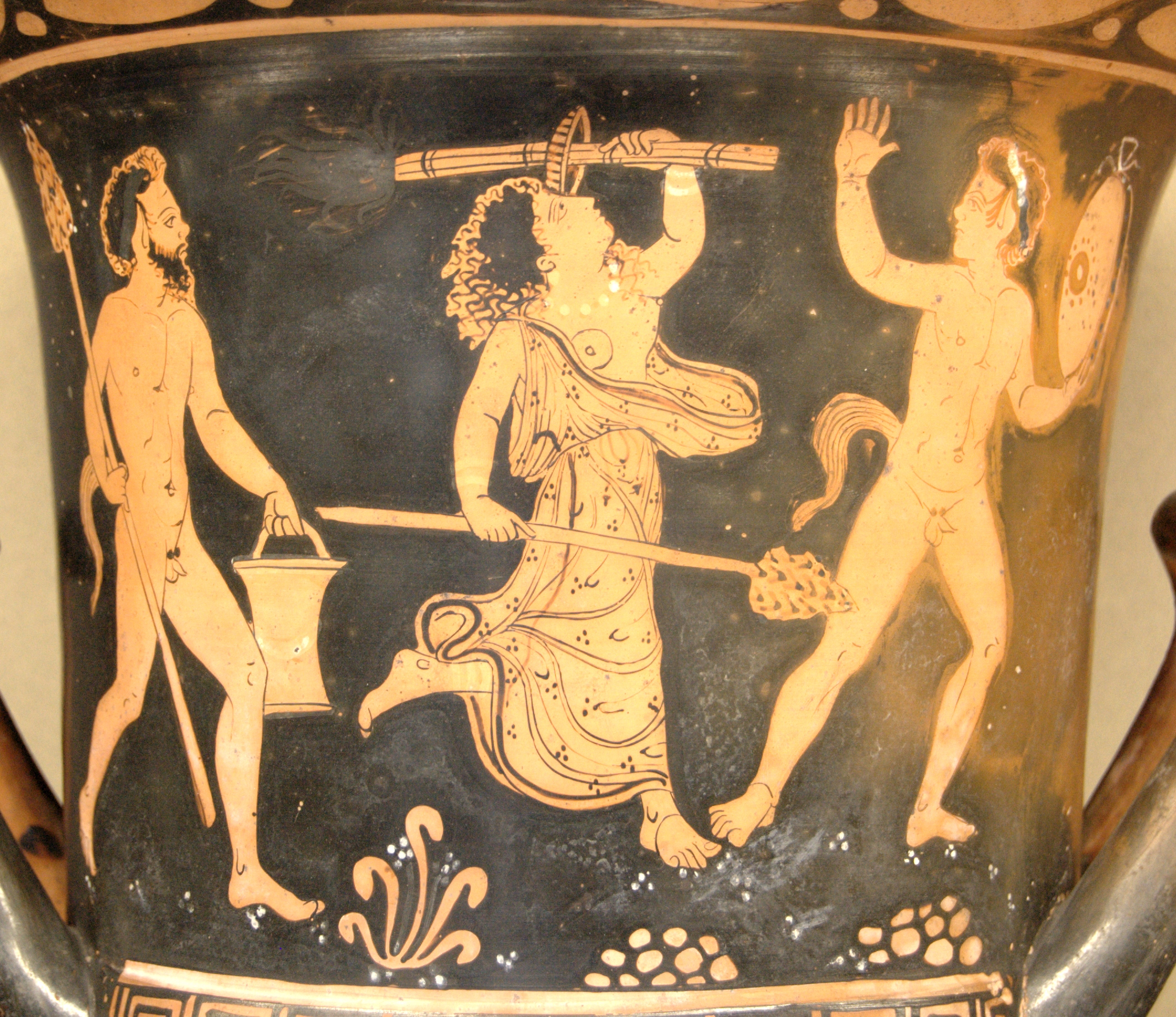
Ancient Greek kylix-krater from Apulia (c. 380 - 370 BCE). Courtesy of Wikipedia.
Ancient Greek kylix-krater from Apulia (c. 380 – 370 BCE). Courtesy of Wikipedia.

Polytheism simply means “Many Gods.” The term encompasses the belief and worship of many Gods and spirits, something which was quite common with our ancestors (and with many contemporary indigenous societies). But this belief implies much more than the simple matter of how we view the Divine, because belief is something that is rooted with our emotional center. It is anchored in the central nervous system, thus dictating how we view and interact with the world around us. Polytheism is plurality: the way we appreciate the diversity of color, race, ethnicity, philosophy, and the Gods. People these days try to say “I see no color,” hoping such rhetoric will make them as non-racist as possible. But by not seeing color, we are robbing people of who they are and trying to create a comfortable umbrella – a facade – of what they are not. we are attempting to pigeonhole all of us into a monochrome vision that overlooks our uniqueness, our worth as an individual, and what we mean to the world around us.

Polytheism is a return to seeing the color and luster of each person, and creating a paradigm whereby they are seen for WHO they are, and WHAT they are. We may have things in common, but we are who we are without allowing those similarities overshadowing that our DNA has worked in making sure that no two humans are completely alike. Even twins have some differences, however subtle.

The Gods, in our approach, are beautiful. They are awesome, and They are terrifying. They are beyond our comprehension, and yet even in Their sphere They are limited. I understand that my Gods are NOT omnipotent, NOT omniscient, NOT omnibenevolent, and NOT omnipresent. I also understand that my Gods are NOT the same, but unique and different. How dare I rob Them of who They are?

Hekate is NOT Diana.

Apollo is NOT Lugh.

Epona is NOT Rhiannon.

Cerridwen is NOT Ishtar.

Aphrodite is NOT Inanna.

Zeus is NOT Thor.

Poseidon is NOT Manannan Mac Lir.

But what They are is for each person to experience themselves. And herein is where my approach to ritual is quite different from other peoples.

Ritual is Love

When I was eclectic, ritual was a pain in the gluteus maximus. I had no idea what I was doing or why. Sure, some books tried to tell me about the intricacies of circle casting, calling the quarters, and invoking Deity. Some more “advanced” books tried telling me about the Occult energies that streamed through and why the circle was cast the way it did. But no one told me WHY we did ritual. What was the purpose? “Walk Between the Worlds?” What the fuck did that mean? I’m sure it has merit for someone somewhere to do ritual mechanically like that, and to make sure the altars have every correspondence that you need so we know what Sabbat we’re celebrating and why. Such is what I all the “Neo-Wiccan” approach to ritual, or even “eclectic Pagan.” Although, to be fair, I think everyone is eclectic in some form.

But as I have personally grown and changed in my faith, I have become a polytheist: a believer in the Gods of my own Temple, and those of others. While I might not necessarily serve cultus to other Gods, I have my own that I have fallen in love with (even if They don’t love me back, which I’ll explain in a later blog post). So my rituals are my love letter to my Gods.

Yes, my love letter. Every symbol in the center of my Temple is meant to convey a reminder of Who THEY are, and what I can offer to Them in return for Their awesomeness. I have no shame in my love letters: the perfume of my incense rising, the burning of the offerings which I have painstakingly taken time to create, the ikon on our shrines being just a flirtatious image of the unparalleled beauty which They behold, but can somehow tease something from me: a point of connection between the two of us.

My Gods are alive, They are real, and They are more than I can ever say. In my desperation to feel a glimpse of Their daimon, I will often starve, deprive myself, cry, bleed, sweat, and cry guttural tones of ekstasis. I want to go back to the Time of my Sacred Ancestors, and dance for Them. I want my joy to overflow like intoxicating wine, and I want Them to be pleased with what I have before me for Their unrivaled Glory. The auguries and oracular possessions are Their mercies poured out so I can but taste Their whispers in my ear.

In my love letters, I ain’t stirring, summoning and calling up shit. I am asking, offering, asking, flattering, offering and worshiping. I worship because They are worthy of worship. I have no issue groveling on the ground before Them, because They are mightier than I. They have rulership over spheres I can scarcely imagine. They are my passion and my yearning.

Eirene kai Hugieia!
(Peace and Health!)
~Oracle~

Those blasted “F” words!

When I was growing up in a Roman Catholic/Santeria/New Age-filled home, I remember hearing the word “fundamentalist.” It was being used by my parents to describe the people who my older adopted sister Melinda were seeing. She had just converted to an African-American Holiness Pentecostal Church. I was about 11 or 12. My parents warned me about her and “those people.” They also used another word in tandem: fanatics.

“They’re very fanatical. Stay away from her.”

Well, I did then what I do now when someone warns me about something; I approached it. I’m was a curious young lad after all, and I didn’t think curiosity was a harmful thing.

When I was 13 I became Pentecostal. I became “one of those people.” I was a fundamentalist and a fanatic.

Many years later I left the Church. I didn’t want to be a fundamentalist or a fanatic. I saw what that mentality did to people and I had my fill of it. As I researched Paganism, I found a faith that was speaking to me and was fulfilling a void that I had come to encounter. I joined a local Pagan Circle, and here I encountered a new word: Eclectic. (For those not in the know, a Pagan Circle is an informal group that can openly welcome members and participants, whereas a coven might be more closed with a screening process and have more formal etiquette and rules; both have their advantages and disadvantages). An Eclectic, I was told, was a person who read books, took what they wanted, dispensed with what they didn’t, and didn’t treat their spirituality with any brutal seriousness. It’s a do-it-yourself approach. On the other side I also learned another new word: Traditionalists. The way these people were defined to me, they were Pagans who had a spirituality that was passed down to them and taught in “secret covens” with rules and hierarchy. The way they were talked about, you would think they were part of government conspiracies. But any Pagans who were perceived as overzealous about rules and the Gods were deemed – wait for it – fundamentalist.

Wait – what???

That’s right – fundamentalist. For a religion that didn’t have any sacred texts, I was confused as to how “fundamentalist” and “fanatic” fit in with Paganism. It was explained to me in no uncertain terms that in modern Paganism it was taboo to tell anyone how to worship their Gods. That smacked too much of the pulpit.  I was told that there were people running around who claimed to be a High Priest or High Priestess and had the audacity of telling others that they were doing things “wrong.” And in modern Paganism, with no central authority, how could anything be “wrong?” Who are they to tell me that I am incorrect in how I perceive or honor the Gods? Seriously?

Let’s backpedal a moment. In my last post I explained about archetypes. The reason I wrote that was because of the huge amount of back and forth arguing going on in the blogosphere about polytheism, archetypes, and the Gods. Lines have been drawn and attacks are being made. But the problem is that words are being tossed about without any clue as to what means what, and perception clashes rooted in ignorance are the primary causes of conflicts without resolution. Hence why I felt the need to share my personal experiences and define just what the word “archetype” means, and that viewing the Gods as such does not conflict with polytheism.

Back to fundamentalism…

Over the years I joined several forums and groups as I was interested in expanding my spiritual horizons, something my father always taught me to do. He always said, “Learn to look through the eyes of another person. Try and understand why they do what they do or believe how they believe. Immerse yourself in their world. If someone says to you ‘Oh stay away from them, they’re bad,’ research it. And always try to come out with a positive experience to tell. If you have nothing but a negative experience, you’re no better than the people ostracizing them.” Taking that advice to heart, I wanted to find out why the “elitist, fundamentalist Pagans” believed what they believed. Why did they feel that “Eclectics” were wrong?

What I came to discover in many years of sitting back and listening was that contrary to what I was being told, in reality Traditionalists didn’t really have issues with Eclectics. Not really. I mean, you have assholes here and there, but on the whole no one really gives a shit how you worship the Gods or create your circles. The main problem came from Eclectics who think they know what Traditionalists are like, and wage cyber-attacks of their own.

Fundamentalist. Fanatic.

Two freakin’ F-words that have have done a lot of damage in conversation. Now, I can sit here and plead “Be nice to one another. Can’t we all just get along?” But I know it won’t work; we’re human, we fight, and we disagree. That’s part of our nature. Honestly, I wouldn’t have it any other way, because fighting and lively debates acts as a checks and balance system in our faith. But when words are used as a way to “one-up” another group in a derogatory sense, we risk losing people on the other side of the fence who could possibly find their calling. I’ll admit that my personal practice prior to now might have belonged in the fluffy-bunny camp, but the vitriolic dialogue spewing from some people nearly turned me off to seeking anything further than what I had. It was their attitude that made me think of the fundamentalist fanatics back in the Church. That and the word “Traditional.” But I’ll address the “Eclectic vs. Tradition” fight in another blog post.

Fast forward a few years, and now we have another ugly fight starting between polytheists and archetypalists (wrong so-called). I should rather use the term Deists (or even Pandeists), because I think this more or less reflects the variety of beliefs among many Pagans. Burnt by years of being abused by the Church due to the excuse of divine revelation and failed prayers, I don’t think many Pagans view themselves as being disrespectful to the Gods when they confess they are not sure whether or not to believe in Them. They know they love rituals and the connection they have with other people. They know they have experienced trance work and psychic phenomena. But beyond that lies a nagging doubt that restrains them from becoming too involved. In this sense, I call them Pandeists. And do you know what? There is nothing wrong with that. They would rather approach their faith through the lens of psychotherapy and reason then be let down. They are one step away from atheism, but again who can blame them? It takes a lot for people to come to Paganism and realize that our Gods are not omniscient, omnibenevolent, omnipotent, or omnipresent (traits ascribed to the Abrahamic God). But that’s what they want. People want to know that if they worship or venerate a Divine Being, that Divine = all of these things and more. Basically, the equivalent of a genie. It takes a lot to face one’s fears that Divine Beings are not all that. There is also the fear that to believe in a Divine Being = letting go of Reason and Science. Once more, nothing could be further from the truth.

Paganism is a Nature-based faith. That means that rather than reading Wicca 101 books on the shelf, you should pick up books on ecology, biology, anatomy, physiology, astronomy, and geology. Immerse yourself in Earth Science, because when you watch the lioness running to catch her kill and eat a young calf, there are the Gods. When you watch a natural disaster overtake an island or a tsunami wipe out most of the population along a coastline, those are the Gods. This is the reason why many of the Myths portray the Gods as unbending, uncaring, and cruel. But these are traits from a human perspective and how we describe Nature. It also shows our hubris, thinking that we are better than what we are. We’re not. We’re exactly what we are: primates. Our tools may be more advanced than our ancestors, but that doesn’t make us better. Our societies and taboos have changed, and perhaps in many ways we are better than ancient societies with slaves and the subjugation of women. But we are still frail mortals, and in that respect some things have not changed. (And don’t get me wrong: my examples above have little to do with the notion that Gods are simply “personifications of Nature,” but I’ll address Pagan polytheist thealogy in another blog post as well).

So why worship and venerate the Gods?

Honestly, that question is for everyone to answer themselves. In my journey I have gone from fundamentalist and fanatic to atheist, Deist, and now polytheist. But I base that journey on my knowledge at the time as well as my personal experiences. Polytheism, for me, is a sense of duty and obligation to the Ones I serve. It isn’t a matter of philosophical debate. I have learned that philosophical debate often distracts me from the greater path of honoring the Gods and Working with Them as well as for Them. But because I have experienced Them, and because I honor Them, means I also respect Them. I respect Their desires, Their boundaries, and Their appropriate rites. This is the break between polytheists and (Pan)Deist Pagans. Unfortunately, just like the “Eclectic vs. Traditional” fight, there is also the “(Pan)Deist vs. the Polytheist” fight, and it’s the latter that are being called – wait for it – fundamentalists. Fanatics. Once again, seriously??

We aren’t. I understand, though, why someone like me is viewed that way by other Pagans. However, that’s no excuse to throw the “F-bomb” my way. Fundamentalist. Fanatic. Those blasted F-words! Drop them. Drop them from the conversation. They don’t help, and automatically these words create and perpetuate a false dichotomy of “us vs. them.” Once that perceived clash comes up, it is hard to break anything else. It’s hard to engage someone in dialogue who is automatically on the defensive and perceives me as a threat. Perception is Reality; it may be a false reality, but it’s reality nonetheless. And you’ll never learn, never grow, and never come to understand why I worship and venerate my Gods the way I do. You’re too busy listening to me waiting to counterattack, rather than listening at all. That frustration is why I can understand why many polytheists are separating themselves from Pagans. Personally, I think it’s a mistake. But who am I to dictate to another human being what to label themselves? (Except for archetypalists; I still think that’s a wrong label and is highly inaccurate).

Earlier I mentioned that in the “Eclectic vs. Traditional” fight that I discovered most of the attacks were coming from Pagans who called themselves Eclectics. They accused Traditionalists of being elitist and holier-than-thou. Now, it’s the (Pan)Deists who are attacking the polytheists for being fundamentalists. Polytheists are being accused of pushing their religious beliefs. You know what? I am pushing respect. Respect for my Gods, the Ones with whom I actively participate, venerate, and honor. When I see a ritual calling on Dionysus as an excuse to get drunk, or I hear Hekate being called a Crone, yes I am going to get pedantic. Dionysus isn’t just a party animal, and Hekate is not a wizened old hag. The Morrighan is not a Goddess who holds unconditional love; She is War and Sex. She will pick out your eyeballs and play marbles with them as soon as she is done sleeping with you. She’s a scavenger, always hungry for blood. So when I see rituals with people having fairy wings, bubble wands, and calling on “Gaia and the Morrighan,” and you expect me not to say anything, think again. That isn’t me being a fundamentalist. It’s me giving my Gods respect.

It’s funny that many Pagans spew venom at Christians for “killing our ancestors and stealing our holidays.” But when it comes to our Gods, they’re not as serious. They are more serious about wanting to roleplay than they are venerating the Gods that they are proud to make memes about on Facebook. It may be a taboo in Paganism to tell others how they do things is wrong, because it’s true that we have no central authority. But if you call yourself “Pagan” and admit to believing in the Gods in some form, then at least do the Gods a favor: research and respect what you claim to believe in. If not, find something else. Seriously. Find something else. Have the balls to come forth about your intentions in belonging to our faith. Are you here because you are angry at the Church? Or are you here because you truly seek to reclaim what your ancestors lost? If the former, get a therapist and sort out your issues. Too many Pagan groups implode due to power struggles as a result of bitterness and mistrust of authority brought in from the Church. If the latter, examine your faith constantly. I mean constantly. Always question, and seek out new experiences. The Gods aren’t your genie. I learned that mistake long ago. There are numerous ways to approach our faith and show respect, even if you relegate yourself to a (Pan)Deist. But at the very least, let’s drop the F-words, and then we can sit down and actually have a fruitful dialogue as opposed to F-bombs that lead nowhere.

Eirene kai Hugieia!
(Peace and Health!)
Luis A. Valadez
~Oracle~

That word: I do not think it means what you think it means…

Carl Gustav Jung (1875 - 1961)
Carl Gustav Jung (1875 – 1961)

When I was learning Paganism I read a lot of 101 Books that had lists of different Gods and Goddesses and what they were “for.” The information from the author(s) had just finished outlining what spells are and how to cast them properly (in a manner of speaking – we’ll get to spells in another blog). In order to help boost your spell power, you were advised to connect to a certain Deity. The list provided by the author(s) was supposed to be a means for a starting point for you to begin learning about Them and what They can do for you. A classic example in some 101 books was Aphrodite. If you wanted to perform a successful love spell, call on Aphrodite. Use symbols appropriate to Her on your altar, and then with the visualization and meditation techniques you learned from the book, you will be able to successfully invoke Her power and BOOM! Love spell success.

At the time, I saw nothing wrong with this. I assumed it was correct because, after all, it was in a book. The author(s) had to know what they were talking about. Some may call it naivety, but when you are new and searching for information, where are you supposed to glean information from? I was a new Pagan, trying to learn what I could and attempting to understand how these Deities worked in this new found faith of mine. Backstory time:

I had just left Christianity not too long before I began journeying into Paganism. I was an ordained minister in a Pentecostal Church. I grew up Pentecostal in my teens, and I was a radical Born-Again Christian. I believed in God, Jesus and the Holy Spirit with all the fiber of my being. I interpreted the Bible as literal Truth. Why not? I had experiences to back up my beliefs. I had prayers answered, mystical visions, and witnessed spontaneous healing. I felt tangible energy weaving its way around the church. I was a Christian, through and through.

I won’t get into the specifics right now of how I left and found my way to Paganism, but suffice it to say that in my 20s I began exploring this religion. So where does one begin? Books obviously. Now, here is where the dilemma came in: I didn’t want to be brainwashed again. I didn’t want to fall victim to a fundamentalist mentality of literally believing that other Myths might be just as real as what I read in the Bible. My analytic brain could not wrap its head around how the stories in the Bible could be true (or so I thought), and how the Greek Myths or the Irish Myths were also true. I felt I had duped myself into believing the Bible was real, so I was not about to do that to myself again. I had been hurt from my falling out with Christianity, and I had reason to feel that way. So in Paganism I was very cautious about how I approached the Gods.

The way that many authors have described the Gods in lots of 101 Books is that the Gods are mental constructs. That is, that the Gods are something we as humans have invented to help us understand the world around us. One of the reasons Paganism seemed to fit for me at the time was because many 101 books purported to blend religion with science – and nicely at that. So being scientifically-minded, the explanation goes, the Gods are only as “real” as we believe Them to be. The books would then throw in names like Carl Jung to explain the Gods as “archetypes,” that is, expressions of basic human experiences according to them. By connecting with the Gods in ritual, we are connecting with the basic fundamentals of our own experiences and interpreting them in a story-telling fashion. It’s not that Aphrodite is a Being who exists outside of my own mind, continues the archetype explanation. It is that Aphrodite is that part of my subconscious which longs for sex, desire and beauty. So when I connect with Aphrodite in ritual, I am connecting with an aspect of myself embodied by Her.

It all seemed to make sense. It was comfortable, and this way of connecting with the Pagan Gods made room for me to feel as if I still had a sense of control. I still had a feeling that I was in charge, because the notion that Gods exist outside of myself actually frightened me. No lie. I felt more comfortable with the notion of aliens in flying saucers as the answer to if we were alone in the Cosmos than Gods. Ironically, technologically advanced beings that might be in conspiracy with our government was more plausible than suprahuman Beings. Go figure. (Interestingly, I find this same cognitive dissonance in the Greater Pagan Community to an extant).

For many years I went along with the Archetype Theory of the Gods. I only did rituals with the group I was with at the time; I hardly ever practiced anything solitary. I discussed my experiences with my fellow Pagans and admitted that the Archetype Theory resonated more with me. Not too surprisingly, so did other Pagans. We all wanted to be more scientific and had bad experiences with literalist Christians. We wanted our religion to make sense. As an aside, many of the Pagans who also leaned towards this bent were anti-religious. Anyway, the Archetype Theory helped me to understand what the late Mythologist Joseph Campbell discussed as the “MonoMyth” that is, the basic pattern of human experience that can be found throughout the world (2008, The Hero With a Thousand Faces by Joseph Campbell, 3rd Ed.). One famous MonoMyth is the “Hero’s Journey” beautifully represented in the the persons of Luke Skywalker, Harry Potter, Herakles, Moses, Wesir (Osiris), Heru (Horus),  Jesus and Buddha. It also gave me an appreciation for the well of creativity that helped artists and writers continue to present basic themes in newer ways. For example, let’s use Aphrodite again. According to the Archetype Theory of the Gods, Aphrodite is the embodiment of female sex, love and beauty. Thus, goes the explanation, any empowered woman in a story that is the vixen, the slut, the model, is a face of Aphrodite in that story. (For the record, I realize I am using terms that may offend some, but it’s necessary for me to be realistic and use terms that we are familiar with to get the point across). To my analytic brain, this explanation also helped me to understand why there were many similarities between Aphrodite and other Goddesses such as Astarte, Hathor, and the Morrighan. It neatly weaved different Deities from different Pantheons and made a well-known mantra ring true: “All the Goddesses are one Goddess, and all the Gods are one God.”

Here’s the problem: all of my philosophical thoughts and neat oratories were smashed to near-obliteration when I had an encounter with the Gods. I do mean encounter. I am talking about an experience that churned me inside-out, split wide my brain, and rerouted my neural circuits. I’m talking about something so “Other” it cannot be condensed into words, because none exist. I had become zapped and melted, then reshaped and saved. Like the heart of Dionysus protected by Zeus after the former was torn apart and boiled, my flesh tingled with the shadowy presence of a thousand volts that had forever transformed everything I ever knew about the world. I thought I was safe; I thought I was comfortable; I thought I had everything neatly figured out. Whatever I didn’t figure out, I told myself I would come to know in the afterlife. But apparently Someone Else had a different plan, and I am grateful for it.

Now, as an Occultist I am trained to always record my personal experiences to look back on later and assess. Not every experience has to be considered valid; I learned that the difficult way as a Christian when I fell into deception because I thought EVERY vision, EVERY experience, EVERY voice was true. It wasn’t. I learned in Occultism to separate what was relevant from what was not. It might take a day, a week, a month, or several years for me to discover if it was relevant, but I would discover it in time nonetheless. So I followed suit, and I wanted to discover if my changes were valid and hence, real.

I began to follow-up on my research from years before on Archetypes. What was missing? Here’s the thing: I had never actually read the works of Carl Jung. I had read about him from others. Or, to make matters worse, I had read about him from what others read about him from others. It was second, third, and fourth-hand retellings. Authors were quoting one another without giving each other credit, and basically every book I was reading began to sound the same. This was evident when even Pagans who adhered to the Archetype Theory could not define what exactly was meant by “archetype.” They gave examples of what they meant. One of the famous examples out there in the Pagan Community is the One Source Example. It goes something like this:

“There is One Source from which all the Gods of every culture come from. Different cultures have their own unique ways of interacting with this One Divine Source, and these are the Masks that we call the Gods. So Venus=Aphrodite=Ishtar.” This is pretty much the basic theme, and it seems to make sense at first. But, was this was Jung meant by Archetypes?

I decided to read Jung for myself, and what I was reading was a far cry from what I had been told.

Let’s start with the basics: Carl Jung did indeed write about Archetypes. He was inspired by the works of Plato (which I ended up reading) and a couple of other sources to develop his own theories and approach to what he was researching, which were basic primordial images that humans shared across cultures and time. But what is even more important is that Jung never completed his theories; he changed them over time, formulating them continuously in an attempt to really come up with his version of a Unified Theory of the Unconscious (my interpretation). I also discovered that there were some mistakes about what others defined as archetypes versus what Jung described as an Archetype. According to Jung in his works such as The Archetypes and the Collective Unconscious, mythological motifs such as the Trickster, the Wise Old Man, the Mother, the Sacred Prostitute, and the Hero were not archetypes in and of themselves, but they were creations that pointed to archetypal events that we all as humans share: birth, death, sex, and rites of passage. Basically, the archetype itself is an innate possibility that we all share that leads to inborn tendencies which shape our human behavior. It is not a thing in and of itself; it is merely a symbol pointing the way for us to understand each other. This definition is a far cry from Gods. Gods were worshiped and experienced. Although Gods might share traits with human behavior, They are distinct in scope, influence and power from beyond ourselves. They are not the empty shells that Jung was defining as Archetypes.

What modern Pagan authors had incorrectly done was assign the term “Archetype” to the motifs, and had gone one step further by stating that the Gods were examples and therefore mental constructs.

So basically, where the hell do the Gods fit in? Are They real or are They fictions?

This is where many Pagans become uncomfortable, because they confuse the word “archetype.” What Pagans were throwing around was a confusion between the word “Archetype” and “stereotype.” The word stereotype comes from two Greek words which mean “solid impression.” It has come to mean an image that is being perpetuated about individuals or customs which are perception errors; those impressions may or may not be rooted in reality. It is an incorrect assumption in other words. The stereotype is that Aphrodite is just a Goddess of Love and Beauty, and ergo She must be the same as Venus, as Ishtar, as Inanna. Hekate is only a Triple Goddess of Magic(k), and so She must be the same as Cerridwen. Upon doing further research and actual Work, I came to realize my blunder. A very serious blunder.

If you don’t want to believe that the Gods are actual Beings which exist, that’s an individual choice. But what is plain ignorance – whether willful or not – is the assumption that because Gods have similar symbols or spheres of influence that They must be the same. Nothing could be further from the truth.

Let’s use ourselves as an example. In actuality, we are all archetypes. Every single human being at some point embodies a certain image or aspect (another much misunderstood word) that is characteristic of innate human behavior such as Grumpy Old Person, Joker, Bitch, Mother, Father, Daughter, Son, Wise Woman, Healer, etc. Although each of us are different with different cultures, different parents, different personalities, different characteristics, and different beliefs, we all share basic patterns that speak to us because at some point we will experience some or all of the behaviors which make us human: we are born, we live, we lose, we cry, we laugh, we have sex, we hurt, we joke, we manipulate, we are good, we are bad, etc. Our stories, our Myths, are just one way we have developed to use analogy in order to make sense of our experiences. It’s how movies and stories from one region will always find an audience in another. But that doesn’t take away our individuality and uniqueness. The Archetypes are simply an alphabet of symbolism that allows us to speak a common language to one another. It’s how fundamental stories  such as the Hero’s Journey transcend cultures and time. Because there is resonance there.

But just because I share the same basic experience as someone living in China doesn’t mean they and I are the same person. We may share traits, but we are different. We are individuals.

The Gods are Individuals as well. They exist. That doesn’t take away the fact that They function as Archetypes, but not “archetypes” in the misunderstood sense of mental constructs. Rather, “Archetypes” in the sense that They have relevance for us as humans and are able to communicate with us and through us. Archetypes in the sense that we are able to communicate with Them and develop a relationship that is real and purposeful. When I work with the Goddess Rhea, for example, I am able to understand Her Work as a Mother Goddess because I see Her Face in the faces of every mother. More importantly, I see Her in the women who have had a role as “mothers” in my own life: my birth mother and my High Priestess. But She is also more than that. As a Goddess She is able to encompass more than even what these women have to teach me. Yet She is able to communicate and I am able to understand Her better because of these women. It’s about validity, not subjectivity. This doesn’t make Rhea any less of a Goddess, nor does it relegate Her to the status of an invented mental construct. But it does make Her even more real. Unfortunately, however, polytheists such as myself have been attacked with the word “fundamentalist.” I’ll get into that in my next blog, and the dissonance between polytheists and other Pagans. In the meantime, hopefully I’ve laid out some food for thought.

But the next time I hear a Pagan talk about archetypes, I’m going to chime in. Because I do not think that word means what they think it means.

Eirene kai Hugieia!
(Peace and Health!)
Luis A. Valadez
~Oracle~