The Spirit of Madness: Dionysos and the Riots

Jim Morrison Dionysos
Jim Morrison as Dionysos by Eva Reid

Dionysos is often viewed as simply a wine and party God, but that is not Dionysos. He is a God of Ecstasy, the Wild, Frenzy, Madness, Drama, and a patron of the Queer Communities. He is also the spirit of the downtrodden – those who are cast aside or controlled by a society that attempts to chain people down.

In his entourage, Dionysos had satyrs, leopards, maenads, as well as the daimons Lyssa and Mania. Lyssa is the daimon of mad rage and fury, while Mania is the daimon of ecstasy and divine madness, to an extent. Usually it is Mania who is sent by the Gods to inflict its power upon mortals who dare to defy the Gods, or else need to be awakened to their weaknesses. Often there was more than one daimon of Mania, and together they were called the Maniai.

In ancient Greek tellings, divine madness was often inflicted on certain people by various deities for their own agendas: agendas which demonstrate the glory of the Gods or else expose the individual’s weaknesses, bringing them to a place where they must seek restitution for what they have done under the influence of mania. For example, Herakles was inflicted with madness (mania) by Hera. He ended up killing his family. When he became sober and grieved, he was tasked with penitence and performed his infamous 12 labors.

The question of rage and blind fury among the protesters across the nation for the murder of George Floyd and others have caught my interest; not least because the riots and protests are classic examples of Mania: divine madness. The Powers that Be have controlled every aspect of our lives with fear. Fear is a barrier that keeps boundaries intact, especially with struggles for power. Fear is the shield which Dionysos breaks in order to induce chaos for order to be restored. One of his epithets is Eleutherios, or the Liberator. It is also this name of Dionysos that I serve as devotee.

The question of the Gods and politics is a hotbed in many Neopagan and Witchcraft circles. But what many seem to forget is that the daimons of the Gods are involved in every aspect of our lives. The daimons carry the personifications of what we as a people seek out and experience. Dionysos approached kings to declare his divinity, and when they attacked him, he caused his enemies to be afflicted with his daimons and they would lose themselves to their passions. An example is King Pentheus. The king forbade the worship of Dionysos, not allowing women to participate in his rituals. When Dionysos appeared before the king, Pentheus had him locked up. The chains which bound the God, however, fell off, and the jail doors opened. Disguising himself as a woman, Dionysos led Pentheus to the mountains where his wife and daughter were, joining in the revelries of the God. When Pentheus was spotted (he was hoping to catch a glimpse of an orgy), he was brought down off a tree and ritually dismembered. It was only when Dionysos lifted the mad daimon that Pentheus’ wife and daughter realized what they had done. This rending and tearing of the king was a sign Dionysos was sending: the powerful can be brought low, and dismemberment of the “natural order” of society could easily be toppled by the God in his desire to free the oppressed.

Dionysos as a God is neither all good nor all bad. He is a God, and his domains are concerned with freeing the spirit of humanity in order to demonstrate his power. He empowers the persecuted, and lifts up those who have fallen beneath the boots of powerful government.

Social constraints were his specialty: in some parts of ancient Greece (like Athens), women were chattel. They were under the authority of their father, brothers, and later husbands. They had zero power except at certain festival rites, especially those invoking Dionysos. Unlike some other Mystery cults, foreigners and slaves were liberated in rituals which had spirit possession. Outlaws found a home with his Mysteries as well. Dionysos took the marginalized of society and helped them find liberty. Once their spirits tasted liberation, they knew they could never go back to the status quo ever again.

With everything going on in the country right now, I cannot help but see the beauty of Dionysos’ energy in everything. The downtrodden are angry. Marginalized groups are finding solace in their wrath, tearing down a broken system which – for far too long – has kept them beaten under the heels of their masters.

This type of mania is blessed by Dionysos. The ancestral wounds of many folks in this day and age have festered for far too long. This kind of holy delirium has long been overdue, and the murder of George Floyd is the final act of a drawn out fight between the oppressor and the oppressed.

Socrates, the great Greek philosopher, criticized Athenian democracy and frequently was compared by Plato to a gadfly. Just as a gadfly pricked and annoyed, so, too, was Socrates the “prick” for judging the societal conscientiousness of Athens. He was also in touch with his daimon directly without the interference of the Gods in an act called “nympholepsy,” or possession by the nymphs in order to heighten his spiritual awareness. This caused the Athenians to also accuse Socrates of blasphemy and impiety. Socrates was aware of his inner divinity. For this disruption to the natural order in Athens, he was tried and convicted. He was killed by drinking hemlock. Yet it was this criticism which needs to be channeled, and the people of the Old Order must be challenged.

One of the greatest examples of a slaves’ connections to the cult of Dionysos is Spartacus. He was a Thracian gladiator whose revolt against Rome led to him having tens of thousands of followers. Plutarch, the writer and theurgist who dwelt at the Temple of Apollo, wrote that Spartacus’ wife was a prophetess of the God. She was an initiate of the Thracian cult of Dionysos (he had different manifestations of his cult throughout the Greek world). One morning Spartacus woke with a serpent coiled around his head (the Agathos Daimon?). From this omen, his wife stated that he would become great. Her ecstatic trances, combined with popularity of the cult among slaves and the poor, drew crowds to Spartacus’ cause. His victories against the Romans solidified his memory, and Italy was shaken by his revolts.

In the end, I contemplate this revolutionary style of fighting for justice as the spirit of the God being unleashed upon our society to tear down the broken system that we have. It is imperialistic in its spirit and oligarchic in its manifestation. This must be brought to the ground if a new awakening is to occur. The Gods are calling us; they are moving us to find our spirits and free ourselves.

Your ancestors all fought for a variety of reasons. Somewhere in our past, we were all warriors. It is there. And we must ask ourselves during this time of upheaval whether we shall be a part of the Old Order, or the New? Will we allow ourselves to have him possess us in holy mania so that we experience the Oneness of Enlightenment? Or will we remain purposefully blind to our own shackles? You cannot control Dionysos. He will free us from chains and open up the prison doors of our minds. It is his ecstatic glory that will find its way into our spirits, a serpent coiling above our heads.

Choose wisely.

Eirene kai Hugieia!
(Peace and Health!)
Oracle

My book is now available for pre-order, to be released October 8, 2020!
 

The Blessing of Dionysus

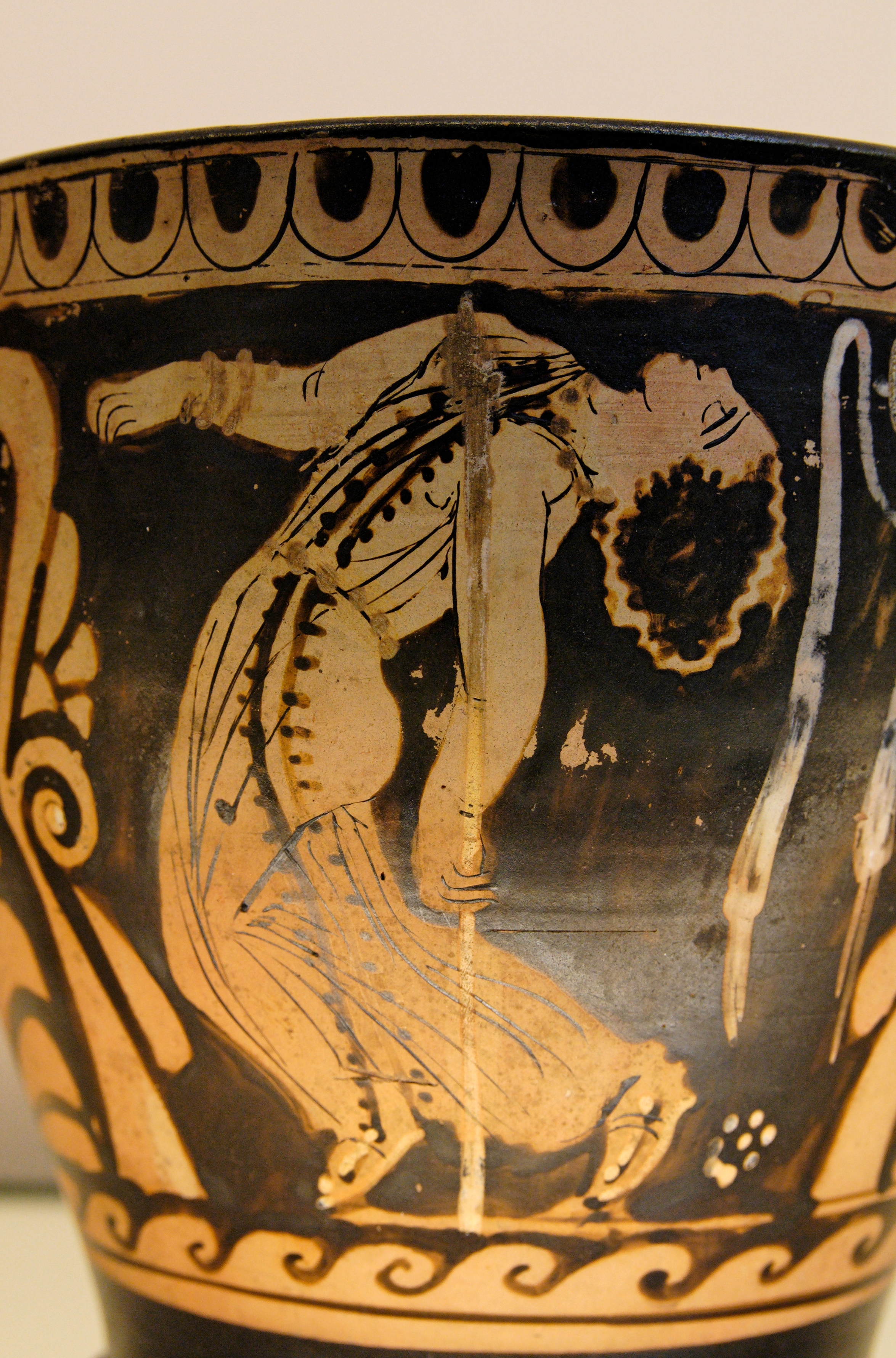
Dancing Maenad
Dancing Maenad

It’s interesting what Dionysus blesses you with, because unless you come to grips with His notion of Reality, everyone is liable to view His blessings as a curse. Or a series of curses. That’s why His calling isn’t for everyone. If it were, this world would be more fucked up than it already is. Even Dionysus, in His place among the Olympians, has to give way to Order and Civilization. Or some semblance of it.

The journey of my Blessing begins on August 21, 2012. If you’re interested in the entire story, you can read it here. In short, I was involved in a serious car accident in which I drowned. I also came away with a traumatic brain injury to my right side, frontal and temporal lobes. I have had a lot of negative affects from it to say the least: chronic depression, anxiety, memory loss, slower processing speed, epilepsy, an inability to distinguish certain types of pain levels and temperature changes, abnormal proprioception,  some slight asphasia, mood swings, ADHD, and exacerbated behavior on the Autism Spectrum. These are just some that I can currently recall. I am continuing cognitive rehabilitation and neurological visits, and various medicinal cocktails to try and help me live as much of a normal life as I can. Or at least functional.

How is all of this a Blessing? I’ve had many people tell me:

-It happened for a reason.

-Be thankful for the little things.

-God has a plan.

-You now know about the important things in life.

Do you know what my answers to these are?

Fuck you.

That’s right, fuck you and you’re philosophies. No, that’s not what I mean by a Blessing. As I said earlier, if you’re not Dionysian, then you’re looking at His Blessing as a curse.

The Dionysian Blessing
Dionysus bestows two kinds of madness: Lyssa and Mania.

Dionysus (left) watches on as King Lykourgos of Thrake attacking his wife (center). The winged daimon Lyssa hovers above.
Dionysus (left) watches on as King Lykourgos of Thrake attacks his wife (center). The winged daimon Lyssa hovers above.

Lyssa is related to the Greek word leukos, which means “white.” Lyssa was personified as a daimon of rage and rabid frenzy; it was sometimes used as a synonym for rabies. Lyssa was the daimon sent by Herakles to curse him into a fit of rage when he killed his family. This tragedy led to his Twelve Labors. Upon the impious Dionysus sent Lyssa, and the onset of the affliction is described by the winged spirit herself as a “scorpion’s sting.” (Aeschylus, Fragment 85 Xantriae (from Photius, Lexicon 326. 22) (trans. Weir Smyth) ).

The madness I am referring to is Mania. The Greek word mania is related to the Greek word mainesthai, which means literally “to go mad.” Mania itself is considered to be a type of otherness that is bestowed by a Deity upon a vessel. Four types of mania (theia mania) were outlined by Plato in his Phaedrus:

1) Mantic Mania (Mediumship): Apollon

2) Telestic Mania (Ritual Trance): Dionysus

3) Poetic Mania (Musical Passion): Muses

4) Erotic Mania (Passion, Love): Aphrodite, Eros

In regards to mania, Plato wrote:

…our greatest blessing comes to us by way of mania, which indeed is a Divine Gift.

Shamanic Mania
Enthusiasmos – literally, having the God within you – was a state of intoxication in which Dionysus revealed Himself in such a manner that it was overwhelming. A Dionysian broke free from the societal norms of the time to enjoy a liberated life, and that taste of liberation continued even after the ritual state was over. A Manic Dionysian – for one cannot have the God without being Manic – was a prey by choice, hunted to the brink where his sanity was captured and brought down by the God. Sanity is the sacrificial offering that the God takes when He anoints you. Sanity is the balanced state of the Ego when the Self is attempting to harmonize with the Greater Community that the Self is a part of. It is attempting to reach self-actualization by identifying with the Community one is a part of. Humans, being primates, have evolved to be social creatures. In order to maintain that social order, we have developed complex rules of behavior and hierarchy. And, no matter how many rebellions occur or anarchic movements occur, inevitably we come back to our natural instinctual behavior of social rule.

But a Dionysian is a type of shaman who lives in miasmic territory. Miasma was considered impurity by the ancient Greeks, and many things were done to ensure that such impurity was always cleansed. But a Dionysian, based on my personal experience, lives in miasma. We’re rule breakers. We dwell in the tombs and caves. We wander about the lands, with sacred sex polluting the people. We’re not fit to be part of the social order. Why? Agents of chaos. We remind society of its ills, its forgotten people. Dionysus is nothing if not a God who takes the oppressed and empowers them. Women, bound to serve their fathers or husbands in a man-ruled society, left the confines of the polis and found refuge in the remote forests and mountains to experience the ekstasis of the Raving One. Liberation came not through wars or laws, but by the God within.

The Brain-Injured Blessing
My brain injury, as I said before, brought me a lot of weaknesses that keep me from being in pace with the world around me. People have to slow down for my sake in many ways. But, the brain injury also exacerbated my behavior on the Autism Spectrum: thus, when I speak to someone, I pay very close attention to their body language and nonverbal nuances. I also log discrepancies and contradictions in their speech and behavior, something that most people do everyday without awareness. The Mania that was bestowed upon me in this net of mental illness is that I am actually more sane than the rest of the world. Watching at a slower pace, I can pay more close attention the details that escape the observations of others in our increasingly fast-paced world. This condition has enlightened me to the depths of my core, shattering the notion of Self I was attempting to build up through my identity with my job and my friends rather than my identity with the God within. It is Dionysus who defines me – no one else. It is Dionysus who shapes me, molds me, and gives me the lens by which I can view the insanity of the world. People do the strangest things to achieve their lives: this is Lyssa in action. People are enraged, rabid and hostile, ready for conflict at anytime. I don’t move at society’s leisure; my whirlwind dance is in keeping with the cyclical rhythm of the Cosmos. But while I dance, I am not paying attention and knocking everything over into a sordid mess. But how can creation occur if destruction does not happen first?

The Manic Jester
I’ve often bemoaned the fact that I am a Heirophant and Kurios (High Priest and Guardian) of my Tradition, because I think a Dionysian Jester is absolutely the worst kind of leader in many respects. I don’t even follow my own rules half the time, because some things are changeable. I dispense advice to my members that I don’t even go by, because I live in a different dimension. But an Oracle, such as I am, ironically is of help in a manic state. Plato wrote of the Pythia that she was not helpful to anyone when she came to her senses; it was her induced mania – taking leave of her senses – when she was able to help out world events. It’s for this reason I can also be viewed as a trouble maker, because I just tend to have that personality clash with people who like a certain type of order to look at me and say, “Yep, you’ll be trouble.” Whether it’s self-inflicted or not, the end result is that trouble follows me. For many people who are in power positions, they view this kind of aura as antithetical to their visions. And, they would be right. However, it has been my experience that what people in power need is a Jester, an appointed Fool that will mock the hierarchy. That was the position of the Jester after all – to help the Powers that Be not take themselves so seriously, and point out the flaws in their otherwise self-centered egos.

Having a brain injury (and I can only speak for myself here) on the day of my accident conferred a type of spontaneous trance-like state that brought on a crisis in my life. Crisis, in Greek, has several meanings, including: selection, judgement, to be separated, to be decided upon, an election. The term is a legal one that spoke of a decision reached by a tribunal whose judgement would affect a person’s place within that society. It was usually used in the sense of a punishment and condemnation. But for a Dionysian, what society deems a punishment, I see as a gateway to enlightenment. The Fool, after all, is perhaps the one who is more at peace than everyone else.

I may not be able to walk with my community how others do. I may not be as fast in processing as everyone else. I may need to use communication and sentences, breaking them down into minute building blocks that may form a different message than the sender intended (or am I reading something hidden that shouldn’t be revealed?). But a krisis is exactly that – a separation unto the Lord of the Vineyard. A turning point when I become His Wine and Intoxicant. So many people think that Dionysian mania is rooted in being drunk and horny. Oh, my friend, if you only knew the real conveyance of the unction of the Bull-Horned Liberator.

Eirene kai Hugieia!
(Peace and Health!)
~Oracle~