Devotional Witchcraft

unnamed
Devotional Candle

In my forthcoming book, “StrixCraft: Ancient Greek Magic for the Modern Witch,” I introduce the term “Devotional Witchcraft.” I don’t know if others have used the phrase, but I do like it. Devotional Witchcraft is something I particularly enjoy. I have found in my journey that it works quite well for me, and I think others as well.

Christian Devotions
The Roman Catholic church (RCC) had a significant influence in my life, particularly rituals such as the novena. A novena is a devotional act in the RCC where one performs a set of prayers for 9 successive days (or 9 successive weeks). Candles and prayers are lifted to Mary or any other saint depending on what is needed. The atmosphere of lighting a candle and doing some rote prayers with the rosary was very magical to me. Of course, at the time I did not realize that the RCC integrated a lot of pre-Christian polytheistic forms of worship and religious activities into its doctrines. The ritualistic air about the church was metaphysical in so many ways: incense, prayer, statues, the altar, the Eucharist, and the candles all played with my imagination. I loved it.

When we converted to the Holiness Pentecostal church, the outward trappings were gone. We first met in a middle school cafeteria, and then in a high school auditorium. There was no incense, no Eucharist, no ritual. Just a lot of heavy preaching, shouting, and dancing. I swear it was great aerobics. However, I noticed in reading some of their early material that formality wasn’t far away. As they grew (in their minds) in prestige, the more formal rituals began to occur. They would banish evil spirits and then invoke the angels of the four quarters into the space. Afterwards, they would invoke the Holy Spirit to “have his way.” So we carried that on into our solitary devotionals. One thing I will give Christianity its due is its emphasis on private prayers and devotions. They’re not the only religion to do so, but that was the one which first impacted my life, and so I am using them as my example. I have Jewish friends who use private devotionals, along with Muslim friends. I’ll have to relay the time I attended a masjid (mosque) for a time to renew my faith. Another blog post for another time.

Side note: I wish Jesus’ admonishing to keep all prayers private would actually happen and none of this “National Day of Prayer” or “Prayer at the Flag” in school nonsense. Anyway…

Coming to Neopaganism
I didn’t pay attention to how much devotions had an impact on my life. Due to the intense pressure to conform, after I left the church I looked back and simply viewed anything we were “asked” to do as a threat to my individual time. I put asked in quotes because it was really more of a subtle threat that if we didn’t draw “closer to God,” then we were drawing ourselves further away and we could end up in Hell.

I was reading everything I could which was available on the Occult at that time. All that I read eventually said the same thing: altars, deities, tools, seasons, magick. Older books mentioned spirits, ceremonial circles, drawings that couldn’t be figured out (aka sigils), and fancy stuff you needed at certain times and days. I was much too ADHD for that. As I explored further, I realized that my heart was drawing me towards the Druid path. Having eidetic memory and a drive to pay attention to Nature more (not to mention the images of Merlin and Gandalf as inspiration), I veered from general Neopaganism to Druidry.

Druidry
Druidry was really a homecoming for me in a lot of ways. There was a huge difference in how to understand morality and ethics, especially because I didn’t rely on a book to give me all of the answers to life. I was also angry at the church in general. It totally ruined my family’s life I feel. If I could go back in time, I would vote to NOT go to the church. I had an interest in witchcraft since I was in 5th grade; that was due to my father’s interest in the paranormal.

In Druidry, I met a lot of Christians who were also Druids, and they were finding the commonalities they both had. These Christians were very progressive, and felt a pull towards the Divine Feminine, environmentalism, and pantheism: seeing the Divine in everything which exists rather than the Christian doctrine of God being outside of everything. The only thing in the world, so the churches taught, was the devil seeking whom he may devour.

Druidry was really a complete healing in my mind, spirit, and body. It encouraged me to make contact with Nature spirits, look inward, meditate, and see the enchantment in the world around me. Druidry also taught me the value of developing the arts; in my case, writing. I practiced writing poetry and hymns. I practiced journaling. I practiced writing rituals. Crude at the beginning to be sure, but hey everyone needs to start somewhere. I think Druidry really gave me a sense of devotions by going out into Nature and meditating. There was no emphasis on candle magic, or poppets, or anything of that kind. It was all about self-development, which I valued and continue to value, sharing this philosophy into other practices I am initiated in. Druidry, to me, is the closest I came to being an actual Wizard in that archetype caricature.

Witchcraft
When I began learning to be a witch, I found that devotionals were nil. Or at least, the emphasis was. I can’t speak for the other traditions of Witchcraft which exist (e.g. Mohsian, Blue Star, Silver Crescent, Central Valley, Gardnerian, etc). I just know for me it was all about generalities: deities, tools, seasons, altars, and a connection with Nature (like Druidry). But, there was also a lot of training in Magick: candles, poppets, hexing, spells, intention, correspondences, and ritual structure.

As I continued to learn, I then made a dedication to my patron Goddess Hekate, the Underworld Goddess of Witchcraft, the Dead, the Crossroads, the Dark Moon, and the Torch Bearer. I’ll go into the details of that in a later blog post. Suffice it to say that performing a formal dedication to her changed my entire being and outlook.

Hekate
It would be a long while before I realized something, but Hekate guided me along the way. That something was how powerful and effective my life would be when I performed devotions. At first I didn’t call them that. I just said “I am going to pray.” It was tough using that sentence, because I felt myself go right back to Christianity with the whole “thoughts and prayers” thing.  But I felt empty. My spiritual lifeline was fading I felt.

I was experiencing a dark night of the soul.

Devotional Witchcraft
As I learned different paths, I found myself drawn to Hellenic Polytheism, working with the Greek Gods and Goddesses. As I asked questions and remained observant, I realized that Hellenic Polytheists were split into two camps: Reconstructionists (who worked hard to recreate the exact ways their ancestors practiced and believed), and Revivalists (who adapted ancient writings and discoveries to modern times).

I discovered that I was a bit of both.

By Hekate’s training, I learned to venerate the ancestors. I also learned a ritual script that helped me to purify myself and work with the Gods and the ancestors. As I continued my workings, I came to realize something: I hated the term “work” or “work with.” To me, it made it sound like the Gods and I were equal pals who could just chum it up and I could use them for whatever I needed.

That’s now how this works.

People who claimed to be witches (or maybe who are witches; it’s difficult in this occult landscape to not be accused of gatekeeping while at the same time trying to live up to certain standards and define just what a witch is) were proud of the word “work.” I know a lot of Heathens (or claimed to be Heathens) would say, “Ha! I don’t bow down to my Gods. I don’t grovel. I don’t beg. We uphold our virtues and walk with courage!” (Yes, real conversation).

Side note: Not all Heathens thought this way. Some admitted that they gladly bow down to their Gods who are greater than they.

That’s when I realized something: the semantic of the word “worship” brought up memories of Christianity. People equated the word “worship” with begging and groveling. But, after having been on my journey, I came to discover that what I lacked was devotions: routine times of the day, week, or year when I could sit with my Gods and spirits and just communicate.

So I sat down and thought about it for quite some time. I wanted to know if me wanting devotions was something left over from my Christian days and was irrelevant, or was it something many religions encouraged, and Witchcraft just didn’t encourage it? I mean, lots of Neopagan and Polytheistic groups had festival days to their deities. But, I also learned that lots of Neopagans and Wiccans had the viewpoint that the Gods existed only in the mind. They were “archetypes,” that is, mental constructs which explained Nature and the world. They weren’t real, just symbols. They weren’t about to bow down to a symbol.

But, that wasn’t my experience. I experienced the Gods and the spirits of the world as real, unique beings. Hekate is. My ancestors were. Other deities I encountered were. They couldn’t just be symbols, could they? It took a while but I found other occultists who felt the same way as I did. But they still didn’t like the word “prayer.”

Well, I did.

I had to remember from my Christian time that worship meant “worthy of acknowledgement.” Veneration. Honor. All of those were included in “worship.” I did not think of groveling or begging. Of course, even if I did, what’s wrong with crying before their altars every now and again?

Contact
So thus began my devotional journey. I included times to meditate to just breathe. To talk to them. To light a candle during certain times. To wash my face and my hands in a sacred act. In fact, I began to think of the Sacred and Mundane as one complete cohesive unit, not to be separated. All of life is sacred. Everything I did could be done in a holy fashion. Take time in the shower or a bath to relax and purge “goo” from your aura. In the morning say a prayer at your altar, shrine, or just wherever, in order to reconnect with them. True, they’ll never leave you. But it isn’t about them necessarily. It is about you, and what benefits you want to see from your life when you begin to create strong boundaries and view your life as a holy instrument.

Devotions are simply a way to treat our lives with a sense of Other. Of Enchantment. To view the world with eyes wide open filled with spirits, wonder, and honor. That tree has the spirit of a dryad. That spring flows with the blessing of a spirit. The ocean swells with the Old Sea Gods. Those squirrels are all related and belong to the Squirrel Spirit*, who has much to teach us. Take the awe of Nature home with you. The stars are the fires of the Elders who have passed away but watch over us in the bosom of the Star Mother.

Devotionals, I feel, help us to not plateau, and encourage us to come closer to our Gods and spirits. Don’t get me wrong: plateauing does happen, and there are steps to help us rectify and heal from that. But how we can enrich our lives in Witchcraft is by looking to the Gods and the spirits. Witchcraft, with its teachings on spells, can use devotions to weave throughout our Work so that we can become more effective as the people who we are striving to be. Based on my experiences and that of others, I feel that devotions in Witchcraft should supercede spellwork. Don’t get me wrong: spells have their place. We need to exercise our Will and shape our Reality. We need to know that we can affect others by manipulating energies and raising the Power. There is always that.

I just feel that if you have a bond with the Gods and the spirits, they will empower you and magnify your Magic. Their energies will be with yours. You’d be surprised at how high you can raise the Power when you are connected to them.

So if you are feeling low or disconnected, I recommend devotions. Write a hymn. Pray. Dance. Light a candle. Anoint yourself. Talk to them. They are real. Speak also with your ancestors and the spirits who dwell around you.

You are all connected.

Eirene kai Hugieia!
(Peace and Health!)
Oracle

*I realize I mentioned ADHD and the first thing which came to mind as an example is Squirrel. The irony is not lost.


Samhain

Samhain
Samhain night is one of the 8 Sabbats of the Neopagan Wheel of the Year.

Samhain is an important holiday in Wicca, Druidry, and some other modern witchcraft traditions. So much has been written about this holy day that I am loathe to add anything to it. But there were a lot of questions I had: did Halloween customs really originate with Samhain? How? Did the Irish bring it over? What about this talk of it being a New Year? Is this an ancient truth or a modern construct in Wicca? And why the end of October/beginning of November? What makes this season particularly important?

Origin 
Samhain means “Summer’s End,” as opposed to the holy day of Cetsamhain, or “Opposite,” that is, the opposite of Summer’s End (i.e. Summer’s Beginning). The latter we also know as Beltainne. (1). It is a Gaelic feis (festival). The name may come from a month in the Coligny Calendar which has the name of Samonios. Samonios takes place from mid-October – mid-November (possibly new moon to new moon). Samonios means “Seed Fall.” The name alludes to the time when, in Gaul (modern day France) and the other lands of the Celtic tribes saw nuts, acorns, and other seeds from trees and plants begin to fall as the trees lost leaves, preparing for Winter.

The Coligny Calendar 


coligny_calendar
The Coligny Calendar

The Coligny Calendar that was discovered in 1897 is a bronze tablet which dates to the 2nd century C.E. The calendar was created in ancient Gaul by the Sequani tribe. It is written in 2 languages: Gaulish and Latin. This helped immensely in deciphering it. It might have been created as a result of trade and travel between Gaul, Rome, and Magna Graecia. The calendar is in the style of what is known as a parapegma. A parapegma was a type of ancient almanac: a tablet which had descriptions of weather phenomena, seasons, and star constellations. Holes were made and pegs were formed which could fit into those holes. The pegs would be moved to indicate the days of the month. Using this instrument, the pegs could be inserted days in advance to accurately predict the weather and star movements.

In the Coligny Calendar, each month begins with a set moon phase. It is lunisolar like our modern Gregorian and Julian calendars, but the Coligny has an emphasis on lunations. It has 5 months of 29 days and 7 months of 30 days. (2) In 12 months this makes for a total of 355 days. Every 2 1/2 years, a 13th additional month was added. Together this creates 2 full years of 13 months (385 days), and 3 hollow years of 12 months each (355 days). This makes the average year 367 days. A ‘day” to the Celtic tribes was from sundown to sundown. Months were divided into 2 halves: 15 days leading up the full moon, and 14 – 15 days after. Room was given for lunar cycles throughout the month.

Celtic-Months-300x265
The Gaulish Celtic Months from the Coligny Calendar

Samonios
As previously stated, Samonios is the time period between mid-October to mid-November. Now, some have conjectured that Samonios comes from “samon,” meaning “Summer,” and that the Coligny Calendar begins in April/May, Samonios located in that time period rather than November. However, little evidence has yet mounted to support this hypothesis. Another conjecture is that Samonios takes place around the Winter Solstice. The reasons are varied, but again there is little evidence to support this. Alexei Kondratiev, the late Celtic scholar and linguist, uses linguistic evidence in Celtic languages which points to Samonios being equated with the month of October/November.(3). Samonios through Giamonios (April/May) marked the dark half of the year, or Winter. Giamonios through Samonios marked the light half of the year, or Summer. (4). This demonstrates that the Celtic tribes had only two seasons.

As also previously stated, the months most likely began new moon to new moon. In the Coligny Calendar there is an interesting inscription that reads:

TRINOX[tion] SAMO[nii] SINDIV
“Three Nights of Samonios [today]”

It is thought that perhaps these three nights of Samonios correspond to three nights of Samhain.

The Dead and the Barrow Mounds
Ireland tends to be the best bet for how Samhain was celebrated. After all, it is a Gaelic festival. According to evidence, this was a time to honor one’s ancestors as a collective. Evil spirits, which would roam, were to be warded off. Sacred mounds were places where the dead were buried, and Druids would often sleep on these mounds at certain times of the year to gain ancestral knowledge and wisdom. Inhumation was the top way that the Celts buried their dead. The bodies were contracted; that is, they were places in a fetal position. (5). Some conjecture that this was purposefully done to show the dead were being “birthed” in the Otherworld. They were buried with ornaments and food. Bodies occurred at various levels in the mounds, showing that the barrows were used repeatedly. In Ireland, the most famous barrows were located at the famous hills of Tlachtga and Tara. While Tara is a famous hill, Tlachtga was the religious heart of Ireland for almost 2,000 years. (6). The festivities located here had origins in a fertility cult, but eventually were incorporated into the later Fire Festival.

Festivities
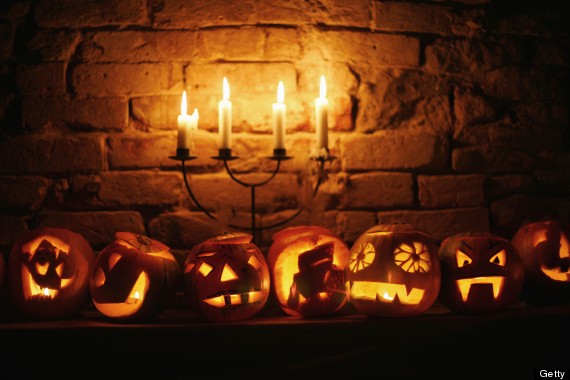
A Fire Festival, a bonfire was lit on possibly the hill of Tlachtga. Bonfires were also lit throughout the land, possibly kindled by the major one on Tlachtga. All fires were extinguished to be set alight by that bonfire alone. Cattle were driven between the two fires, most likely to rid them of pests. Hollow turnips were carved which were turned into lanterns; they illuminated the processions and possibly were believed to harness the power of light against the evil spirits which roamed about. On the political capital of Tara, 12 miles away, the people gathered to hear the Druids recite the ancient laws, enact new laws, and recite the histories of the land. (7). This helped the people stay in touch with the environment and their ancestors. Grievances, debts, and disputes were judged and settled. The king also mated with a white mare, the representative of the Goddess of Sovereignty. After ritual copulation, the horse was sacrificed and dismembered.

When families settled in each evening for the 3 days Samhain was celebrated, food and offerings were left out for them. The light from the turnip lanterns guided them, but many spirits were thought to be tricksters (the fairy folk), and so venturing out past nightfall was taboo.

The Catholic Church: Allhalowtide
Samhain is a 3 day festival, and so is the Catholic holy days of Allhallowtide. Allhallowtide includes All Saint’s Eve, All Saint’s Day, and All Soul’s Day. There is Christian history of respecting the dead and remembering them. A 4th century theologian by the name of Ephraim (later known as Ephraim the Syrian) wrote about honoring the dead and the importance of relics. He writes:

Wherefore, of those that live with God , even their very relics are not without honor. For even Elisha the prophet, after he was fallen asleep, raised up a dead man who was slain by the pirates of Syria. For his body touches the bones of Elisha, and he arose and revived. Now this would not have happened had not the body of Elisha were holy.

We could conjecture that the practice of holy relics came from pre-Christian practices of Hero cultus, and possibly it is so. However, needless to say that even if this were the case, it does not pollute Christianity with “pagan practices.” Christianity is but one religion which found its own practices verified through exegesis of the New Testament and Tanakh (Old Testament). The veneration of the dead is a near-universal practice. I believe simply that early Christians found a way to incorporate this practice into their own liturgy using their own sacred texts.

Allhallowtide was the vigil held before the actual honoring of the saints and the martyrs: All Saint’s Day and All Soul’s Day. These were also known as the “triduum of death.” In the mid-15th century, Pope Sixtus IV extended Allhallowtide to an 8-day celebration. This was rescinded in the 1950s following Vatican II Council.

Originally, Allhallowtide was celebrated in Ireland in mid-April. (8). It was the end of the Winter season approaching the beginning of Summer, so the placement makes sense. It wasn’t transferred to November until the 11th century, when it finally moved to the late October/early November date. Interestingly enough, when the old Irish calendar was replaced by the Gregorian calendar in 1752, 12 days were dropped. This caused date confusion, moving Samhain to November 12th. This is now referred to as “Old Samhain.”

New Year’s? 
Today many in the Neopagan and modern witchcraft communities celebrate Samhain on November 1st and as the hallowed Celtic New Year. Is this true? Scholars are divided here. As mentioned earlier, many things took place at Samhain on the hill of Tlachtga. It was a time of important transition. The Winter in Ireland was harsh, and families would settle in for the entire season. Tlachtga is also famous in that the sun rises into the mound on the morning of Samhain. Obviously it was a very important festival. There were practices which seemed to follow other New Year’s festivities in other countries on Samhain: games, feasting, drinking, divination for one’s future lover, as well as dousing the old fire and reigniting the new. But still, the evidence that it is a specific New Year holy day is scant. When the Irish Revival took place in the late 19th – early 20th century, the hypothesis of Sir John Rhys as the “Celtic New Year” became prominent. So much so that in a famous film “Meet Me in St. Louis,” one of the characters on Halloween night states, “Well another year come and gone.” This was entrenched in the popular mind, and it has been repeated by authors ever since. Regardless, it is now accepted as the Neopagan New Year. More specifically, the Wiccan and Druid New Year. Not all Neopagans celebrate Samhain after all.

Conclusion
We’ve taken a journey from the past to the present. A lengthy blog post to be sure, but one I found important for myself as well. When writing, I am always learning new things. This helps me, as a Wiccan (among other things) to understand the holy day better. It gives me a sense of history and purpose. It allows me to question and contemplate. I don’t like accepting things “because they are that way.” It’s just not me.

Samhain seems to have always been a festival held by the Celtic tribes, although our best evidence is from the annals and myths of Ireland. It was an important occasion, marking so much activity for the political and spiritual well-being of the tribes. Today we can stop and remember our link with the land, sea, and sky around us. We can learn to embrace the dead and, yes, learn to have a healthy sense of fear for the aos sidhe (fairy folk). I’ll write about my thoughts on the fairy folk in a later blog post. For now, suffice it to say not all spirits are wings and fairy dust. There are real spirits which need to be held at bay for a variety of reasons.

The Roman Church had its own theologians which wrote on the importance of honoring the dead. Sure, it might have stemmed from the earlier Hero Cults, but borrowing has always been a religious tradition. This doesn’t make the Church corrupt, so much as what it is: a religion. Does it make it hypocritical? Sure. Especially when writers with that religious background condemn all things “pagan.” But it’s important to take into account that nothing was stolen. It merely traveled and amalgamated.

This Samhain I plan on remembering my ancestors and helping to celebrate the collective dead with my coven. I always venerate mine, but Samhain affords me the opportunity to cherish and share these things with like-minded individuals. If one thing ancient Samhain customs have taught me while writing this, it is that community is important. We are all related, and at some point your ancestors converged with mine. We need to keep this in mind. It is a time of reflection: to know where we came from. May the blessing of Samhain this season bless you and your ancestors. Remember, what is remembered lives!

~Oracle~

(1) Nichols, M. (2010). The Witches’ Sabbats. OR: Acorn Guild Press, LLC.

(2) McCluskey, S.M. (1998). Astronomies and Cultures in Early Medieval Europe. Cambridge UK: Cambridge University Press.

(3) Kondratiev, A. (2003).  Apple Branch: A Path to Celtic Ritual. NY: Kensington Publishing Corp.

(4) Hopman, E.E. (194). A Druid’s Herbal for the Sacred Earth Year. NY: Simon and Schuster.

(5) Scott of Rothbury, A., Reverend. (1894) The Celts and Druids and Their Stories From the Earliest Times, in Twelve Chapters. North Shields, Bedford Street: W.J. Potts, Printer and Publisher.

(6) Gilroy, J. (2000). Tlachtga: Celtic Fire Festival. Glanmire, Cork Co., Ireland: Pikefield Publications.

(7) Crump, W.D. (2008). Encyclopedia of New Year’s Holidays Worldwide. NC: McFarland & Company, Inc. Publishers.

(8) Hutton, R., Prof. (1996). Stations of the Sun: A History of the Ritual Year in Britain. NY: Oxford Paperbacks.