Why I Am A Witch


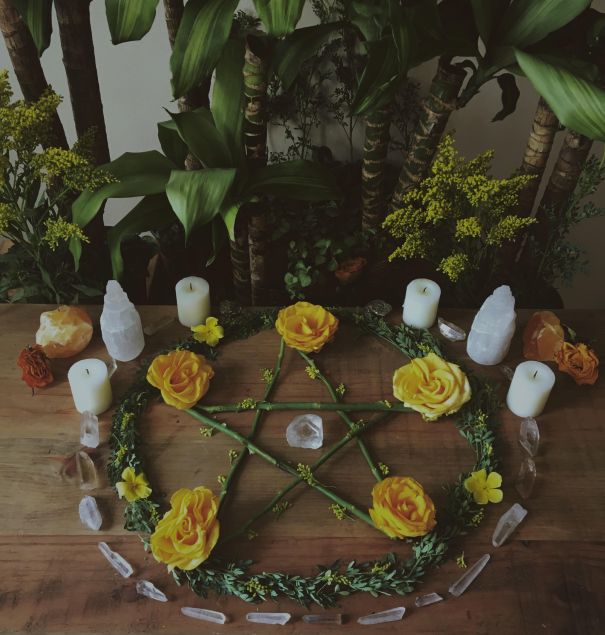
Pentacle_on_wiccan_altar
A Wiccan Altar

When I was younger, I was a born-again, Holiness Pentecostal Christian. I even became a licensed and ordained minister, and was far above my peers in knowing the Bible (I could quote entire sections verbatim). As a teenager, many looked up to me in how I was very ethical and demonstrated morals. Of course, though, I wasn’t perfect, even though the church taught that we should be “perfect in everything.” Perfection was the goal; our prize of striving towards excellence. One slip, and if we died, no matter how much we worked to be good Christians, we’d go to Hell.

Born-Again Christian Struggles
As a born-again Christian, I enthusiastically embraced this religion. It was different – new and shiny. The attendees were 98% African-American, and being Holiness Pentecostal, there was a lot of shouting, music, dancing in the spirit, and hard brimstone and hellfire preaching.

I believed in it, though. Wholeheartedly. The energy was palpable. I could sense it. In addition, solid prayers lasting an hour plus frequent fasting seemed to awaken things in me: prophecy, healing, and a way to channel energies for such things as laying on hands. But, in all of that, I encountered some problems: my sexuality, books which I was not allowed to read, and the chaos that impacted my family because of religious obligations.

Sexuality
Since I was 5 years old, I liked guys. I can’t remember a time when I didn’t. To girls at the time, I was curious. But my attraction to other boys (as a kid, not an adult) really caused me a lot of internal problems. Problems that I took out on other family members. I was a mimic, so I behaved as others did around me. But, I was afraid to be different, and I felt shame. It wasn’t because I was threatened by an adult. No one knew at the time. It was simply an instinct to hide this side of me.

When I hit puberty, we were attending the church. As a result, I didn’t have a normal adolescence. I was strictly held in certain boundaries: the men at the church wanted me to behave like them. Shake hands like them, “bro hug” like them, and dress like them. When I was younger I walked around in my mom’s heels and played with her makeup when no one was around. I really enjoyed feeling like I was performing for an audience. I loved women’s clothing. I thought they were more elegant and chic compared to what I saw men wore, which was boring and lacked color and flair.

I knew that I would encounter issues with the church. Again, as a mimic I followed along with the crowd. I carried myself in school and around others with a smug sense of superiority because I was going to Heaven and I was no longer a sinner. Yes, I could still sin, but I needed to immediately ask God for forgiveness so I wouldn’t be in Hell. I hid what I could, but unfortunately the suppression of my sexual identity manifested in other ways, such as shamefully still looking at guys and having nervous breakdowns behind closed doors. I hurt people. I hurt my family. I had a nasty temper needing to always be right about things.

Books
My dad had an extensive library filled with books on the paranormal and metaphysical. When I was in fifth grade, I began my interest in witchcraft. I read a book on the occult, along with Madame Helena Blavatsky’s writings. Madame Helena, for those not in the know, was the founder of a movement known as Theosophy. Theosophy made a powerful influence on the occult scene in England and the United States in the mid-19th century. It would influence such occult pioneers like Dion Fortune. There were even concepts from this spiritual movement which crept into Wicca, such as the word Summerland, the place where witches are believed to go to when they die.

He had a lot of information that I studied in-depth: chakras, pranic breathing techniques, healing, reincarnation, UFO’s, out-of-body experiences, spirit possession, and healing. His bookshelves were also filled with various books on Nature, archaeology, anthropology, and cryptozoology. I loved it.

But, when we converted to Christianity, my father refused to convert. He hated churches and the Bible. He would often take out different versions of the Bible and point out inconsistencies. He never wanted to go back to that limited viewpoint of the world. He wanted me and my siblings to learn how to “expand [our] horizons” and explore the wonders of the world.

As a result of this refusal to convert, our pastor quoted the Bible. Acts 19:19 stated:

Also, many of those who had practiced magic brought their books together and burned them in the sight of all. And they counted up the value of them, and it totaled fifty thousand pieces of silver. (Acts 19:19, NJKV).

Fifty thousand pieces of silver, if they were silver denarii, would equal today to about $5 million dollars. If they were silver talents, then the cost is enormous, at about $1.5 billion! All of that knowledge and wisdom lost to the ages. My passion, however, was reading and researching. I carried that over into my Christian days, but the pastor said that in order to free my father and household from demonic spirits (everyone not saved had a demon, in a view echoed in the film the Matrix, wherein everyone not unplugged was a potential agent and therefore threat), we had to burn the books.

By the house we had a metal barrel. Immediately, anything that was remotely metaphysical or encouraged it, was destroyed. I mean Disney videos, video games, books, and any films deemed inappropriate. While this purging was happening, my siblings and I quickly hid stuff. Yes, I was a hypocrite. I struggled to do the right thing, but I felt so much heartbreak, and I secretly protected a couple of books. One of them is a first edition hardback of the book “The Mists of Avalon.” My dad read that book nightly to me when I was 7 and 8 years old. What happened after the Great Purge? No change. My dad still refused to go.

The Occult
When I was older, I left the church. I wanted nothing more to do with it. My love of research influenced me to find another path. I wanted spirituality, but one which wasn’t damning about who I was as a person. I was messed up and, like my siblings, had PTSD about so much. Were we going to Hell for real? Were we wrong? And a zillion other questions.

But explore I did. I went for it and just did not care anymore. Based on my independent research, my dad was right about the Bible and its contradictions and shortcomings. It wasn’t being interpreted correctly; verses were picked that fell in line with the doctrine of the church. A lot of other things were ignored.

That’s when I returned to the inspiration of my youth: the occult. Not knowing where I was going or what I was doing, I read everything I could. I didn’t realize how much was involved in spiritual awakenings: deities, tools, altars, and seasonal celebrations. But often authors had disagreements about certain correspondences. However, unlike the Christian church I grew up in, no one called out anyone else. Differences of opinions were fine. Some stuff was not compromised, such as authors who were part of secret Mystery Traditions and felt that their way was the way according to their unified practices and philosophies. I had to learn the difference because of the PTSD involved when it came to opinions on certain matters.

Either way, my sexuality was also vindicated. There were plenty of figures in Neopaganism and Witchcraft who expressed their identity proudly. I wasn’t lost anymore. I could at last find some peace among people who would accept me for what I was.

The Benefits of Witchcraft
The more I studied, the more I was intrigued about a religion whose sole teachings happened to be about “harm none.” Or virtues found in Heathenry. Or the triad sayings in Druidry. I could make my own moralistic decisions and create my own path. I could ask questions and answers were readily given. Or if they didn’t know, they would tell me. No one pretended that they had all of the answers. Later, however, I learned painfully that some figures in the Craft felt that they were superior and filled groups with gossip about other groups and people. Don’t get me wrong, I didn’t exactly put people on a pedestal. But my Christian upbringing instilled in me a penchant to “respect your elders” and not contradict anyone if you felt differently about a subject. To many folks, that was fine. To a few, it wasn’t. I had to learn how to navigate the differences.

Be that as it may, I learned a lot about personal responsibility and not blaming anything on the devil. I learned about self-development. I learned that I could free myself from my Christian upbringing. Although, to be sure, it took many, many years for that to happen. I’d have nightmares about being back in the church and hearing those sermons about Hell. Emotionally and spiritually, I was still connected to that energy. It took a very long time for those cords to be cut finally.

Witchcraft introduced me again to who I felt I was. It didn’t mean I never ran into mistakes, because I did. A lot. It wasn’t perfect. And yes, there were politics in groups. Many groups imploded because of issues. I realized quickly that if people left Christianity angrily at a distrust of authorities, they would bring that attitude into Neopagan and Witchcraft circles. A bunch of angry people trying to be in charge is always a recipe for disaster. Gossip kills groups more than anything. But the key to work with that, I learned, was that wherever humans come together, there be politics. It was just about educating oneself on ethics, choices, and boundaries. And one can always vote with their feet, as the saying goes.

Witchcraft opened me up to the paranormal and metaphysical. I saw pictures of occultists’ houses with large libraries. Books were their church, their sacred places. Honoring Nature and themselves in whatever way they thought was best. Artists, anarchists, lawful citizens, historians, lawyers, teachers, immigrants: people from different backgrounds and races who felt a pull to the Other. There is still so much to learn in Witchcraft. The journey never ends. That, more than anything, thrills me the most.

Eirene kai Hugieia!
(Peace and Health!)
Oracle

Worship

Ancient Greek Worship
Ancient Greek supplicants in worship and sacrifice. Artist currently unknown.

worship (n.) Old English worðscipwurðscip (Anglian), weorðscipe (West Saxon) “condition of being worthy, dignity, glory, distinction, honor, renown,” from weorð “worthy” (see worth) + -scipe (see -ship). Sense of “reverence paid to a supernatural or divine being” is first recorded c. 1300. The original sense is preserved in the title worshipful “honorable” (c. 1300). (1) 

Worship (n.) 1. The practice of showing deep respect for and praying to God or a god or goddess. 2. Religious rites and ceremonies. 3. Great admiration and respect for someone. 4. (His/Your Worship). Esp. in Britain: a title of respect for a magistrate or mayor. 5. v. (worships, worshipping, worshipped; U.S. also worships, worshiping, worshiped). 1. Offer praise and prayers to God or a god or goddess. 2. Feel great admiration and respect for. (2) 


So, I was going to write a post on Dia de los Muertos and cultural appropriation, since that is a hot topic at the moment. But after I shared my post on Hekate and Samhain, a comment arose about a statement I made. Here is the original paragraph: 
As previously posted, Samhain is an important holy day in modern Druidry, Wicca, and some other witchcraft traditions. While a Gaelic festival, some modern witches have incorporated the meaning of this night with the worship of the Goddess Hekate. I say “worship” rather than “work with.” (emphasis mine).  I hate the latter phrasing, making it seem as though the Gods and spirits are toys to be trifled with. One minute they are useful, and the next to be put away in some neat package of your mind until They are useful later on again. I consider that disrespectful.
The comments made were geared towards stating that they do not worship. They do not grovel. They do not beg. Others PMed me, stating that they desired to know the difference as to where I was coming from when I made those statements. 
Christian Worship
Christian theology teaches that Christ is the “King of Kings and the Lord of Lords.” (Revelation 19:16). It’s a genitive phrase. “Genitive” is rooted in the Latin word gignere, meaning “to beget.” It’s a phrase of ownership, a possessive statement. “King of Kings and Lord of Lords” means that Jesus owns you when you profess salvation in His Name. He is your High King, deserving (note that word) of your praise. In fact Jesus states that God, who is known by the Hebrews as the “King of Glory” (Psalm 24: 7 – 10), can only be honored if Jesus is accorded that same exact honor (John 5:23). It is His due. He demands homage and humility from His followers, and blind obeisance. To disobey him is likened unto the sin of witchcraft, the penalty of which was death. (1 Samuel 15:23, Exodus 22:18). Another thing to note here is that Christian theology demands that Christians treat themselves as slaves to Christ and God (Ephesians 6:6, 1 Peter 2:16). In fact Christians as slaves is the best way to describe their relationship with their God. The word appears 130 times in the New Testament alone. He is their Master. Groveling and begging are demanded of their time. No questions asked. This insight hopefully will help you to understand the fundamental difference between Christian worship and pre-Christian forms of worship. Let’s take a closer look, shall we?
Hellenistic Worship
When it comes to Hellenism, we aren’t going towards theology so much as philosophy and practice. Works, not Faith, is the foundation here. In remote times it seems that there were no public temples: just private sanctuaries and hearths in the oikos. Their greater temples were done in ancient groves or near rivers, lakes, crossroads, or pits. Over time the Athenians and their colonies built greater temples on high places, hoping to be near to their Gods (unless it was the Underworld Deities). In Sparta, however, religious areas were not so grandiose because the Laws of Lykourgos demanded that service to the Theoi were done with as little outlay as possible. (3). Worship here became synonymous with Themis: “Divine Law.” Themis is the Goddess of Divine Law and Cosmic Order.
The Hellenes felt that by sacrifices and hymns that they propitiated the Gods and spirits in order to ensure that their societies retained favor and well-being. She proclaimed (themistes) the sacred customs and ways to the people of hospitality, piety, offerings to the Gods, conduct, and right governance. As an example of cosmic and terrestrial order, Her children were the Moirai (Fates), Eirene (Peace), Dike (Justice), and the Horai (Seasons). (4). These divine children were considered the stewards of all of humanity. Religious practices ensured this divine contract between mortals and Immortals was assured. The philosophies and ways of the Hellenes later expanded the worship of the Romans, except the Law of Themis was translated to the Pax Deorum.
Celtic Tribal Worship 
Little is known about the actual worship practices of the ancient Celtic tribes. What little we do have seems to focus on hymns and prayers, similar to those which are in the Carmina Gadelica. (5). The most extant documents on their customs and ways we have are from the writings of the ancient Greeks, ancient Romans, archaeological finds, and medieval Irish documents.
According to author Peter Berresford Ellis, the Celtic peoples often gathered in sacred groves or gave offerings and sacrifices in the earth, springs, bogs, rivers, and lakes. (6). The Druid caste members officiated over the ritual proceedings and sacrifices. They led the public rituals. According to archaeological evidence and some writings, the Celtic tribes had their own local Gods and spirits that they worshiped.
The question though comes as to WHY they worshiped their Gods and spirits. While the Hellenes, Romans, and some other Mediterranean peoples felt their societies were in Right Order by Right Practice, the Celtic tribes (from what we currently know of) seemed to have petitioned favor for courage, fidelity, honor, truth, and strength. They hallowed bravery in warfare (which was very common among the clans), and sought to die honorable deaths. Offerings such as Battersea Shield, Wandsworth Shield, and Waterloo Helmet are ripe examples. Llyn Cerig Bach in Wales had over 150 offerings of metal objects also related to worship and warfare. Not all votive offerings were though. Bowls, torcs, and jewelry found their way into sacrificial pits. 
As Roman influence made its way into the Celtic tribes of Gaul and Britain, images of their deities and small wooden temples were constructed. Here the Celtic tribes venerated the forces of the natural world. (7). I believe that there was an influence on philosophies of religious practice which possibly made its way into the Celtic lands from the Graeco-Roman world. Whatever they were, however, has been lost to us for the time being. 
Conclusion
I’ve tried to cover the main areas of Neopagan and modern polytheist interest. As a Hellenic polytheist, that is main area of strength and so I will understand the nature and ways of worship much more readily. However, as someone interested in Druidry and Celtic Reconstructionism I cannot ignore the ways of the ancient Celtic polytheists. 
My original thesis was to ensure that a proper understanding of Christian worship was given. These notions of slavery, obeisance, and a theology of the slave-master relationship all demand groveling and begging. This is the caricature that many Neopagans and some witches have of “worship.” They will go into immediate defense mode about how they don’t bow but are on an equal eye-to-eye standing with their Gods and spirits. Personally I have misgivings about that. To me it is hubris to think we have an equal footing to some of the most powerful beings in the cosmos. I don’t think I am equal to Hekate or Dionysos, for example. I am also someone who gladly bows down in reverence and gives hymns to my Gods and spirits. I am gladly humble (not humiliated) to be in contract with Them. My worship is a reminder to stand in Piety and Good Fortune.
Granted, the Powers That Be don’t need my worship to stand on Their own. I choose to worship. I choose to make my hymns of praise known to Them. I am not in a slave-master relationship, and I will never be in one. I chose to be in a contract with Hekate and Dionysos. I chose to follow the leading of my spirits and go down the paths I am now on. 
As we can see, the results of worship are part and parcel of religious practices in the ancient world, and I believe belong in the modern world. I believe that we should not let Christianity dictate our forms of worship these days, and that the “w” word is nothing to be afraid of. I don’t “work with” Gods and spirits. I am not on equal footing, as I said. I am also not in the habit of Deity shopping for the most convenient divine genie who can help me at any given moment. “Working with” has been used for a long time in the Neopagan communities and some modern witchcraft traditions as meaning, “I don’t grovel, I am equal, and when I am finished I will move on with my life until I have need to court Their favor again.” I work hard to maintain these relationships, and I believe anyone who is willing to walk the path of the modern polytheist or witch should take time to cultivate the roots of their work. 
In the end, we must all seek for ourselves the nature of our alliance with our Gods and spirits entail. I know what my alliances entail, and how. The affinity we take to Them and with us must always be questioned. I know I always question mine. I encourage that we take back the “w” word and understand that it isn’t a boogeyman. To be afraid of something is to give power to it, and in this case allows another conquering religion to monopolize the nuances of our praxis. 
~Oracle~
(1) Worship. In Online Etymology Dictionary. Retrieved from https://www.etymonline.com/word/worship. 
(2) Waite, M. (Ed.). (2013). Worship. In Pocket Oxford English Dictionary. (Eleventh Edition, p. 1074). Oxford, UK: Oxford University Press. 
(3) Berens, E.M. (2013). The Myths and Legends of Ancient Greece and Rome. Bremen, Germany. 
(4) Hesiod. (1914). Theogony: The Homeric Hymns and Homerica. (Hugh G. Evelyn-White, Trans.). NY: The Macmillan Company. (Original work published 8th – 7th c. BCE). 
(5) Carmichael, A. (1900). Carmina Gadelica. Edinburgh: T. and A. Constable Publishers. 
(6). Ellis, P.B. (1998). The Ancient World of the Celts. UK: Constance and Constable Publishers. 
(7) Cunliffe, B. (1997). The Ancient Celts. Oxford and New York: Oxford University Press