Remember The Dead

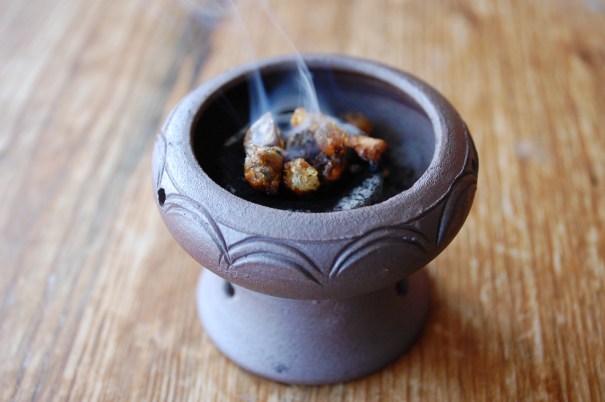
Myrrh Gum Burning
Myrrh Gum Burning. Myrrh is often used in Underworld workings for the blessed dead.

Many in the Neopagan and Witchcraft communities state that at this season, as Samhain approaches, the veil between the worlds is becoming thin. Personally, I have a difficult time with that concept seeing as the veil tends to be continuously in motion around me. Basically, I think no veil exists. If it did, communing with my spirits would be a difficult thing.

What Veil? 
I think a lot of people would agree with me on this. There has been an objection raised that what is meant by the term “thinning of the veil” is that even people who are not involved in the Neopagan and Witchcraft communities can sense there is something “else” in the air. I still don’t know about that. Roman Catholics have their sacred days at the end of October and the beginning of November. Many Christians have Harvest Festivals. Mexican-Americans and other Hispanics such as Bolivians have their Day of the Dead. I guess it seems like everyone has something about the Otherworld to celebrate; to bring the ancestors close to us. I just find it funny since, as a Hellenist as well, the dead aren’t necessarily celebrated right now. So it’s a cultural thing methinks. Besides, technically Samhain is a Celtic holiday which made its way into Wicca. Since Wicca is not a Celtic path, there is room to mix and match here. Anyway, the main thesis of this post is not to downgrade the season. Rather, it’s about to emphasize something important: veneration of the dead.

I once wrote that if my family got together and spoke to me once a year and walked away thinking I’m all better for it, they better think again. How do your ancestors feel? Samhain/Shadowfest/Feast of the Dead shouldn’t be the only time we commune with our beloved Dead. They have a right to commune with you, to be fed and honored.

A Part Of Us
Ancestral veneration seems to be in inherent part of humanity. We don’t just have special days designated for them, but we also instinctively seem to want to do it. As an example, when loved ones pass away, some folks build a small “shrine” with photos and mementos where they can be seen. People will toast to their memory on their birthdays. They’ll say “They were here today watching over you,” or even “So-and-so is an angel now.” None of this involves magickal rituals, just remembrance. For a particular person who might have had an extraordinary life or tragic death, a non-profit might be named in their honor to raise awareness of something dear to them. For major celebrity figures, a statue might be erected, or their home might have flowers, cards, alcohol, and other memorabilia stacked. This happened when Princess Diana passed away. Another celebrity was Harry Caray, a sportscaster who was known very well for his undying support of the Chicago Cubs. He once said, “Sure as God made green apples, someday, the Chicago Cubs are going to be in the World Series.” As the Chicago Cubs entered the Play-Offs in 2016, people began putting green apples on the statue of Harry Caray, hoping it would bring “luck.” Something must have worked, because that was the year the Chicago Cubs won the World Series.

The Holy Days of Memory
The capability of the imagination and its link to Memory is something powerful. We build egregores and monuments. We light birthday candles sometimes or say, “Happy birthday Grandpa.” All of these are instinctual actions that help us venerate the dead, and we shouldn’t limit it to once per year. They need to be honored and fed. We need to talk to them. We need to celebrate their achievements. Why? Because when you honor them, you are honoring yourself. You are a part of a remarkable lineage of people who survived so much to be here: war, famine, plague, slavery, persecution, poverty, rebellion, and so much more. You have a lot to offer this world. Your ancestors made sure that they survived so you can be here. There is something inherently spiritual about that.

Memory is very tangible. It was so important to be remembered that many folks in the ancient world adopted others into their family if they had no children just to be remembered. Memory is what keeps us alive. We become part of the stream of consciousness that, like a river, is ongoing in the subconscious of our human race.

Before the Gods
I think Samhain and other holy days set aside for the dead should be simply when an entire community of strangers come together to honor everyone. I know that this is the definition of Samhain for many (a DUH from some), but you’d honestly be surprised how many forget about the ancestral dead after Samhain.

I was taught by Hekate to honor the ancestors in ritual before honoring the Gods, because it was the ancestors to whom knowledge of the Gods was discovered and to whom the sacred lore was passed down to. In turn they passed it down to the next generation, and they in turn to the next, etc. In addition, the ancestors are the closest thing to us who understand our trials and tribulations. While I honor the Gods, I also honor the ancestors. I pray to them constantly because they know my plights more than the Gods. The Gods, being Gods, might not sympathize with humanity as much. They have their own time table. They may not understand why we need that donation, or that paycheck. They may not understand how we need to cry and release our depression. Gods tend to separate from humans because of pollution (miasma) until we are purified again. But the ancestors? Being human spirits, they know what it is to be stuck in the metaphorical mud (sometimes literal). They know our suffering and desperation.

Remember: Honor your past so that your present has meaning and your future is blessed.

Eirene kai Hugieia!
(Peace and Health!)
~Oracle~
Maintaining Memory

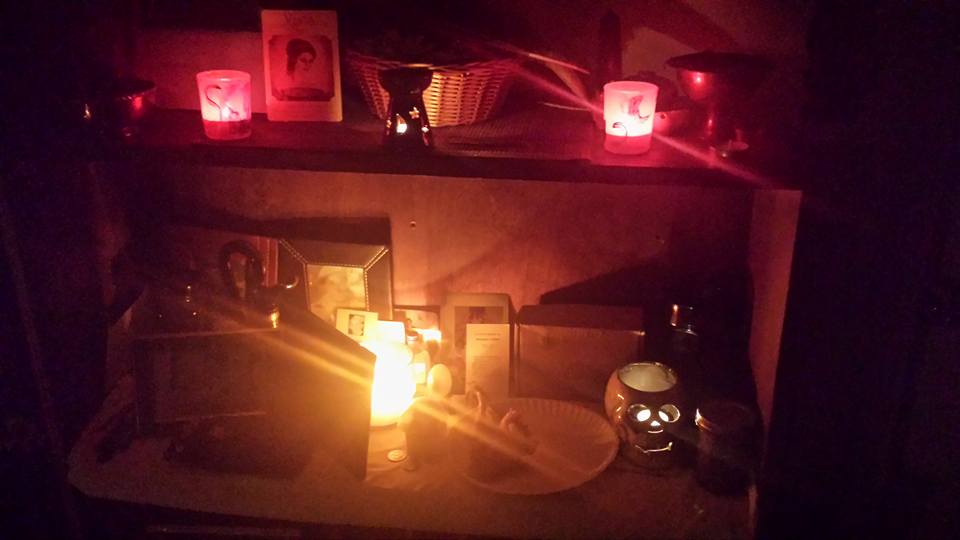
Ancestral Altar
                               Ancestral Altar

If my family got together and spoke to me once a year and walked away thinking I’m all better for it, they better think again. How do your ancestors feel? Samhain/Shadowfest/Feast of the Dead shouldn’t be the only time we commune with our beloved Dead. They have a right to commune with you, to be fed and honored.
Honor your past so that your present has meaning and your future is blessed.

It’s That Time of Year
This time of year is interesting in the NeoPagan world, because many of the people and groups influenced by Traditional Craft and are DIY Wiccans honor their ancestors on Samhain. By the by, DIY Wiccans is now my term of preference rather than “eclectic Pagans” and “NeoWiccans.” Feel free to use it. Anyway, Samhain is an important part of the NeoPagan Wheel of the Year. If you pick up any 101 book, it’s a night of sorrow and joy to feast with the departed. Many will even state that it’s a wonderful night to divine, and mediumship is popular. Black robes, lit candles, and processional chants with shrines hallowed for passed loved ones (including animals) are the highlight of the festivities. Some folks incorporate what’s known as a “Dumb Supper,” a silent meal shared by the community in honor of the beloved dead.

My quote above is not to go against the Wheel of the Year and be disrespectful towards this sacred day or the people who celebrate it. It is special and very important because it connects the community with the realization of Memory. But if the dead are so powerful and existent, why not continue to celebrate them beyond Samhain/Shadowfest/Feast of the Dead? They subsist as you and I do, but in a different reality than what many of us are used to. In this blog I won’t go into hauntings and my personal take on them. I don’t want to lose the focus here, which is that many modern communities, for the most part, have severed themselves from the living well of Memory. To many the dead aren’t as interactive and alive, or if they are they are not fed to maintain their egregore with the family unit.

The Wellspring of Memory
An abundant stream of consciousness that finds its source in the Underworld cauldron of wells and trees, the Wellspring of Memory is the most powerful contact that a people have with their lineage. It is something within our very DNA that births and links generations upon generations with their past, so that they might carry on the continued work of their ancestors. We honor the past by being alive, by overcoming the odds and becoming more than what we are on a daily basis. Each time we grow into self actualization, we are culminating into the peak of what our ancestors have fought and conquered so much for. Memory is a living fabric connected to the strings of Ananke, of Fate: a golden thread which connects all people. But in a family unit, a specific clan within a tribe within a nation, the clan is banded together with their own stories and songs which may be similar or different than the tribe and nation they belong to. And these stories and songs of the ancestors were passed down to succeeding generations at one time. People were proud of their heritage, and some still are. My own family is just discovering our lineage through mementos and photographs. We are informing one another, thanks to my mom who set the whole thing up, about our family histories. Knowing these informs me of my own spiritual practices. Why? Because I believe that blood and bone never die.

The Body of Memory
The immense information held deep within the blood and bones of who we are, the Body of Memory is the vessel that is evidence of the past succeeding into the present. It is the caricature of triumph held within our very flesh. Like I said above, if my family all spoke with me once a year and thought that was okay, they better think again. Many of us hate to be disconnected and feel alone. Loneliness is the requiem of companionship, and humans are nothing if not social creatures. We evolved that way. It’s how we’ve been able to thrive for hundreds of millennia. It’s not enough to know you meet someone and you have similar tastes in music, art, films, drinks, food, etc. It’s not enough to simply have a family or even friends around us, because loneliness is a disassociation of the soul: the soul has forgotten why the connection to the living exists in the first place. It has forgotten the message of Memory, the stream of consciousness connected to Ananke that underlies all of us. There is no clan, no Mythos, no tribe, no rites of passage to pass on the past to the present and give us hope for the future. We have forgotten that our bodies are a living testimony.

The Shrine of Memory
As the living are lonely, so are the dead. They aren’t frightening, just sad. Many folks have a shelf or several in their homes that has photos of the their departed loved ones. They frequently look at them and smile, saying, “Happy birthday dad” or “I miss you brother.” Today lots of folks also have Facebook pages up to memorialize the deceased. This is commendable, because it demonstrates that within our very being we are desiring to acknowledge that our bodies are the central whirlpools of energy within the stream of Memory: in other words, we are desperate to remember and keep something alive within us. The only way to be truly alive is to maintain the shrine of Memory. A shrine is a shelf or flat surface that acts as a house. This “house” has photographs and mementos of the beloved dead. Candles may be lit and offering bowls may be present. This shrine is the external manifestation of the internal stream. This is the central point that our inner energies are connected to. The building and maintaining of a shrine to the dead is not only ancient, but it is where we actually weave the strings of Memory and Ananke to tie us always to the spirits. We establish the foundation for an egregore. After that, it is up to us to continue to remember the dead not just by being alive, but by helping them to not be lonely. We need to acknowledge them all of the time. We need to feed them, care for them, and speak with them. They are desperate to speak and help us. Many, myself included, are learning or have learned to ask them for assistance rather than a Deity because the ancestors are closer to us. In my temple, we honor the dead before we call on the Gods, because it was our ancestors who taught us the stories of the people. They revealed the spirits and Gods. They contacted the Old Ones and shared these so that we might be able to have an identity and be a part of something greater than ourselves: to bring honor to them. Honoring ourselves is honoring them.