Honoring the Dead

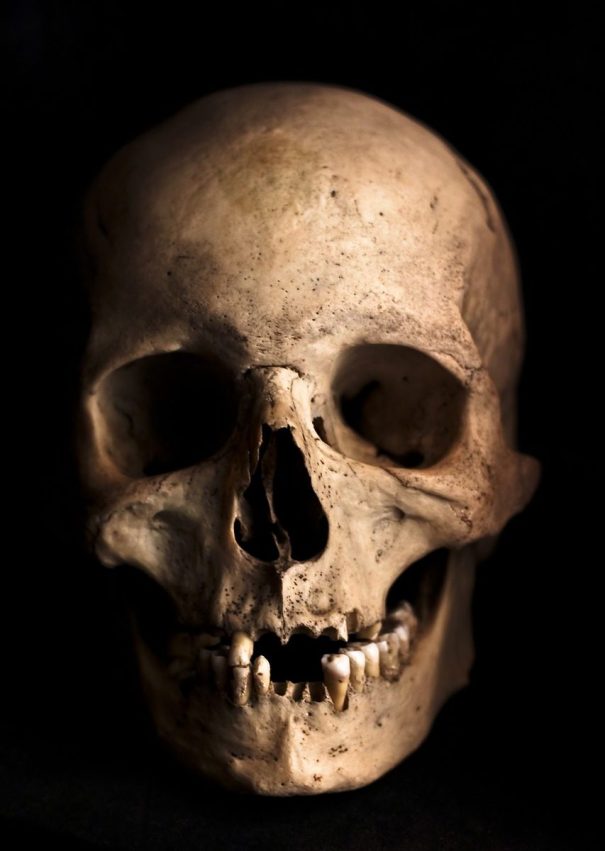
skull-765477_1280-853x1200
The Skull of the Dead

I have written about the ancestors here. Anyone who knows me knows that I look at our ancestors as the lifeline to my Craft. The accumulation of their knowledge and wisdom flows through me, and getting in touch with that empowers me. But how do we honor the ancestors? What’s an example we can use for veneration and shrines?

Who are the Ancestors?
When most people think of the ancestors, the first thought are those who are connected with us in blood. This isn’t wrong, and in fact is a stepping stone to understanding the ancestral link we carry with the past. I call this the Crimson Thread. The idea of the Crimson Thread is that it represents our unity with the beloved dead.

For many folks, the Crimson Thread is a simple lineage via on ethnicity/race into the past. With modern technological advances such as found in organizations like ancestry.com or 23andme, we are able to explore our lineage even further and see where our bloodline stems from. For others, it is a mishmash of various cultures. One isn’t better than the other, and in fact when we go back far enough, we are all mutts.

The beloved dead can be divided into different categories:

  • Family
  • The Shadowy Ones
  • The Heroes
  • The Collective

Family
Family lineage is the first introduction people have to ancestral veneration. Many start with the death of parents, grandparents, or others. There are photos and/or mementos and we place those on a mantle or a table that acts as a shrine/memorial. It is a simple way to remember, and keep in mind the power of Memory: that lifeline which keeps the remembered dead some immortality. For the family lineage, we typically keep those members who belong there and had a good relationship with. It is an idealized format. It also includes family by choice: adopted family, group souls, and even pets.

The Shadowy Ones
These are the relatives we would rather not remember. The ones who were abusive, psycho, or others which were harmful to us. Ones we would rather not be related to. These we would rather cut the Crimson Thread from. We don’t want to be associated with that side of our bloodline.

The Heroes
These are the dead whom we exalt to a status of what would be idol worship: celebrities who made a positive impact on our lives. Not limited to celebrities, it extends to anyone not of family relation who influenced us for the better: mentors, teachers, friends, neighbors, and others.

The Collective
The collective dead are the sum of our past. They are not immediate members of our family, but generations within generations within generations. These are the ones which group themselves together and go all the way back to our very first ancestor in Africa. Power resides here.

Working with the Ancestors
Certain criteria are needed to work with the dead:

  • Consciousness exists after the death of the physical body.
  • Communication between the living and the beloved dead occurs.
  • Influencing factors occur between the living and the beloved dead.

These three are crucial. Without these beliefs, there is zero point in forming a relationship with them. I believe that in our Craft and Occulture, ancestral veneration is a must if we are to claim our power and create a healing, vital, positive impact in our lives. Mind you, they are beliefs, subject to doubt. There is nothing wrong with doubt, and in fact healthy doubt keeps us sane. However, like Magic, it requires some faith to understand the workings of bloodline and see the synchronicity that occurs from veneration of the dead and watching the results in our lives.

Ancestral Shrine
If you want to interact with the ancestors, there are some things I have done which might help you. Mind you, the following isn’t necessarily a prescription so much as a set of ideas and a grounding framework from which you can launch your own praxis. I begin with a very basic foundation. The additions are up to you or whatever your particular tradition prescribes.

The Shrine
Pick a shelf, a table, a mantle, or any other flat surface you may have. If your space is limited, then I encourage you to use a dresser, a chest, a corner table, or anything you see which may be of use. You don’t need to complicate matters. In fact, as you continue to work and honor them, they may grant you blessings to eventually have more space. For now, use what you have. If you have a home and understanding family who would love to participate, leave an empty chair for them. You may also use a vertical space such as a cabinet.

Get a white cloth and place it on the flat surface. On it place a small glass for water. Water is the lifeline of who we are as beings in this world. The glass, when filled, reawakens their energies. Don’t leave it there for weeks though. Change out the water and clean the glass when you see it get dirty.

Place one candle on the shrine. I prefer tealights and votives. They don’t take up a lot of space like some tapers do. I’m also writing for people with small spaces in mind. If you have a larger space, use two candles and two glasses of water. If you have a table space, leave some food and drink for them which you will later dispose of.

KEY: DO NOT UNDER ANY CIRCUMSTANCES EAT FOOD LEFT FOR THE DEAD!!!

Continuing with the shrine, place photos and/or mementos on there. Be sure that the photos only have their image on there; no living members should be on the shrine. Why? If someone alive is on there, you’re telling the ancestors that this person is ready to join them.

KEY: DO NOT UNDER ANY CIRCUMSTANCES PLACE PHOTOS OF THE LIVING ON THERE!!

Offerings 
As mentioned earlier, leave food and drink for the dead. Perhaps cook their favorite meal, or a family favorite if you have more than one ancestor on there. Place their favorite alcoholic drink, juice, cigars, cigarettes, or whatever you think will make the space homey. This is where they will visit you. This is a portal, and to attract them is the goal.

Other offerings you give perhaps may be reading from a book they loved, writing some hymns, or or engaging in an activity you know they would want to see you do (e.g. weaving, playing video games, talking to them from your heart, etc). You may also place fresh flowers they loved. To add, celebrating their birthdays or milestones in your life with them will certainly add to trust. The beloved dead yearn to communicate with us, and so offerings are an ideal thing to make and strengthen that connection.

Communication
Communing with the dead is simple: just talk. That’s right. Just speak to them. Tell them your wishes, your fears, and your goals. The ancestors are very adept at helping you make things happen…more so than deities I should say. Why? The ancestors have struggled to overcome life. Deities have not, and they may have demands which may be overwhelming. The ancestors, however, may not. The only demands I have ever had – which is overwhelming in and of itself – is to live my best life, and to honor their legacy by honoring myself.

But how will the dead speak? They speak in various ways: synchronicity, divination, trance work, dreams, or automatic writing. Each of these are skills which, with time, can be developed. The dead will help you.

But What If…
But what if your occult activities aren’t making grandma happy because she was a Southern Baptist?  I get this question a lot, and it is a good one. I have generations of Roman Catholics in my family, and a bit of Holiness Pentecostal. However, I believe – based on my experiences – that these can be worked with. I believe that by addressing the Collective, grandma can remember her past and her lineage. This will bring about healing for you and yours. Grandma, after all, will know she is dead and be conscious about it. She’ll meet everyone else in the Collective. Being dead doesn’t make you a better person, but I believe it does help us in this day and age heal from the past.

Then again, to really give you something to think about, there is inherently nothing wrong with honoring grandma by putting a Bible on the shelf. She may be dead, but she will still help you. She’ll understand that much. Celebrate her triumphs, her goodness, and her faith. The Bible, although believed by many to be the inerrant Word of God, is also used loosely in Magic without the literalist baggage. I’m not saying grandma believed in using the Bible for Magic (unless you have conjure ancestors); I’m saying that making it comfortable for her and others in your bloodline to come to you is important. Remember: working with the dead isn’t just about you, but about instilling Memory in you to keep their legacy alive.

What about the Shadowy Ones? Those abusers with whom you eschew relationships with? I have a separate altar for them. Yes, an altar. On it is one candle. The candle is for me – to show that despite all, I am a survivor. Whatever happens with them in the afterlife is up to higher powers. I am not concerned about it. I don’t have to forgive anyone. I warn people about bitterness being a poison, which it is. But one can be unforgiving without being bitter. You just forget and let it go. I keep the Shadowy Ones there because I want to acknowledge that their spirits are there, but also that they cannot overcome my light. It is a ward, so to speak. I use a black altar cloth on that one. I only light it on the dark moon, during which the Goddess Hekate is active and helps with the train of the dead.

Hekate and the Restless Dead
For my personal religious calendar (also used in StrixCraft), I follow a lunar cycle. The end of one “moonth” (month) is the dark of the moon, when it doesn’t shine in the night sky. This day is sacred to the Goddess Hekate, the Lady of the Underworld, the Crossroads, the Dead, Witchcraft, the World Soul, and the Liminal Spaces. Because the dark moon is a transition time between one lunar cycle and the next, as a liminal being she guards that area.

For the Shadowy Ones, I believe they ride in her train and are taken to their destination, one I do not know about nor would I wish to. During this time, I also encourage you to clean your altars and shrines so that you can enter the next cycle prepared in cleanliness. The Goddess Hekate is also your protector from the Shadowy Ones. Remember that they cannot harm you when you connect with the Goddess. There are other beings of the Crossroads of course, and these will be specific to your traditions if you are in one.

I must add this as well: there might be times when the dead are restless and perhaps even the Shadowy Ones might be active to harm you. The Goddess, however, is Queen of the Restless Dead; she and your ancestors will ward you. It doesn’t mean you let your guard down. It means that your faith and connection will help you to be protected. When in doubt, seek out a specialist adept in exorcisms who can handle a haunting. I say this not to scare you, but to demonstrate how palpable ancestral working can be.

Generational Curses
Family curses, in my experience, happen more often than we would like. What is a generational curse? Simple. It is a vice or trait which creates a negative and perhaps even deadly impact from one generation of your family to the next. It can be alcoholism, mental illnesses like schizophrenia, early deaths, abusive behavior, or other. Generational curses can be healed with the help of the Collective Dead. It will take time and inner healing, but I encourage you to seek out an experienced spiritual guide to help you transition these pains. Doing it alone is never easy, and in fact may make things worse.

Conclusion
I didn’t touch on the Heroes and I realize that, but to be honest honoring them can be, in some ways, no different from your immediate ancestors or the Collective. In your Craft, ancestral veneration is powerful. The Crimson Thread unites you with your past, even your pre-Christian past that was conquered by Christianity. While yes your family was Christian probably for 2,000 years (at most), your pre-Christian practices go back longer. For me, my ideal connection to the Collective is a pre-Christian ancestor who is a spirit guide in all of this. For my immediate ancestors, it may take some time after grieving to release them to the Collective, but release them in time I will (they have to be prepared as well of course). When you honor and work with the Crimson Thread, you will be amazed at the results of your Magic and Craft. May the journey bless you, as it is well worth it.

Eirene kai Hugieia!
(Peace and Health!)
Oracle
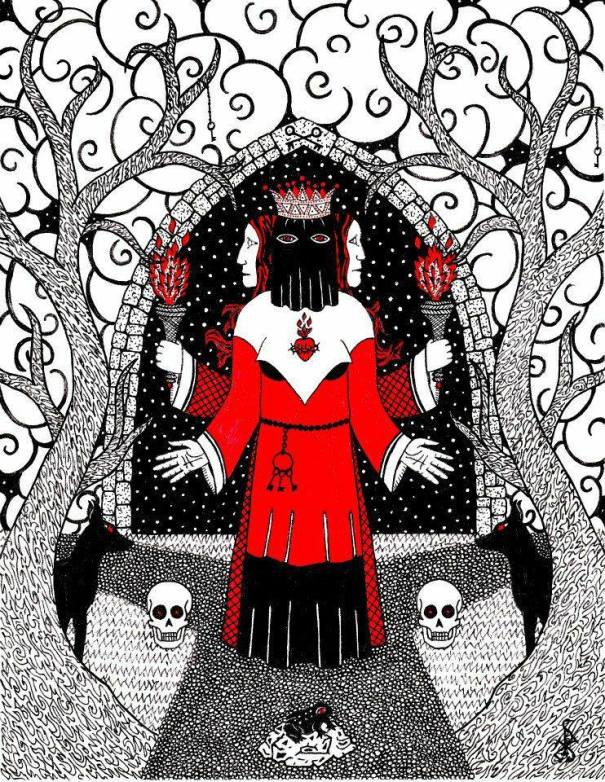


Hekate and Samhain

Red Hekate
Hekate by Patrick John Larabee

As previously posted, Samhain is an important holy day in modern Druidry, Wicca, and some other witchcraft traditions. While a Gaelic festival, some modern witches have incorporated the meaning of this night with the worship of the Goddess Hekate. I say “worship” rather than “work with.” I hate the latter phrasing, making it seem as though the Gods and spirits are toys to be trifled with. One minute they are useful, and the next to be put away in some neat package of your mind until They are useful later on again. I consider that disrespectful. I’ll write a blog post on worship later on, but for now let’s return to the task at hand: Samhain and Hekate.

The Underworld
Below the soil of our world, where trees take root and caverns open wide, lies a place known as the Underworld. Many societies and tribes had their own versions of an Underworld, presided over by a God or Goddess that dealt with death, if not death itself. In ancient Greece it was Hades, who was later joined by Persephone: both were not a God and Goddess of Death so much as Those who reigned over the Underworld which held the dead and a host of spirits. Hekate is known by many names (called epithets). One of those epithets is Khthoniê, or “Of the earth,” aka “Underworld.” The world was seen to be divided into 3 separate realms: the land, the sea, and the sky. The land, or beneath it, was the residency of the Underworld, hence “Of the earth.” Khthoniê is another name for other Goddesses, such as Demeter and Persephone. Unfortunately, because some have matching names people tend to think that They are the same God/dess but in a different guise. They aren’t. It just means they share similar functions but perhaps differently. For example, when I worked as a bank teller, I was a teller. Other people there had the same title: bank teller. It didn’t mean we were related in some way or the same person. It just meant we shared the same functions. So when someone says Hekate is Demeter or Hekate is Artemis, the answer is “Nope.” We’ll be going through this in another post about polytheism. So for now let’s focus (again) on the nature of this post.

Queen of the Dead
Another epithet of Hekate was Anassa eneroi, or “Queen of those Below [Dead].” Again, Her Underworld status is well established. This means that Hekate is the ruling monarch of those who dwell there.  This was an epithet which Medea, priestess of the Goddess Hekate, called on when doing some magic. Apollonios Rhodios writes the following: (1)

To make the ointment, Medea, clothed in black, in the gloom of night, had drawn off this juice in a Caspian shell after bathing in seven perennial streams and calling seven times on Brimo, nurse of youth, Brimo, night-wanderer of the underworld, queen of the dead (Anassa Eneroi)…

“Anassa” is rooted in the Greek word “anax.” It has variously been translated as [tribal] chief or leader. The title of “Anax” was used in the Iliad for rulers such as Agamemnon. It was also a title, not just for monarchs, but for those of “lesser station” within the ruling household. Examples include the master of slaves, the lord of the stables, and the house-lord. (2). So while Hades and Persephone are the overall King and Queen of the Underworld, Hekate is also Queen; just with a shared influence and possibly that of a lesser station in the Underworld. “Lesser” is not synonymous with “less powerful.” Hekate is Lady of the 3 Realms of Land, Sea, and Sky. She is favored by Zeus and can do so much within Her power. If you want to know more, read the Theogony by the Greek writer Hesiod. Any copy can be obtained from Amazon cheaply. Hekate does have a lot to give, but when it comes to the Underworld, She doesn’t make the final say-so.

All of the Gods are limited within Their scope, as it should be. The only deity who claims to be omnipresent, omniscient, and omnipotent is the God of the Christians, Jews, and Muslims. I don’t need my Gods and spirits to be all of that. They aren’t and I am fine with it.

The Role of Hekate 
As can be seen by two of Her epithets, Hekate has a great deal to do with the dead. Since Samhain is a night or festival devoted to them, it is only right that many modern witches and even some Druids have called on Her to help them with ancestral workings. She is the Guide of the Dead, after all. They walk with Her and behind Her. She is the Lady to be called on, and from my experience She is only too happy to oblige.

Hekate has helped me in my ancestral workings. I’ve called on Her aid to open the gates between this world and the Otherworld: to guard them and then close them when I am finished. She keeps evil and restless spirits at bay. I often propitiate these spirits on the dark moon, leaving behind food and offerings at a local crossroads. I don’t look back. I believe the spirits witness it. Although no dogs have barked, they don’t need to. I practice my rites and I have seen results to this type of working by veneration and honor. I haven’t had any issues with wandering dead in my home. The only spirits in my house are those which I and my household have welcomed.

Conclusion
I think a connection between Samhain and Hekate are inevitable. Wicca, Druidry, and some modern witchcraft traditions have introduced Samhain to the Neopagan communities at large. This makes it a communal festive. The Goddess Hekate is no longer confined to Greece or ancient Anatolia (modern-day Turkey). Her worship has been revived and spread.

To combine the two isn’t cultural appropriation in my opinion. I say this because I’ve had a couple of people message me about Samhain and cultural appropriation of a Gaelic feis. I’m sorry, but that hasn’t been the case since the Celtic Revival of the late 19th – early 20th century, when Samhain customs were introduced to the States. If you would like to celebrate it your ancestral way then do so. I can see what you’re saying, but Samhain is a public festival now. I only hope that Neopagans can continue to bring honor to that holy day with respect and love, which happens. It is such a reverential day. Yes, some people do mix it with Halloween, and that’s just as fine.

The question comes about Dia de los Muertos: is it cultural appropriation to celebrate it? I’ll write that in a later blog post. Cultural appropriation and respect are important during this time (i.e. honoring the ancestors). Blessings to you and yours. May the Infernal Lady guard the gates and keep the restless and evil spirits at bay this Samhain. Hail Hekate!

~Oracle~

(1) Apollonios of Rhodes. (1989). Argonautica: Book III: 828. R. Hunter (Ed.). UK: Cambridge University Press. Original Work Published in the 2nd century BCE.

(2) Deger-Jalkotzy, S., Prof. & Lesmos, I. (Eds). (2006). Ancient Greece: From the Mycenaean Palaces to the Age of Homer. Edinburgh: Edinburgh University Press.

Samhain

Samhain
Samhain night is one of the 8 Sabbats of the Neopagan Wheel of the Year.

Samhain is an important holiday in Wicca, Druidry, and some other modern witchcraft traditions. So much has been written about this holy day that I am loathe to add anything to it. But there were a lot of questions I had: did Halloween customs really originate with Samhain? How? Did the Irish bring it over? What about this talk of it being a New Year? Is this an ancient truth or a modern construct in Wicca? And why the end of October/beginning of November? What makes this season particularly important?

Origin 
Samhain means “Summer’s End,” as opposed to the holy day of Cetsamhain, or “Opposite,” that is, the opposite of Summer’s End (i.e. Summer’s Beginning). The latter we also know as Beltainne. (1). It is a Gaelic feis (festival). The name may come from a month in the Coligny Calendar which has the name of Samonios. Samonios takes place from mid-October – mid-November (possibly new moon to new moon). Samonios means “Seed Fall.” The name alludes to the time when, in Gaul (modern day France) and the other lands of the Celtic tribes saw nuts, acorns, and other seeds from trees and plants begin to fall as the trees lost leaves, preparing for Winter.

The Coligny Calendar 


coligny_calendar
The Coligny Calendar

The Coligny Calendar that was discovered in 1897 is a bronze tablet which dates to the 2nd century C.E. The calendar was created in ancient Gaul by the Sequani tribe. It is written in 2 languages: Gaulish and Latin. This helped immensely in deciphering it. It might have been created as a result of trade and travel between Gaul, Rome, and Magna Graecia. The calendar is in the style of what is known as a parapegma. A parapegma was a type of ancient almanac: a tablet which had descriptions of weather phenomena, seasons, and star constellations. Holes were made and pegs were formed which could fit into those holes. The pegs would be moved to indicate the days of the month. Using this instrument, the pegs could be inserted days in advance to accurately predict the weather and star movements.

In the Coligny Calendar, each month begins with a set moon phase. It is lunisolar like our modern Gregorian and Julian calendars, but the Coligny has an emphasis on lunations. It has 5 months of 29 days and 7 months of 30 days. (2) In 12 months this makes for a total of 355 days. Every 2 1/2 years, a 13th additional month was added. Together this creates 2 full years of 13 months (385 days), and 3 hollow years of 12 months each (355 days). This makes the average year 367 days. A ‘day” to the Celtic tribes was from sundown to sundown. Months were divided into 2 halves: 15 days leading up the full moon, and 14 – 15 days after. Room was given for lunar cycles throughout the month.

Celtic-Months-300x265
The Gaulish Celtic Months from the Coligny Calendar

Samonios
As previously stated, Samonios is the time period between mid-October to mid-November. Now, some have conjectured that Samonios comes from “samon,” meaning “Summer,” and that the Coligny Calendar begins in April/May, Samonios located in that time period rather than November. However, little evidence has yet mounted to support this hypothesis. Another conjecture is that Samonios takes place around the Winter Solstice. The reasons are varied, but again there is little evidence to support this. Alexei Kondratiev, the late Celtic scholar and linguist, uses linguistic evidence in Celtic languages which points to Samonios being equated with the month of October/November.(3). Samonios through Giamonios (April/May) marked the dark half of the year, or Winter. Giamonios through Samonios marked the light half of the year, or Summer. (4). This demonstrates that the Celtic tribes had only two seasons.

As also previously stated, the months most likely began new moon to new moon. In the Coligny Calendar there is an interesting inscription that reads:

TRINOX[tion] SAMO[nii] SINDIV
“Three Nights of Samonios [today]”

It is thought that perhaps these three nights of Samonios correspond to three nights of Samhain.

The Dead and the Barrow Mounds
Ireland tends to be the best bet for how Samhain was celebrated. After all, it is a Gaelic festival. According to evidence, this was a time to honor one’s ancestors as a collective. Evil spirits, which would roam, were to be warded off. Sacred mounds were places where the dead were buried, and Druids would often sleep on these mounds at certain times of the year to gain ancestral knowledge and wisdom. Inhumation was the top way that the Celts buried their dead. The bodies were contracted; that is, they were places in a fetal position. (5). Some conjecture that this was purposefully done to show the dead were being “birthed” in the Otherworld. They were buried with ornaments and food. Bodies occurred at various levels in the mounds, showing that the barrows were used repeatedly. In Ireland, the most famous barrows were located at the famous hills of Tlachtga and Tara. While Tara is a famous hill, Tlachtga was the religious heart of Ireland for almost 2,000 years. (6). The festivities located here had origins in a fertility cult, but eventually were incorporated into the later Fire Festival.

Festivities
A Fire Festival, a bonfire was lit on possibly the hill of Tlachtga. Bonfires were also lit throughout the land, possibly kindled by the major one on Tlachtga. All fires were extinguished to be set alight by that bonfire alone. Cattle were driven between the two fires, most likely to rid them of pests. Hollow turnips were carved which were turned into lanterns; they illuminated the processions and possibly were believed to harness the power of light against the evil spirits which roamed about. On the political capital of Tara, 12 miles away, the people gathered to hear the Druids recite the ancient laws, enact new laws, and recite the histories of the land. (7). This helped the people stay in touch with the environment and their ancestors. Grievances, debts, and disputes were judged and settled. The king also mated with a white mare, the representative of the Goddess of Sovereignty. After ritual copulation, the horse was sacrificed and dismembered.

When families settled in each evening for the 3 days Samhain was celebrated, food and offerings were left out for them. The light from the turnip lanterns guided them, but many spirits were thought to be tricksters (the fairy folk), and so venturing out past nightfall was taboo.

The Catholic Church: Allhalowtide
Samhain is a 3 day festival, and so is the Catholic holy days of Allhallowtide. Allhallowtide includes All Saint’s Eve, All Saint’s Day, and All Soul’s Day. There is Christian history of respecting the dead and remembering them. A 4th century theologian by the name of Ephraim (later known as Ephraim the Syrian) wrote about honoring the dead and the importance of relics. He writes:

Wherefore, of those that live with God , even their very relics are not without honor. For even Elisha the prophet, after he was fallen asleep, raised up a dead man who was slain by the pirates of Syria. For his body touches the bones of Elisha, and he arose and revived. Now this would not have happened had not the body of Elisha were holy.

We could conjecture that the practice of holy relics came from pre-Christian practices of Hero cultus, and possibly it is so. However, needless to say that even if this were the case, it does not pollute Christianity with “pagan practices.” Christianity is but one religion which found its own practices verified through exegesis of the New Testament and Tanakh (Old Testament). The veneration of the dead is a near-universal practice. I believe simply that early Christians found a way to incorporate this practice into their own liturgy using their own sacred texts.

Allhallowtide was the vigil held before the actual honoring of the saints and the martyrs: All Saint’s Day and All Soul’s Day. These were also known as the “triduum of death.” In the mid-15th century, Pope Sixtus IV extended Allhallowtide to an 8-day celebration. This was rescinded in the 1950s following Vatican II Council.

Originally, Allhallowtide was celebrated in Ireland in mid-April. (8). It was the end of the Winter season approaching the beginning of Summer, so the placement makes sense. It wasn’t transferred to November until the 11th century, when it finally moved to the late October/early November date. Interestingly enough, when the old Irish calendar was replaced by the Gregorian calendar in 1752, 12 days were dropped. This caused date confusion, moving Samhain to November 12th. This is now referred to as “Old Samhain.”

New Year’s? 
Today many in the Neopagan and modern witchcraft communities celebrate Samhain on November 1st and as the hallowed Celtic New Year. Is this true? Scholars are divided here. As mentioned earlier, many things took place at Samhain on the hill of Tlachtga. It was a time of important transition. The Winter in Ireland was harsh, and families would settle in for the entire season. Tlachtga is also famous in that the sun rises into the mound on the morning of Samhain. Obviously it was a very important festival. There were practices which seemed to follow other New Year’s festivities in other countries on Samhain: games, feasting, drinking, divination for one’s future lover, as well as dousing the old fire and reigniting the new. But still, the evidence that it is a specific New Year holy day is scant. When the Irish Revival took place in the late 19th – early 20th century, the hypothesis of Sir John Rhys as the “Celtic New Year” became prominent. So much so that in a famous film “Meet Me in St. Louis,” one of the characters on Halloween night states, “Well another year come and gone.” This was entrenched in the popular mind, and it has been repeated by authors ever since. Regardless, it is now accepted as the Neopagan New Year. More specifically, the Wiccan and Druid New Year. Not all Neopagans celebrate Samhain after all.

Conclusion
We’ve taken a journey from the past to the present. A lengthy blog post to be sure, but one I found important for myself as well. When writing, I am always learning new things. This helps me, as a Wiccan (among other things) to understand the holy day better. It gives me a sense of history and purpose. It allows me to question and contemplate. I don’t like accepting things “because they are that way.” It’s just not me.

Samhain seems to have always been a festival held by the Celtic tribes, although our best evidence is from the annals and myths of Ireland. It was an important occasion, marking so much activity for the political and spiritual well-being of the tribes. Today we can stop and remember our link with the land, sea, and sky around us. We can learn to embrace the dead and, yes, learn to have a healthy sense of fear for the aos sidhe (fairy folk). I’ll write about my thoughts on the fairy folk in a later blog post. For now, suffice it to say not all spirits are wings and fairy dust. There are real spirits which need to be held at bay for a variety of reasons.

The Roman Church had its own theologians which wrote on the importance of honoring the dead. Sure, it might have stemmed from the earlier Hero Cults, but borrowing has always been a religious tradition. This doesn’t make the Church corrupt, so much as what it is: a religion. Does it make it hypocritical? Sure. Especially when writers with that religious background condemn all things “pagan.” But it’s important to take into account that nothing was stolen. It merely traveled and amalgamated.

This Samhain I plan on remembering my ancestors and helping to celebrate the collective dead with my coven. I always venerate mine, but Samhain affords me the opportunity to cherish and share these things with like-minded individuals. If one thing ancient Samhain customs have taught me while writing this, it is that community is important. We are all related, and at some point your ancestors converged with mine. We need to keep this in mind. It is a time of reflection: to know where we came from. May the blessing of Samhain this season bless you and your ancestors. Remember, what is remembered lives!

~Oracle~

(1) Nichols, M. (2010). The Witches’ Sabbats. OR: Acorn Guild Press, LLC.

(2) McCluskey, S.M. (1998). Astronomies and Cultures in Early Medieval Europe. Cambridge UK: Cambridge University Press.

(3) Kondratiev, A. (2003).  Apple Branch: A Path to Celtic Ritual. NY: Kensington Publishing Corp.

(4) Hopman, E.E. (194). A Druid’s Herbal for the Sacred Earth Year. NY: Simon and Schuster.

(5) Scott of Rothbury, A., Reverend. (1894) The Celts and Druids and Their Stories From the Earliest Times, in Twelve Chapters. North Shields, Bedford Street: W.J. Potts, Printer and Publisher.

(6) Gilroy, J. (2000). Tlachtga: Celtic Fire Festival. Glanmire, Cork Co., Ireland: Pikefield Publications.

(7) Crump, W.D. (2008). Encyclopedia of New Year’s Holidays Worldwide. NC: McFarland & Company, Inc. Publishers.

(8) Hutton, R., Prof. (1996). Stations of the Sun: A History of the Ritual Year in Britain. NY: Oxford Paperbacks.

Remember The Dead

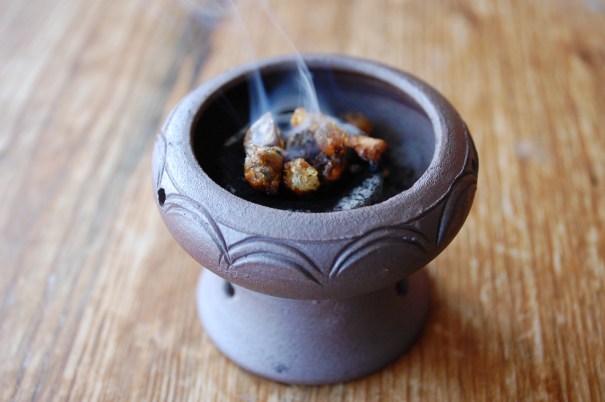
Myrrh Gum Burning
Myrrh Gum Burning. Myrrh is often used in Underworld workings for the blessed dead.

Many in the Neopagan and Witchcraft communities state that at this season, as Samhain approaches, the veil between the worlds is becoming thin. Personally, I have a difficult time with that concept seeing as the veil tends to be continuously in motion around me. Basically, I think no veil exists. If it did, communing with my spirits would be a difficult thing.

What Veil? 
I think a lot of people would agree with me on this. There has been an objection raised that what is meant by the term “thinning of the veil” is that even people who are not involved in the Neopagan and Witchcraft communities can sense there is something “else” in the air. I still don’t know about that. Roman Catholics have their sacred days at the end of October and the beginning of November. Many Christians have Harvest Festivals. Mexican-Americans and other Hispanics such as Bolivians have their Day of the Dead. I guess it seems like everyone has something about the Otherworld to celebrate; to bring the ancestors close to us. I just find it funny since, as a Hellenist as well, the dead aren’t necessarily celebrated right now. So it’s a cultural thing methinks. Besides, technically Samhain is a Celtic holiday which made its way into Wicca. Since Wicca is not a Celtic path, there is room to mix and match here. Anyway, the main thesis of this post is not to downgrade the season. Rather, it’s about to emphasize something important: veneration of the dead.

I once wrote that if my family got together and spoke to me once a year and walked away thinking I’m all better for it, they better think again. How do your ancestors feel? Samhain/Shadowfest/Feast of the Dead shouldn’t be the only time we commune with our beloved Dead. They have a right to commune with you, to be fed and honored.

A Part Of Us
Ancestral veneration seems to be in inherent part of humanity. We don’t just have special days designated for them, but we also instinctively seem to want to do it. As an example, when loved ones pass away, some folks build a small “shrine” with photos and mementos where they can be seen. People will toast to their memory on their birthdays. They’ll say “They were here today watching over you,” or even “So-and-so is an angel now.” None of this involves magickal rituals, just remembrance. For a particular person who might have had an extraordinary life or tragic death, a non-profit might be named in their honor to raise awareness of something dear to them. For major celebrity figures, a statue might be erected, or their home might have flowers, cards, alcohol, and other memorabilia stacked. This happened when Princess Diana passed away. Another celebrity was Harry Caray, a sportscaster who was known very well for his undying support of the Chicago Cubs. He once said, “Sure as God made green apples, someday, the Chicago Cubs are going to be in the World Series.” As the Chicago Cubs entered the Play-Offs in 2016, people began putting green apples on the statue of Harry Caray, hoping it would bring “luck.” Something must have worked, because that was the year the Chicago Cubs won the World Series.

The Holy Days of Memory
The capability of the imagination and its link to Memory is something powerful. We build egregores and monuments. We light birthday candles sometimes or say, “Happy birthday Grandpa.” All of these are instinctual actions that help us venerate the dead, and we shouldn’t limit it to once per year. They need to be honored and fed. We need to talk to them. We need to celebrate their achievements. Why? Because when you honor them, you are honoring yourself. You are a part of a remarkable lineage of people who survived so much to be here: war, famine, plague, slavery, persecution, poverty, rebellion, and so much more. You have a lot to offer this world. Your ancestors made sure that they survived so you can be here. There is something inherently spiritual about that.

Memory is very tangible. It was so important to be remembered that many folks in the ancient world adopted others into their family if they had no children just to be remembered. Memory is what keeps us alive. We become part of the stream of consciousness that, like a river, is ongoing in the subconscious of our human race.

Before the Gods
I think Samhain and other holy days set aside for the dead should be simply when an entire community of strangers come together to honor everyone. I know that this is the definition of Samhain for many (a DUH from some), but you’d honestly be surprised how many forget about the ancestral dead after Samhain.

I was taught by Hekate to honor the ancestors in ritual before honoring the Gods, because it was the ancestors to whom knowledge of the Gods was discovered and to whom the sacred lore was passed down to. In turn they passed it down to the next generation, and they in turn to the next, etc. In addition, the ancestors are the closest thing to us who understand our trials and tribulations. While I honor the Gods, I also honor the ancestors. I pray to them constantly because they know my plights more than the Gods. The Gods, being Gods, might not sympathize with humanity as much. They have their own time table. They may not understand why we need that donation, or that paycheck. They may not understand how we need to cry and release our depression. Gods tend to separate from humans because of pollution (miasma) until we are purified again. But the ancestors? Being human spirits, they know what it is to be stuck in the metaphorical mud (sometimes literal). They know our suffering and desperation.

Remember: Honor your past so that your present has meaning and your future is blessed.

Eirene kai Hugieia!
(Peace and Health!)
~Oracle~