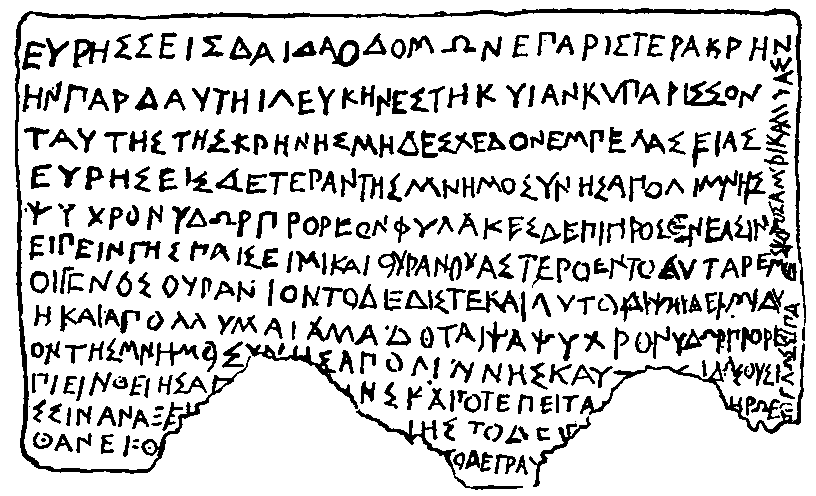
Orphic Tablet from Petelia, Italy (in Harrison, Prolegomena, p. 573)
Something about how my girlfriend said this statement really resonated with me, because it’s so true. I truly believe that the Lore of any Tradition speaks volumes about how an initiate can learn to interact with the Deathless Ones, because these Myths are the stories of our Ways, our People, our Ancestors, our Dances. We can leave the nuances of thealogical discourse for those outside of our Ways, but for the paths which call to us, it is not what we walk away with that matters, but the experiences in that very moment which speak beyond anything we can touch or sense. Because when we walk away, our analysis begins, and ever afterwards we wonder if we are the round hole or the square peg?
When you are called by the Gods of a particular Tradition, you need to know that you are being called to dance a particular rhythm with the Cosmos. You are being called to sing a specific tune, to harmonize with a specific vibration, to play a particular instrument. It’s a gift exchange, this calling: the Ancient Ones want to hear your aria in concert with your fellow chorus, while you are given a skill/talent/gift to in turn become something most excellent!
Yes, the Theoi (or insert your pantheon here) want to hear your serenade, because that’s what your worship is to Them. They are hungry for attention, which can baffle many of us because why should something as awesome and mega-powerful as a God need attention?
Simply put: ask Them.
Gods are not Gods because They are pure or omni-anything. They are Gods because They are Gods. No mystery needed. But in Their Godhood, They are in a symbiotic cycle with us mortals which comes from Laws more ancient than even Them. Call it Ananke, Wyrd, Themis, Ma’at, what-have-you. But at the core of nearly all of our Polytheistic religion expressions is our return to our Dances.
So if you don’t have a living Mythos while you are building something for Them, then write it. Write down your experiences. Write down your Visions. Look to the past at what has survived, and if it’s been broken: then write new ones. Don’t be afraid to create a new Dance for Them, because at some point that’s what the ancients did. You’ll find out what works and what doesn’t as you keep trying. Keep working. Keep dancing. Keep serenading. Because in the end, the living Mythos that is weaved with pen, tongue, instrument, and heart will beat within the Soul of those who come after you. And then we will all look forward to an eternal chorus hearing the music that was born from Love.
The following is based upon a combination of research and personal gnosis.
The Starry Bull of Heaven.
The Sacred Moon-Child of the Moon and Sea.
Half-Bull, Half-Man, All Hero.
He is the Sacred King who sits within the center of the Labyrinth.
The Labyrinth: the spiral dance of the Sun Bull, the House of the Double-Axe, the fylfot womb which nurtured the Beloved Child. He is Taurus, the Starry Bull of the Equinox that marked the New Year. His sacrifice maintained the Law of Themis, the covenant between the Deathless Ones and the mortal realm. His death was the expiation for the world to maintain its harmony. He is simultaneously father and son. He is the light that perpetually shines in the Underworld as He walks the veil above. He is Zagreus: the torn child whose seven separate limbs became the Seven Planets, His heart remaining to birth forth humanity. Order from Chaos.
He is the apotheosis of the Labyrinth mandala – the place to which we all aspire to travel, and come forth back again. I desire for the Bull to eat and ravage me into pieces, for I desire rebirth into His world. I desire to be eaten, to be separated, and to be brought back together within His body. I desire to know the pain of omophagia that I might truly live in wonder, and behold the Starry world which is hidden from all but those courageous enough to walk the darkness of the spiral.
I am His sacrifice. I am His propitiation. I am His expiation. I am His and I am not my own.
I am the sweat of the stars made flesh. I am the incarnation of His form above. I am the spilled semen, the joy of His ejaculate, the ekstasis of His guttural cries, the bliss of His little death (or is He the bliss of mine?). Where does He begin and I end? Where do I end and He begins?
He is my Psychopomp, guiding my soul to reunion with the stars. As the light penetrates the entrance to the cavernous womb in Knossos, might He be its very manifestation, come to awaken us to Truth?
Our traditions may have been broken, but our Visions are renewed.
Our ways may have become historically lost, but our Memory is strong.
Our customs may have become nearly eradicated, but our Spirit is eternal.
Our languages may have become dead, but our Tongue can still speak the Sacred Names.
Polytheism is not just a return to plurality. It is not limited to reconstructionism, revivalism, or solitary devotees of any path. It is a word which encapsulates the responsibility and obligations with which our Elders are returning from their home in the stars to come down in flesh and bring back the worship and cultus of the Old Gods and Heroes. Many years ago as I sat in contemplation, I was granted a Vision by my Queen, Hekate, as She began to open the Gate of Souls and allowed the Souls of Old to come and walk among us again.
Yes, we Europeans, North Africans and Middle Easterners have our own Elders, our own Ways, our own Tribes, Temples, Gods and spirits that we once served. And with the Old Ones crying out for Their sacred fires to be lit once more, we have mistaken many times that the Gods and spirits call whom They will. Perhaps They do…but I’d like to think that They touch the ones who knew Them, who adored Them of Old, and who were teachers, priests, iatromantoi, magoi, strixoi, backkhai and more.
What does this mean for us? For you?
It means that you have the Power of Memory. Memory is palpable, tangible. Memory is your lifeline to the Gods and Spirits. Memory becomes manifest in your rites and cultus. Memory is what you carry deep within the constellation of your soul, proof that you have tasted the Well of Memory. But you thought you would stay among the Stars forever? You thought you would remain in eternal joy with nectar and ambrosia?
No, my friend, my brother, my sister, myself.
You must return. You must come back, because we need you. We need our Elders to teach the young of the world again. We need our stars to be clothed in flesh, to remind us of the Once Ways in which we walked one with our Gods of place and temple. Because our Gods need us, though They exist beyond our own confines or imagination. They exist, yet Their Fates are tied to the world in which we exist. And so it is that as the world needs us, it is our Gods who need us too. We cannot exist one without the Other. This is the Law of Ma’at, of Themis, of the Pax Deorum. This is the Sacred Exchange between the Golden Deathless Ones and the mortal world. This is the sustenance which drives all of our known existence within our purview to continue as we know it.
The Elders are returning. They are becoming reborn and walking among us, forged in the fires of trauma and pain so that They might have the mettle and fortitude to go past their ordeals to rise and fight for the preservation of our Ancient Ways. They are here to remind us of the paths we once knew, of the glades we once worshipped and frolicked, of the spirits whom we once touched.
Last night I performed a midnight devotional to Dionysus. I poured libations to the dead, blessed the wine, and began a sacred dance in my backyard to him. All I had on was a red scarf while I was nude, the wind and the stars witnessing my ode. Oh how I reveled in ekstasis! I danced my love, my worship, crying glossolalia. My body was His, IS His, and as I drank within the sacred precinct of my Temple-Not-Made-With-Hands, I became inexorably possessed:
I began to fall on my hands and knees, raved like a mad bull in heat, bellowed out gutteral ties. I was possessed! Oh yes, my sweet delicious Intoxicant bestowed His mercy and grace to come down and inhabit my body. I won’t go into the rest of the details, as they are extremely private, but an oracle did pour forth as I lay panting after seizing. Here it is, both the Vision and the Voice:
I saw His infant form torn apart, blood splattered with tendons, bones and meat everywhere. His ichor stained the earthen cave; you could smell the iron. When the white-chalk Titans had finished their course, the blast of a thousand million volts came and sizzled the very cavern. Where once lay the mighty, now they had fallen so low. Nothing but post-apocalyptic ash remained, mixing with the ichor of the God babe. It was then that I heard a voice,
“From my suffering, I gave you life. From my blood, I gave you thought. From Myself, came forth You, In all your perfected Glory. Your kind is My kind: mortality, suffering, and death. And so it was My joy to come among you long ago, And bestow the salvation to your suffering – Pleasure. Undeniable pleasure. The grace of wine, The nectar of sex, The ambrosia of freedom, The ointment of laughter, The weapons of peace, The promise of a shared concord with the Immortal Ones. This was my Gift, This was my Joy, To teach you rites to touch the breath of the Mighty Ones. To show you rituals whereby you may engage with the Shining Ones. Indeed, it is within your nature to be violent, to suffer. It is your doom that you share the flesh of the Strugglers. And so it is your doom, too, that within you flows My blood. This is the salvation you seek. This is the purpose you long for. It is not that evil shall be taken away, But that you are given the choice to engage with Pleasure, That with it, your suffering might me eased, And your Memory, your Soul, shall be set free. Set free…”
“Cultivated hemp. Cannabis (some call it Cannabion, some Schoinstrophon, some Asterion) is a plant of much use in this life for the twisting of very strong ropes. It bears leaves like to the Ash, of a bad scent, long stalks, empty, a round seed, which being eaten of much doth quench geniture, but being juiced when green is good for pain of the ears.” (Russo, E.B., MD. Cannabis and Cannabinoids: Pharmacology, Toxicology, and Therapeutic Potential)
“Pausanias continues that above the Argive Heraion flowed the river Asterion, on whose banks grew the asterion plant. The vines and leaves were woven into garlands for the statue of Hera, and the plant was made an offering to Her. Asterion was one of the ancient names for cannabis, according to the first century C.E. Greek physician named Dioscurides.” (Rigoglioso, M. The Cult of Divine Birth in Ancient Greece)
Note: the following blog post in no way reflects the teachings of the Minoan Brotherhood. It is a result of my own independent research into entheogens. NO secret teachings of the Brotherhood are held within this post.
Cannabis Cannabis has been a psychotropic drug, otherwise known as an entheogen, since ancient times. The origin of the plant is thought to have come from Central Asia (Rudgley, R. The Lost Civilizations of the Stone Age). Its use for twine is well-known, but braziers were also discovered as far west as Romania showing evidence that the seeds were burnt for ritual purposes (and I suspect the use of cannabis may have lead to big munchies which nearly killed of the Mammoths, but just my morbid speculation). These discoveries date back to the Neolithic Era. Cannabis, along with opium, were venerated in places like Minoan Crete for their properties as mind-altering substances which opened up the portals to the spirit realm. It’s a well-known fact that many spirit walkers in indigenous societies use entheogens in order to connect with the spirit realm. Central Asia, as the ancient home of cannabis, is also conjectured to be the source of Pythagoras’ teacher Abaris (Kingsley, P. A Story Waiting to Pierce You). It wouldn’t be too much of a leap in logic to suggest that wherever a spirit-walker went, his psychotropic drugs went with them.
Connecting to the Spirits
This fact makes the illegal status of marijuana even more of a travesty, since it is forbidding us from engaging with the Gods in ways our ancestors would have known. Many realms, I believe, remain untapped due to the non-use of this potent drug, and it has also diluted the essential power of the Craft (in my opinion). To be a spirit walker, an iatromantis, a shaman, or what-have-you, is to have an alliance with the realms of the plant and animal spirits. It means to remember the time of the Sacred Ancestors and join in the Sun Dance of the Labyrinth. It means to open ourselves up to the spirits themselves and use their connection as a authentication of our power. Without that connection, a spirit walker is nothing. Although the use of drugs is not necessary, it is also not forbidden. I think the Mysteries, missing this ingredient, are robbed in some way of their true essence. These plants had a meaning that was more than the average street user or the “War on Drugs” politician could ever imagine. They were the lifeline our ancestors relied on for a purpose. Opium was sacred to the Goddess Rhea for a reason. Cannabis was labeled Asterion for a reason.
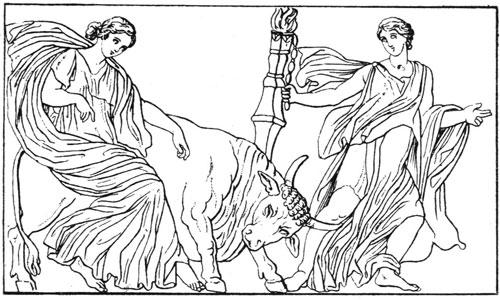
Europa taken by the White Bull
The White Bull and the Western Cow
As I wrote in another post, the public name of the God in the Minoan Brotherhood is Asterion. The mythology we have available states that Asterion was the name of two sacred kings in Minoan Crete: the first was a Cretan King who reared the children of Zeus and Europa. Europa was a Phoenician princess (hinting at the cultural relationship between the Minoans and the Phoenicians), kidnapped by Zeus in the form of a white bull. The etymology of Europa means “wide-eyed,” and hints that she was possibly a Cow Goddess. The abduction story of Europa is very similar to the kidnapping of Kore by Hades:
“Zeus saw Europa the daughter of Phoenix gathering flowers in a meadow with some nymphs and fell in love with her. So he came down and changed himself into a bull and breathed from his mouth a crocus.18 In this way he deceived Europa, carried her off and crossed the sea to Crete where he had intercourse with her. Then in this condition he made her live with Asterion the king of the Cretans. There she conceived and bore three sons, Minos, Sarpedon and Rhadamanthys. The tale is in Hesiod and Bacchylides.” (The Catalogues of Women by Hesiod).
All three sons were raised by Asterion, who wed Europa. After their marriage, Zeus transformed the White Bull into the constellation Taurus. Two of the sons, Minos and Rhadamanthys, became Judges of the Underworld. Sarpedon became a long-lived king (some say he died in the Trojan War, and Philostratus mentions that he, too, became Judge in the Underworld with his brothers). This is quite the story, and holds a lot of interest to me because of the early relationship, as I previously pointed out, about the kidnapping of the Maiden to become a Queen of a rich land.
Attic Kylic depicting Pasiphae and Her baby Minotaur
The Star of the Labyrinth
The second Asterion is the Minotaur of the Labyrinth. Asterion was the Son of Poseidon (the Zeus of the Sea) and Pasiphae, daughter of the Sun God, sister of the sorceress Kirke, and wife of Minos (son of Zeus). Pasiphae was considered to be a Goddess in Her own right. Plutarch mentions:
“Now there was a temple and much respected oracle of Pasiphae at Thalamae.” (Plutarch on Sparta, p. 60).
Pasiphae possessed the ability of Witchcraft, which was to say she was a skilled pharmakos. I personally would LOVE to know how she had her husband ejaculate scorpions, millipedes and snakes into women she hated. Talk about some jacked up shit! That makes for a great anime!
Anyway, Pasiphae and Poseidon’s child was at the center of the Labyrinth. For now we’re ignoring the Greek telling, because it was full of political claptrap that made the Athenians look good and the Minoans very evil. Theseus, the hero, was the legendary founder of Athens (and Athenian democracy which subjugated women as chattels and property). What a piece of shit. Ignoring the political veneer, the Minotaur is shown in the Attic Kylix just like the classic Mother-Child motif found with Aset (Isis) and Heru (Horus), Parvarti and Ganesha, and Mary with Jesus.
R.F. Willetts speculates that the Labyrinth design was based on an ancient sun dance (Ancient Crete: From Early Times Until the Roman Occupation). The ancient mimetic dance was probably used to honor the Sun Bull, the Cretan Zeus, who was represented in the person of the Minoan King. The journey into the Labyrinth and from it was probably a rite of Initiation, whereby the person was led by the Priestess (Ariadne, the Spider Weaver who used the scarlet cord to lead them to the center). At the very heart, the initiate became the Man-Bull: the union of Divinity and Mortality.
Reefer Madness!
Cannabis was identified as being called Asterion, the gift of Poseidon. His mother was a pharmakoi Goddess, Pasiphae. The ritual use of cannabis was the catalyst of Enlightenment (or, as I call it, Gnosis). The prototype for Dionysus from Crete, then, is the jewel Cannabis: the Son of the pre-Olympian Poseidon who is the Sacred Bull. That’s right peoples: reefer madness of Dionysus! Pipe it up, inhale, and enjoy the effects. In fact, cannabis enjoys and interesting piece of warning which the United States slapped on it much like the Romans did on the Bacchic revels in 186 BCE:
“Marihuana is that drug – a violent narcotic – an unspeakable scourge – The Real Public Enemy Number 1! It’s first effect is sudden, violent, uncontrollable laughter; then come dangerous hallucinations – space expands – time slows down, almost stands still…fixed ideas come next, conjuring up monstrous extravagances – followed by emotional disturbances, the total inability to direct thoughts, the loss of all power to resist physical emotions…leading finally to acts of shocking violence…ending often in incurable insanity.”
Eirene kai Hugieia!
(Peace and Health!)
~Oracle~
Sources:
Hunter, R. (Ed.)(2008). The Hesiodic Catalogue of Women: Constructions and Reconstructions.
Kingsley, P. (2010). A Story Waiting to Pierce You: Mongolia, Tibet, and the Destiny of the Western World.
Rigoglioso, M. (2009). The Cult of Divine Birth in Ancient Greece.
Rudgely, R. (1999). The Lost Civilizations of the Stone Age.
Russo, E.B., MD. (2002). Cannabis and Cannabinoids: Pharmacology, Toxicology, and Therapeutic Potential.
Talbert, R.J.A. (Transl.) (1988). Plutarch on Sparta.
Willetts, R.F. (1965). Ancient Crete: From Early Times Until the Roman Occupation.
Cave painting from Chauvet Cave, France (c. 30,000 BCE). The Man-Bull and the vagina of the Woman.
The sanctity of the Bull as a symbol for the Sacred Masculine can be found as early as the Paleolithic cave paintings of Lascaux, Livernon and Chauvet in France. During the Bronze Age (4000 – 1700 BCE) the Spring Equinox occurred during the constellation Taurus due to the Precession of the Equinoxes[i]. Currently it occurs in the constellation Aries (the Sacred Ram). During the Age of Taurus the Myths of many cultures personified the life forces as a Bull that needed to be slain so that the Cosmos would continue. As a result, many cultures and religions celebrated their New Year on the Spring Equinox. The New Year would entail the sacrifice of an actual bull, reenacting the First Sacrifice that made the Cosmos possible, as everything that exists was said to be made from parts of the Bull. Cultures and religions that had these mythic motifs included the Persians, the Mesopotamians, the Minoans, Eastern Anatolia (where Phrygia was located), the Indus Valley, the Gaulish Celts, the Canaanites, and the Thracians. Interestingly, the Sacred Bull was also linked to the Goddess Hekate. In the Greek Magical Papyri, a collection of texts with spells and incantations dated from the 2nd century BCE – 5th century CE, Hekate is addressed in the Prayer to Selene as “O Night Bellower, Lover of Solitude, Bull-Faced and Bull-Headed One,” and “Bull-Eyed, Horned, Mother of Gods and Men.”
Dionysus and the Bull
Dionysus was also described as being “bull-horned.” In the Orphic Hymn to the God of the Triennial Feasts[ii], the hymnist writes, “I call upon you, blessed, many-named and frenzied Bacchos, bull-horned Nysian redeemer, god of the wine-press, conceived in fire.” Other hymns go on to say that He is “bull-faced.” Dionysus may have had origins in Crete, where the Sacred Bull was especially venerated. The Sacred Bull was linked to the symbolism of the Moon. A Zoroastrian prayer says that the “Moon is the Seed of the Bull.” Apis, an Egyptian God who is another form of the Sacred Bull, was illustrated with the Moon between his horns. Shiva is linked to the Sacred Bull, and drawings often show him with a Crescent Moon on His brow resembling horns. The Minoan Horns of Consecration sculpted to represent the horns of the Sacred Bull, I believe symbolize the powers of the Moon. The Egyptian God Ptah was said to incarnate as a black bull created by moonbeams. This connection of the Sacred Masculine to the Moon may be rather startling to find since many modern Pagans, familiar with Wicca, have come to symbolize the Moon as a solely female. As we are seeing, the ancient world was not so easily divided.
Horns of Consecration (restored) in Knossos, Crete.
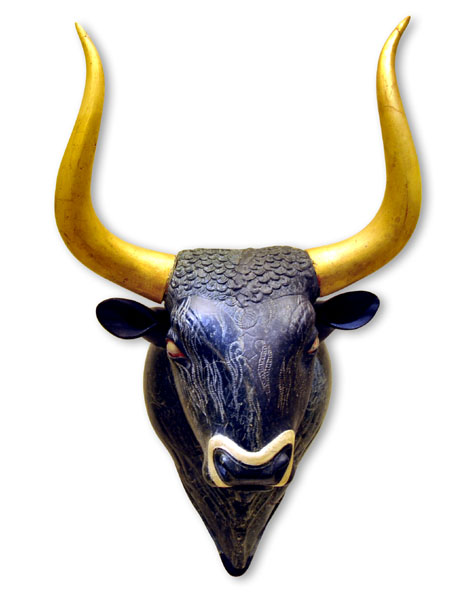
Minoan Sacred Bull
The Sacred Bull was particularly venerated in Crete, where representations of Sacred Bulls can be found everywhere. According to the Orphic Hymns, Dionysus was born in Crete. The name itself, Dionysus, was first found in Mycenaean fragments known as Linear B. The Linear B alphabet predates Greek by several centuries, and was found mostly in the Minoan capital city of Knossos. It is descended from the older Linear A alphabet spoken by the Minoans, and as of this writing remains undeciphered. This language was formed after the language found in Linear A, confirming the Orphic Hymns that Dionysus may have originated from the Minoan Civilization. Or, perhaps an archetypal Deity like this has always existed in various forms in various cultures? What we do know is that in Minoan Crete He was given the name Zagreus, a title for a hunter who captured live animals. As Zagreus, He was identified as the Cretan Zeus. Carl Kerenyi[iii] stated that the title was rooted in Minoan Mythology.
Bakkhoi women leading a bull to the altar.
The Sacrifice of the Bull
Rites depicting the Sacred Bull would always recreate the creation of the Cosmos and humanity by sacrificing a bull. The sacrificial death of the Sacred Bull was seen as a dismemberment of the God Himself. His flesh and blood, eaten by His worshippers, would be viewed as the God investing His very Presence into the bodies of His followers, granting them a portion of His Divinity (known as theophagy, or “God-Eating”). This omophagia (eating raw flesh) would ensure immortality. Such a sacrifice occurred among raucous festivals on the island of Crete every two years. At the height of the ritual when the Bull was killed, a basket would be held aloft showing the survival of the heart[iv]. In Orphic Myth, seven Titans sought to dismember the infant God. In order to escape, Dionysus shape-shifted into various animals, the last being a young Bull. They tore Him into seven pieces (diasparagmos) and ate His flesh. They were killed by Zeus, and the only surviving piece of flesh was His heart.
Cakes and Ale
The reenactment of the sacrifice of the God lives on today in the Cakes and Ale portion of many Pagan rituals, although many usually just see it as the “grounding” portion after performing a ceremony. Between the main part of the ritual and the end when announcements are made, Cakes and Ale are usually handled as a brief “snack break” that is there just because. I wonder how many realize the significance of Cakes and Ale as the modern Pagan continuation of the ancient custom of the Sacrifice? To simply view the Cakes and Ale as a mere “add-on” in ritual removes the importance of the Cakes and Ale from its origins as the very embodiment of the Divine into humanity. In ancient times the animals that were sacrificed were very often shared among the ritual participants. This was viewed as partaking of the essence of the God. This part of the ancient rituals was often the most important, because it symbolized the reciprocity between the Gods and mortals. The sacrifice itself was a gift of thanksgiving to the Gods so that Their essence was fed by hymns, prayers, worship and offerings. In turn, the Gods would bless the worshippers and renew their life force through the medium of the animal that was the God Incarnate. The cakes are the flesh of the God, and the ale is the blood of the God. What we have here is a return to our Classical Pagan roots in the Eucharist symbolism of the Cakes and Ale. In Roman Catholicism, the Eucharist (or Communion) is the belief that the wafer and wine literally become the flesh and blood of Jesus Christ. This is merely a Christian adoption of what once was a Pagan ritual. In the third century CE, beneath St. Peter’s Basilica in the Vatican[v], a fresco of Jesus shows him with symbols from both Apollo and Dionysus. In this syncretic mosaic are written the words:
“I am the True Vine.”
Dionysus
In our Temple, our religious calendar places the New Year celebrations to take place at the Full Moon closest to the Spring Equinox for a public celebration, and a more private celebration typically for Temple members only held during the Spring Equinox itself. The Sacrifice of the Bull is very important, as in so doing we are reweaving the energies throughout the land itself, and we are participating in the First Sacrifice. We are also remembering that it was by Sacrifice that humans were created: from the ashes of the Titans and the blood of Dionysus Zagreus. Thus, by blood and ash we are ever participating within ourselves the suffering of the sacrifice. Our lives are a gift from tragedy, something that a God had endured, but we were the result.
Ritual is Memory: it is reentering the Sacred Dance and Rites given to us by Dionysus. In ritual we touch the very core of our inner being, bringing forward from the past the power we need to engage the present and ensure the continued existence of the future. That’s what sacrifice is all about: legacy. A legacy built on a continuous gift exchange which was first bestowed upon us. And we have that opportunity to always return it to Them.
Thank you, Dionysus.
Eirene kai Hugieia!
(Peace and Health!)
~Oracle~
Footnotes and Sources:
[i] As the Earth revolves and rotates, it also “wobbles” like a spinning top. This wobble causes the constellation that the Spring Equinox occurs in to change. Because there are 12 constellations, it takes 2167 years (1/12) for the Spring Equinox to rise in each constellation. A complete rotation = 1 Platonic Year (26,000 years).
[ii]The Orphic Hymns translated by Apostolos N. Athanassakis.
[iii] Kerenyi, Carl. (1976). Dionysus: Archetypal Image of Indestructible Life. UK: Princeton University Press.
[iv] Albinus, L. (2000). The House of Hades: Studies in Ancient Greek Eschatology. Aarhus, Denmark: Aarhus University Press.
[v] Morford, M.P.O., & Lenardon, R. (1999). Classical Mythology (6th Ed.).NY: Oxford University Press.
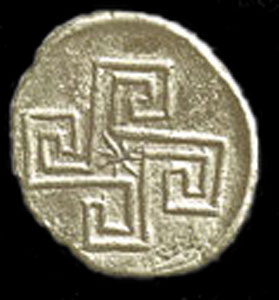
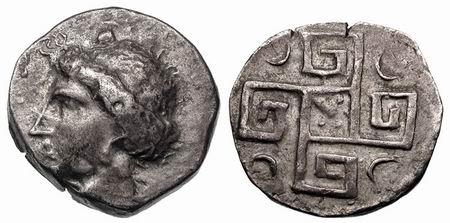
Ancient Cretan coin. (Left) Head of Pasiphae/Ariadne. (Right) Swastika Labyrinth with four crescents between arms, five pellets in center.
I happen to be an initiate Witch of the Minoan Brotherhood, a men’s Mystery Tradition for gay, bisexual and hetero-comfortable-with-their-sexuality-and-willing-to-engage-with-other-men-erotically men. (I know a mouthful. Get it? Mouth.Full.? Never mind). Being a Mystery Tradition, there isn’t much really I can share about the lore, but what I aim to do is to bring in the Dionysian aspect as I study about Dionysus Zagreus more in His role of Asterion, the Sacred Bull God of the ancient Minoans. Anything I share will already have been published in scholarly books, and the rest is pure guesswork and my own careful navigation of what I can share versus what I feel is very, very private. Sub rosa.
Europa taken by the White Bull
Asterion
Asterion (Gk. “Starry One”) was the name of two kings in ancient Crete, the island-nation that was the seat of the Minoan Civilization. Publicly, it is the also the name of the Bull-Horned Son of the Great Goddess Rhea. As my devotion towards Dionysus continues, I’ll be posting my personal thoughts and research on Asterion, and His connection to my beloved Intoxicant. Asterion was my first cult-image connection to the Raving One, and my spiritual path was all the better for it. He became more real, more sublime, and much more powerful than I could have ever known.
(Roman Motif, 1st Century CE) Grapes being torn apart, much as Zagreus was also torn apart by the Titans.
Zagreus
Zagreus is another cult-image of Dionysus from Crete: the Divine Son of the Dread Queen and Zeus (although sources may differ on whether it was Sky Zeus or Hades). Zagreus is also another face of the Divine Son and Mother motif as recorded from Alkmeonis, an early Greek epic that is now lost, with only fragments quoted here and there. Dating from about the sixth century BCE (about the time when Pythagoras was born), a prayer goes:
“To Mistress Earth and Zagreus who art above all the other Gods.”
(~Alkmeonis)
I’ll be exploring these and other Mysteries during the upcoming week. Maybe longer or shorter, depending on the Serpent-Crowned God Himself and what He wants. Either way, this should be of interest. If to no one else then to at least me.
I have of things to think about and to write my thoughts on here. Thank the Gods for blogging and social networking! A lot of times I need some sort of creative outlet to express myself unhindered, even if it can be rather crude. Having a right-brain injury has affected how I used to be and how I am now. So many times the only outlet I have is writing, which is good considering that I’m not usually as crude as I have been in a couple of blog posts. But moving past that…
A few days ago, just before our Temple celebrated the Rite to Hestia, Dionysus came a’knocking and instructed me to begin an intense devotional with him that will last 3 lunar cycles. I have absolutely no idea what is in store, if anything. But I plan on sharing some of my experiences and thoughts throughout this process. I’ve done it before with Hekate, and the gnosis achieved was beyond intense. The subsequent revelations and Visions I received led me to the path I am now, and to the establishment of the Ophic Strix Mysteries.
In any case, I know I can expect one thing: change. Change for my own good, whatever that may entail. As I write about (some of) my experiences and thoughts, I hope to spur others to worship the Gods. Because sometimes, while venting can be an outlet, a lot of arguing accomplishes nothing. Especially if that arguing is not backed up by actually doing any work. I mean, hell, that’s all anyone complains about when it comes to politics! And while I think there is a time and place for debate, there is also a time when we need to center ourselves and commit to the kind of Work we proclaim to do.
I know for myself one of the things which Dionysus has done is take away my craving for meat. I am a proud omnivore, glad to fill my face with steak cuts of any kind! But when He began to impel this kind of Working upon me, I began to notice that I wasn’t craving meat, chicken or seafood. And…I was okay with that. This is very different from when Hekate asked me to go on a temporary fast for Her. She didn’t ease anything at all! Ugh! *blows a kiss to the Bitch’s altar* I love you, Momma! Hehe.
Anyway, off I go. Time for some pruning and shearing. Time for some preparation. Oh, sacred God, let me be intoxicated with Your love!
I hope it can accomplish the task of prompting further community questions and discussions on these topics and more. I welcome dialogue. Dialogue can often lead to impassioned opinions on every side of the opinion aisle, but as long as they are courteous and professional, I see no reason why we can attempt to understand one another, even if we disagree. The majority of this blog was extrapolated from an article I wrote for the Witches’ Voice. You can find the original article here. There have been some additions to this blog post, however, so it will be quite different in many respects.
The Debate
It has become somewhat of a proverb in our modern Pagan Community: just what is Paganism? What makes you a Pagan? I read a lot of blogs and occasionally chime in on Facebook feeds where many people debate just what Paganism means to them. Unfortunately, the fights begin when people start pushing their personal definitions onto others and begin using them as a means of comparing who is “more Pagan” than the other. Pagans who are vegetarian begin to condemn Pagans who are meat-eaters for not being Pagan; Pagans who are polytheist begin attacking Pagans with atheist leanings that they are not Pagan; Pagans who perform daily devotions begin chiding other Pagans who don’t for not being Pagan “enough.”
What has happened is that rather than focusing what unites us and having a real discussion, our human propensity for one-upping emerges and it bleeds into spirituality. Ego battles ensue, and very soon we forget what we were discussing in the first place. Then there are the Reconstructionists who eschew the word Pagan because they think of eclectic New Age White-Lighters with crystals chanting “Om, ” or hippies smoking ganja with a “feel good” outlook on life that are anti-authoritarian. While this is certainly an image of some, it’s not everyone. Nonetheless stereotypes emerge and they are construed as negative imagery. It seems that even amongst our own, we have turned the word “Pagan” into a negative term…something that, ironically, our Christian forebears began doing to their non-Christian neighbors.
(For the record: I am not saying anything is wrong with holding crystals and chanting “Om” or to be a hippie that smokes ganja) .
A blogger had written about how he doesn’t call himself Pagan anymore. When he started studying Druidry, he found that what he was studying wasn’t historically accurate. He then went on to study Celtic Reconstructionism. Unfortunately, he and his group didn’t find a comfortable welcome at Pagan festivals. While he was focused on historical accuracy, many of the Pagan workshops focused more on what he felt were contemporary New Age concepts such as ley lines, auras, and the like. In addition, many Pagans who were familiar with Wicca felt disconnected to the Reconstructionist methods of performing ceremonies. He states that he and his group seemed to find more common ground with practitioners of other belief systems such as Native Americans and Tibetan Buddhists. He is one of many who have dropped the appellation “Pagan” in favor of “Polytheist.” While that is certainly his right, I personally believe that there were some missed opportunities; opportunities which I will explain later.
Definitions
It has been noted in a publication that was a collaboration of scholars (many of whom are practitioners) that many dictionaries seem to be responsible for presenting a non-definition of Paganism (2005, Modern Paganism In World Cultures: Comparative Perspectives). Michael Strmska has done a marvelous job of looking at The Oxford Concise Dictionary of English Etymology, The American Heritage Dictionary, and The Scribner-Bantam English Dictionary for how “Pagan” is defined:
1) “One who is not a Christian, Muslim or Jew, ”
2) “Heathen, ”
3) “Idolator, ”
4) “One who has no religious beliefs, ”
5) From Latin paganus rustic, peasant, from pagus rural, the country, originally landmark fixed in the earth, ”
He rightly concludes that hardly anyone can come away with a positive sense of the term Pagan, and thus we in the Community are having a troubling time defining just who and what we are. Many modern Pagans believe in some of these definitions, and will hastily classify Buddhists, Shintoists, and Native Americans as “Pagans.” Moreover, an implied conclusion is drawn that since Christianity, Judaism, and Islam are popularly seen as Monotheistic faiths, then “Pagan” should apply to only those who are polytheistic. This presents a problem, as it effectively excludes a growing number of Goddess worshipers who venerate solely the Great Mother Goddess, a monotheistic concept in which the Goddess is All That Exists. She is tangible in everything: the earth, the wind, the fire, the sea, the stars, you and I. While this type of monotheism includes a pantheistic blend, it is nonetheless monotheistic.
What I think happens is that terms are thrown around like everyone knows what they mean, but in the midst of arguing and debating they are lost in visual and word associations that have little to do with the ACTUAL definition. For example, if I say “monotheism” many minds will automatically jump to the Father concept of God in Christianity. Your mind may also link to other word and concept associations such as “exclusionary, ” “Bible, ” and “transcendent.” In other words, your mind comes to terms with how many Christians, Jews and Muslims define monotheism, but not necessarily what the word actually means. Monotheism simply means “One Deity.” That’s it. So if you are a Pagan who believes in the Great Mother Goddess, that She is All and All is She to the exclusion of other Deities, then you are monotheistic. This concept is very popular in a growing number of Dianic and Hekatean circles. In my opinion, the transcendent vs. immanence debate is more a matter of epistemology than theology/thealogy.
But we still haven’t answered where “Pagan” comes from or if the definitions above are valid.
Pagan is Pejorative
The problem is that the negative appellation of “pagan” comes from the Roman Christians themselves who applied the term to others who were not part of their faith. Moreover, as Christianity spread and conversion occurred through war and politics, traditional customs and folk practices among the rural populace were called “pagan.” But country folk had no name for their observances, as they were the result of hundreds and perhaps thousands of years of familial custom and traditions. The religious evolution of the word “Pagan” started becoming more evident away from its original definition of “rural dweller” around the fourth century CE with the changing religious tide. Here we have evidence of the progression of the word as it began to change with the times.
This is where many modern Reconstructionists break with those who call themselves Pagan. For Reconstructionists, they are using historical accuracy and scholarly research in an attempt to bring back the original ritual practices, ethos, and philosophies of their ancestors. This means that many modern Wiccan-inspired Pagan ceremonies that involve cast circles, invocation of the Four (or Five) Elements, and celebration of the Oak and Holly King are nowhere near what they do. In addition, because they include ancestral veneration in their praxis, they feel it was an affront to their ancestors to have their faiths demeaned by the Christian rulers with the negative word “Pagan.” Reconstructionism, in a sense, can be seen as an attempt to reclaim and take pride in one’s ancestral lineage, whether that is ethnic Greek practices, Romanian, Russian, Bulgarian, Lithuanian, Scandinavian, Irish, Nordic or Roman; there is a swell of pride in that one is actually reviving the ceremonies and sacred mythos that was suppressed or altered by Christian conquerors. I for one am glad to know that people are reconnecting and reforging relationships with their ancestors and their cultures.
Medieval Paganism
Shortly after the fourth century CE and at the onset of the Middle Ages, many people in various rural areas in southern, western and northern Europe were amalgamating beliefs from Christianity into their folkloric customs and superstitions (a term applied by Church authorities to what many now refer to as folk magic). People readily adapted, and there are numerous examples worldwide of ethnic practices that survived – many times with the approval and participation of the local Christian clergy – as syncretic expressions of people’s faiths (2005, Pagan Survivals, Superstitions and Customs). What happened was that the cultural expressions and traditions continued, albeit changed and altered. Sometimes even new rituals and customs were created to fit with new paradigms. According to the literature of the period, “Pagan” was still pejorative. But what we are glimpsing is the adaptation of traditional customs and the development of new ceremonies in the light of the times.
It didn’t just happen in Europe either. The same thing occurred among native populations in the Middle East, Africa, Central Asia and India under Islamic rule (2012, Paganism in the Middle Ages: Threat and Fascination). From reading the Bible, we can also get a glimpse that similar situations had occurred under the rule of the nation of Israel (and even later when the nation split into Israel and Judah). The native beliefs of the Canaanites, Hittites and Amorites would not be squashed under Jewish rule. They stubbornly clung onto their native traditions, in spite of governmental persecution and ethnic genocide. But evidence is abundant that many practicing Jews also syncretized their faith with that of others. Syncretism is not new, and is a very old practice among humanity. We are always borrowing ideas and norms from other places, because this is what we do. It’s natural behavior. But in this blending of ideas, myths and practices, unique differences were evident depending on the culture, region, town or area you traveled in. This is important to keep in mind, because this format neatly resembles the wide diversity of practices, beliefs and customs found in modern Paganism.
Renaissance Paganism
There is an argument as to whether any Paganism existed during the Renaissance. Keep in mind however that when these arguments are taking place among scholars, they are using the definitions that we had used earlier. The most popular is describing someone who is not a Christian, Jewish or Muslim. The argument goes that the people responsible for reviving Classical Greek and Roman studies (i.e. mythology, imagery, literature, etc.) identified as Christian, and therefore could not be Pagan. Rather some even argue that no one in the Renaissance actually believed in pre-Christian Deities, but rather pretended as if they actually existed (2005, The Pagan Dream of the Renaissance).
But the revival of pre-Christian philosophies, sacred literature and practices cannot be denied. The translation of the Corpus Hermeticum, The Chaldean Oracles, andThe Orphic Hymns served to bring Classical Pagan Neoplatonic thought into a world on the cusp of change. Indeed one of the influences of the Italian Renaissance, Gemistus Pletho (1355 – 1454?) founded a Mystery School in Greece where he taught polytheism and his students prayed to and venerated the Olympian Gods. While modern Reconstructionists may argue if his formats were correct, this is a wonderful example of Pagan thought reviving. Much later the English Platonist Thomas Taylor (1758 – 1835) described himself as a Hellenistic Pagan. Here we have the definition evolving to religious identity.
Modern Paganism
If you remember the definitions of Pagan in the dictionaries, the most common was someone who is not a Christian, Jewish or Muslim. However, without realizing it, during the studies done about the Middle Ages “Pagan” became the appellation attributed to continuations of religious and folk practices that had their roots in the pre-Christian past. During the Renaissance it became applied to people who gathered to study and practice the pre-Christian Hellenistic as well as the syncretic Judeo-Egyptian-Hellenic Hermetic faith in some way. Whether these roots had different offshoots or made way for new expressions, the commonality between them all was that they had come from a period before the political takeover of Christianity.
The continuation and re-discovery of pre-Christian practices, literature and philosophies throughout the Middle Ages, Renaissance and post-Renaissance world opened up new avenues for the fall of political Christianity in Europe, the rise of scientific thinking, the era of the Romantics and Transcendentalists. It also paved for the Occult Revivals – from Italy to England and to the United States – which were all social, political and spiritual grounds that were broken and made possible the 20th century public revival of Paganism beginning with Wicca. Modern Paganism is the newest expression in a long line of movements in which people were desperately trying to break free from a belief system that they did not align with. Many of us use similar practices, philosophies and concepts that were studied during these tumultuous times, no matter what our Group or Tradition is (i.e. ADF, AODA, British Traditional Wicca, British Traditional Witchcraft, Hellenismos, Theodism, Kemetic Orthodoxy, Stregha, Strix Craft, etc.) . Or we have spawned new expressions of celebration that were inspired by these efforts.
Reclaiming the Name
Recall that the Roman Empire had taken over the entirety of Europe, North Africa, and parts of the Near East. As a result in these areas is where we find the term “Pagan” applied to the people and cultures that did not align with Christianity. But as we have also seen, this term evolved from its original meaning of “country dweller” to “non-Christian.” Later the definition expanded to “someone who is not Christian, Jewish or Muslim.” It even meant “idolator” in the sense of someone who honored the Old Gods or were seen as superstitious by the Church. However, I believe the term “Pagan” can continue to evolve in meaning, and we have the opportunity to use it in the present. We have examples in our past of the term being for religious identity.
I mentioned earlier that I believe our blogger missed a valuable opportunity at Pagan festivals (although to be fair to our blogger, it doesn’t seem like the missed opportunity was his fault in the least). Rather than feeling welcome, he and his group felt like outsiders in a place that promoted many teachings and paradigms akin to New Age. I can’t say I blame the blogger for feeling like an outsider. There are many Pagans who argue about the rightness and trueness of casting a circle, calling the Elements, doing Cakes and Ale, and talking about the Moon Goddess and Sun God. Many, but not all, have and will attack a ritual practice they deem at odds with their own ideology. And many, but not all, have very liberal, Leftist and anti-authoritarian leanings. So much so that if a Pagan were to admit they were Republican, conservative and did not believe in Climate Change I predict a fair share of ostracism. The opportunity I believe that may have been missed was education to introduce the Pagan Community to Reconstructionism. It really was unfortunate that he and his group were belittled for “doing things wrong” because he did not follow Wiccan-inspired formats.
Pagan has become synonymous with Wicca, and that is a definite mistake. But another error is that for too long “Pagan” has adopted rudiments of political and activist thought. This is another weakness in our definition, because it is not accurate. For example, you will not find under the definition of Christianity the word “United States Republican , anti-gay, pro-life and pro-war persons who believe in the literalism of the Bible.” There are many Christians who are Leftist and Democrat in the United States, and there are many who do not believe in the literalism of the Bible. Yet, they identify as Christian nonetheless even though the fringe fundamentalists may not accept them as such. And that’s the problem we’re facing: the difference between practice and belief. Liberal Christians (sometimes called progressive Christians) self-identify as Christian because they share similar practices with their more hardline right-wing contemporaries: they share inspiration from the words and teachings of Jesus Christ. While the interpretations might differ between the camps, nonetheless they have a unifying principle between them.
I believe there is a commonality that many of us – whether Reconstructionist, Revivalist, or Eclectic – can share when we designate ourselves “Pagan.” But it will definitely take ongoing dialogue, intellectual discussion, and agreeing to examine ourselves in order to drop unnecessary divisions that cloud our minds rather than free it (e.g. including veganism, peace activism, Goddess monotheism and politically liberal leanings as automatic synonyms of “Pagan”). In other words, we have to be willing to leave our individual beliefs behind and look at what our practices bring together, as well as where they come from. There is nothing wrong with trying to reconstruct our past, but there is also nothing wrong with creating new celebrations; indeed, that has always been a part of human expression!
A vast scope of diversity and yet shared unity can be seen similarly in modern Hinduism. Many scholars view the striking similarities between many Pagan ideals, ideologies, practices, and divisions with Hinduism. Indeed, some go so far as to say we share a common spiritual (and perhaps genetic) ancestry as Indo-Europeans. This may be our shared commonality: the revival or reconstruction of the pre-Christian religious practices, mythologies and philosophies of Europe, North Africa and the Middle East. As I mentioned before, this was the extension of the Roman Empire, and it was in these areas that Classical Pagan thought, philosophy, magico-religious practices, customs and beliefs that were essential as the inspiration behind the modern practices of what we call Paganism. It is also where we find the word “Pagan” used so much. Beneath this Pagan umbrella we can include ethnic polytheist Reconstructionists, American and European witches, Druid Revivalists, and American and European peoples who practice continuations of folkloric survivals, customs and traditions rooted in our pre-Christian past.
Pagan is a term to be reclaimed to fit with the times. We also should not discount the anti-authoritarianism of our hippie predecessors. Their activism is what made possible the public emergence of Pagan practices. It sowed seeds that have blossomed in many corners as people revive links that were thought lost. While certainly we are far from ending our dialogue, I am hoping that our shared commonalities as peoples who are building bridges to our nearly lost spiritual inheritance can at least open up more avenues to explore what our future means for all of us.
Post Script
My Hellenic Temple, the Temple of Hekate: Ordo Sacra Strix, is a polytheist Temple that blends aspects of the Western Mysteries and Classical Hellenic Polytheism. In this case, we tend to approach ritual theology from a different angle than our Neo-Wiccan and Wiccan neighbors. I am a Traditional Wiccan myself, being an initiate of the Minoan Brotherhood. I am also a member of the Order of Bards, Ovates and Druids. I have friends within the various Polytheist, Neo-Pagan, Neo-Wiccan, Trad Wiccan, Recon, and Revivalist camps. I have walked among them, spoken to them, and come to understand where each person is at in their faith and why. Unfortunately for Polytheists, there seems to be a great deal of misunderstanding currently regarding their praxis and the clash they are experiencing with those familiar with Neo-Wiccan ideology. Why? I haven’t the foggiest clue. I don’t know if it’s due to people suspecting practices that are different, or just ego clashes between leaders of the various camps, all of whom are strong-willed people. As a devotee of Dionysus and Hekate, as well as someone who has triumphed over a lot of trauma, I, too, have a very strong-willed and assertive personality which easily clashes with other people. The side-effects of my brain injury don’t help: lack of empathy, asking a million questions, and being difficult with social cues. Nonetheless, I am a firm believer in the wonderful Work of my Gods and the Spirits that we worship and are allied to. This dogmatic belief is very antithetical to what modern Paganism claims to embrace. And so, like other Polytheists, we are finding difficulty in finding some sort of cohesion within the Community. But I’ll blog about that in another upcoming post. For now, we have legacy to think of and Gods to worship.
Strmiska, Michael (2005). Modern Paganism in World Cultures: Comparative Perspectives. In Michael F. Strmiska (Ed.), Modern Paganism In World Cultures: Comparative Perspectives (pp. 4-54). CA: ABC-CLIO, Inc.
Filotas, Bernadette. (2005). Pagan Survivals, Superstitions and Customs.Toronto, Canada: Pontifical Institute of Mediaevel Studies.
Steel, C., Marenbon, J., and Verbeke, W. (Eds.) . (2012). Paganism in the Middle Ages: Threat and Fascination. Belgium: Leuven University Press.
Godwin, Jocelyn. (2005). The Pagan Dream of the Renaissance.NY: Red Wheel/Weiser.
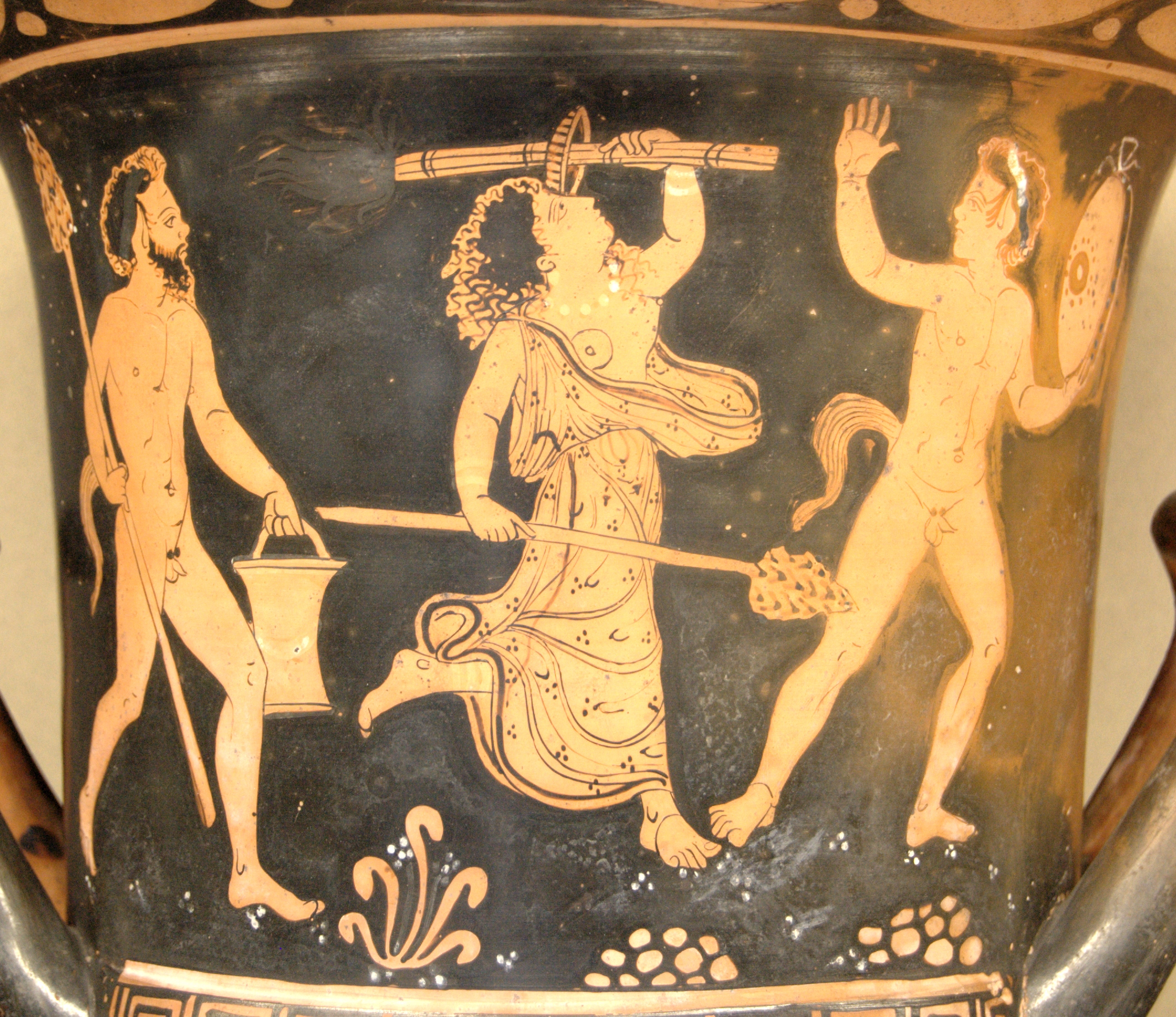
Ancient Greek kylix-krater from Apulia (c. 380 – 370 BCE). Courtesy of Wikipedia.
Polytheism simply means “Many Gods.” The term encompasses the belief and worship of many Gods and spirits, something which was quite common with our ancestors (and with many contemporary indigenous societies). But this belief implies much more than the simple matter of how we view the Divine, because belief is something that is rooted with our emotional center. It is anchored in the central nervous system, thus dictating how we view and interact with the world around us. Polytheism is plurality: the way we appreciate the diversity of color, race, ethnicity, philosophy, and the Gods. People these days try to say “I see no color,” hoping such rhetoric will make them as non-racist as possible. But by not seeing color, we are robbing people of who they are and trying to create a comfortable umbrella – a facade – of what they are not. we are attempting to pigeonhole all of us into a monochrome vision that overlooks our uniqueness, our worth as an individual, and what we mean to the world around us.
Polytheism is a return to seeing the color and luster of each person, and creating a paradigm whereby they are seen for WHO they are, and WHAT they are. We may have things in common, but we are who we are without allowing those similarities overshadowing that our DNA has worked in making sure that no two humans are completely alike. Even twins have some differences, however subtle.
The Gods, in our approach, are beautiful. They are awesome, and They are terrifying. They are beyond our comprehension, and yet even in Their sphere They are limited. I understand that my Gods are NOT omnipotent, NOT omniscient, NOT omnibenevolent, and NOT omnipresent. I also understand that my Gods are NOT the same, but unique and different. How dare I rob Them of who They are?
Hekate is NOT Diana.
Apollo is NOT Lugh.
Epona is NOT Rhiannon.
Cerridwen is NOT Ishtar.
Aphrodite is NOT Inanna.
Zeus is NOT Thor.
Poseidon is NOT Manannan Mac Lir.
But what They are is for each person to experience themselves. And herein is where my approach to ritual is quite different from other peoples.
Ritual is Love
When I was eclectic, ritual was a pain in the gluteus maximus. I had no idea what I was doing or why. Sure, some books tried to tell me about the intricacies of circle casting, calling the quarters, and invoking Deity. Some more “advanced” books tried telling me about the Occult energies that streamed through and why the circle was cast the way it did. But no one told me WHY we did ritual. What was the purpose? “Walk Between the Worlds?” What the fuck did that mean? I’m sure it has merit for someone somewhere to do ritual mechanically like that, and to make sure the altars have every correspondence that you need so we know what Sabbat we’re celebrating and why. Such is what I all the “Neo-Wiccan” approach to ritual, or even “eclectic Pagan.” Although, to be fair, I think everyone is eclectic in some form.
But as I have personally grown and changed in my faith, I have become a polytheist: a believer in the Gods of my own Temple, and those of others. While I might not necessarily serve cultus to other Gods, I have my own that I have fallen in love with (even if They don’t love me back, which I’ll explain in a later blog post). So my rituals are my love letter to my Gods.
Yes, my love letter. Every symbol in the center of my Temple is meant to convey a reminder of Who THEY are, and what I can offer to Them in return for Their awesomeness. I have no shame in my love letters: the perfume of my incense rising, the burning of the offerings which I have painstakingly taken time to create, the ikon on our shrines being just a flirtatious image of the unparalleled beauty which They behold, but can somehow tease something from me: a point of connection between the two of us.
My Gods are alive, They are real, and They are more than I can ever say. In my desperation to feel a glimpse of Their daimon, I will often starve, deprive myself, cry, bleed, sweat, and cry guttural tones of ekstasis. I want to go back to the Time of my Sacred Ancestors, and dance for Them. I want my joy to overflow like intoxicating wine, and I want Them to be pleased with what I have before me for Their unrivaled Glory. The auguries and oracular possessions are Their mercies poured out so I can but taste Their whispers in my ear.
In my love letters, I ain’t stirring, summoning and calling up shit. I am asking, offering, asking, flattering, offering and worshiping. I worship because They are worthy of worship. I have no issue groveling on the ground before Them, because They are mightier than I. They have rulership over spheres I can scarcely imagine. They are my passion and my yearning.




 The Cave of Oracle