Since then I have learned a great deal more in my walk and Work with the Theoi. So I might do an update. In the meantime, I hope these essays help fill people with hope.
Donald Michael Kraig (March 28, 1951 – March 17, 2014)
It’s been a hectic time for me on a personal level since my last blog post. I began new anti-seizure medications that had severe side effects, including intense drowsiness. I found myself sleeping nearly 15 hours per day. Include that with some other personal issues with my sister, my family, and trying to keep a Temple going, and I just did not have the time to be on the blog-o-sphere as much. I did keep up with current events however. This blog post is dedicated to an individual that I just met, barely knew, and yet had a significant impact on me.
Donald made a blog post on February 8, 2013 with a title, “I Want You To Write!” It was just before he was scheduled to attend PantheaCon that year. I made a comment (as I sometimes did on his blog posts), and shortly afterwards I made contact with him. Like many within the NeoPagan Community, I was a fan in my early days, and later a critic, of Llewellyn Publications. I honestly didn’t know where to stand half the time, because when I began to make contacts within Traditional Craft lots of people were seriously against this publication for various grudges and political reasons that went back to the 60s, including the writings of controversial authors and material in the 90s. Situations which I’ll leave out of this blog post.
But I knew one thing: I wanted to write. I had so many thoughts and issues I wanted to address. I began to write a few articles on Witchvox, but it wasn’t steady. I also did not have a lot of time to devote myself to writing. Not until after my car accident. Keeping it short, I’ll say that my correspondence with Don was encouraging. In fact, this blog was born because of his influence. He encouraged me to put my name out there and build an audience. His exhortation, the inspirational seeds he planted within my conscious, soon flowered into what we have here.
Don died recently. I mourned his passing along with other people. His books started me on my serious adventures into the Occult World. But his influence upon me reverberated way more than outside of our personal communications. I made friends with mutual people. I am writing. And this, following below, is my last letter that I would have written Don. Call it closure. Call it a memorial. I may not have known him as well as other people. But the briefest meeting and the subsequent results prove what a great man Donald Michael Kraig truly was. So Don, wherever you are, I hope you’ll read what I have to say below:
“Dear Don,
Thank you very much for your time, your friendship, and your mentorship. I don’t think I had an opportunity to say that. Or I mean, I did several times when you answered all of my questions individually, and again when you steered me in the right direction with submitting a manuscript, or how I would put together my pictures and such. I mean, seriously, you were a great help. But honestly, that’s not all I want to thank you for. You changed my world. Literally. I guess you would personally argue that you didn’t do anything: you wrote the books, and it was up to me to put them into practice. I changed my own world is what you would have said. But no, you did. Don’t take away the praise that you deserve.
By your writing, you also developed a network of fans and students who all soon grew up and became comparable magical practitioners in their own right. People like Tony Mierzwicki. I made mutual friends like Alfred Surenyan. And, more than anything, your spirit was with me the entire time I began to seriously dive into the Occult World. It was a personal dream come true when we began to correspond, and you took my project seriously.
With you gone, so many are mourning. I know I am, and I hardly knew you. But I hope you’re proud of me, because I am writing. I am building an audience. I am putting my name, my beliefs, and what I stand for out in the world. I am taking a risk like other authors. You’re in the Spirit World, and you are still inspiring me. You’re awesome.
My project isn’t done. I will write that book. I will continue to pass on what you have taught me writing is all about – teaching, growing, legacy and building bridges for future generations of writers. Thank you for teaching me the business side of book companies, and for opening me eyes. I’ll never forget what you told me. You said, ‘If you think you can write a better book, than write it!’ I realized then and there I was part of the problem, not the solution. I hope I will always continue to be part of the solution. I hope I bring honor to what you have shown me.
So, I went and reread John Halstead’s blog wherein he discussed Pantheacon’s “Wiccanate Privilege Discussion,” and something caught my attention. Having a TBI, it takes my brain a while to process what I am reading and interpreting that information. So while some will say “Duh,” it’s not for me. Yeah, I don’t get the obvious. Anyway, moving forward…at the bottom of the article, John has a subsection entitled “Polytheistic with a Hyphen.” In the article he referred to Lupus’ discussion of the word polytheism and the nuances which can cause confusion and, thus, conflict when using a word which may mean different things to different people. John encourages people within the Greater Pagan Communities who identify as “polytheists” to perhaps use prefixes which differentiate their particular polytheist thealogy (i.e. devotional, hard, soft, Jungian, etc.). Galina responded to John’s suggestion of the hyphen usage here, and it’s a great write-up. I strongly suggest reading those articles before reading my own thoughts on the entire matter below.
Theos
Let’s start with the basics. Polytheism is rooted in two Greek words:
Polu – “Many”
Theos/Theia – “Divinities.”
But there is much more than just the simple definition given above. Ancient Greek carried with each word an entire cultural milieu that had a specific set of visual associations which pertained to the semiotics of the word. Thus, “theos” came with a shared cultural understanding of a phenomenon. That phenomenon sharply contrasts with our modern Western Christian-infused concept of “God.” For modern people within our Christian-majority environment, “theos” or “God” comes with a specific set of synonyms and adjectives including the notion that the Sacred is separated, or transcendent from, the mundane. Humanity, as part of the mundane sphere, cannot be privy to the sphere wherein lies the Divine Concept but through the sacrificial acknowledgement and belief in the expiation of Jesus. But more than this, “theos” has come to insistently mean “One.”
One God, One Being, One Power, One Force.
And even where the Christian Trinity can be clearly cited as an example of Polytheism, yet the Christian doctrine emphasizes repeatedly that the paradox is that it is “3-in-1.” So, no matter how separated the various Beings are, invariably They are One. The monistic concept of the Trinity has bled into our Pagan/Polytheist outlooks, with evidence around that people simply have trouble abandoning their Christian doctrines in the face of even the apparent contradiction that the Church enforces its believers to adopt. When we say that the world is filled with spirits and a host of Celestial Immortals, those still entrenched in Christian philosophy cry out “No! They are not independent Beings but simply ‘Many-in-One!'” The plurality of polytheism is surrendered for a desired homogenous state that exists only within the utopic minds of its adherents. The works of Joseph Campbell in his “Monomyth” and Frazer’s “Archetypal Sacrificed God” have also served many modern Pagans to give notice to the “Mono” over the “Many.” While the works of both have brought many people a wonderful foundation into modern Paganism, the unfortunate side effect is that people try to find in our practices how the variety of Temples, Cults and Traditions are similar before meriting an agreement of “Hey look! We can have a festival together!” The differences are excluded in favor of false conformity.
A World of Spirits and Beings
To the ancient Greek mind (and, cross-cultural comparatively other pre-Christian cultures both ancient and modern) there existed no word like “religion.” Instead, a concept that comes closest to that word is theon timai “Honors to the Theoi.” The honors given to the Theoi are encapsulated within the ethos in how we live, what we practice, how we serve cultus, and the festivals which we celebrate. In other words, polytheism is not simply about faith, but it is more so directly tied into action and works. Again, our Christian culture has bled its teachings of “By faith and not by works” wherein people have tons of altars and shrines without ever feeding or giving attention to the Deities in question. Statues are mere decorations, and rituals are more concerned with the participants attending and the facilitator’s skill at drama and timing (so as not to interfere with the feasting!) over the specific acts which touched our ancestors with the spirit world. But Polytheism is about honoring the Theoi (or insert pantheon here) with action and works which ripple into our very lives. These actions and works are important because “theos” itself implies a “third objective power.” (L.A. Wilkinson, Socratic Charis: Philosophy Without the Agon). It refers to a specific presence that carries a weight and validity to the people who are within Their sphere.
Otiose
“Otiose” is a word that means “Leisure,” or even “Serving No Practical Purpose.” The word has come to be used in anthropology circles to describe polytheistic faiths such as Hinduism, some sects of Buddhism, and aboriginal tribal beliefs that do espouse a “One” Spirit that created everything or was responsible for creating the host of Beings and Spirits that inhabit a particular Cosmos, but the One itself is Unknowable, Untouchable, and Unconcerned with the world as-is. That’s why He/She created the Spirits in the first place: to run things. Think of a CEO playing golf and away from the company, never visiting or knowing what’s going on even with the daily worker. No, it’s the lead workers, the department managers, the operation supervisors and such within the company’s hierarchy that are concerned with the daily welfare of the corporation and its people. That’s us folks: we humans are the people at the bottom of the Cosmic rung in many ways. My Tradition’s teachings have a “One” as well: an otiose Protogonoi that cannot be touched or fathomed because S/He is everywhere. Yet S/He is unconcerned with anything at all except Hirself, and in the Grand Cosmic Scheme of things that’s all that matters really. So just because we have a “One” concept doesn’t mean we’re monotheistic. No, we’re Polytheistic. We work with the Divine Beings and Spirits that inhabit this world, and our temple’s power rests upon the honors that we bestow upon Them through our ritual actions and works.
Emic vs. Etic
Abundant evidence of polytheistic practices demonstrates that for many in both the ancient and modern world, rituals are tied specifically to a spirit or Divinity. As Jan Bremmer writes, “It is neither practical nor advisable to study the two entities separately.” (J. Bremmer, Ed., The Gods of Ancient Greece: Identities and Transformations). But the problem with modern Polytheism in general is that arguments against Polytheism are coming from those who are outside the Polytheistic scope. They are brandishing themselves “polytheists” without the complex understanding that the word in and of itself entails: the honoring, through ritual action and works, of many individualized and supra-powered Beings. In cultural anthropology, the contrasting view between studying the innards of a paradigm from a person within that culture as opposed to an objective observer who is an alien to that paradigm is known as emic vs. etic, respectively. The problem with etic observers is that they come with a template of biases which cloud what they are attempting to document and understand. They have a limited background that is not rooted within the Polytheist Model. If you want to approach Mythology and the Theoi (or insert pantheon here) via the Jungian School of Thought, you are not a Polytheist. You are a lay psychologist, a Jungian, or perhaps a Pan-Deist. But you are not a Polytheist.
It surprises me that we even need to have this argument of “hyphens” and prefixes. Polytheism is what it is. I reverence the Ancestors, the Heroes, and the Theoi of my Temple. I am a Polytheist. They are independent of me, and ritual is my lifeline to Them. It is also how I feed my spirits, those to whom I am aligned to. I probably could have just come out straightforward and made these statements, thus making the blog shorter. But honestly, I think some backstory was needed; research, if you will. Polytheism is not a term for anyone to use – in my opinion (lest I get angry messages about being too authoritative and…ah fuck it!) ….
Polytheism is NOT a term for ANYONE to use unless they are serving Spirits and Beings which are viewed as independent and volitional Beings in Their own right – NOT figments of the imagination or caricatures of the human psyche.
Go ahead, send the e-mails.
Eirene kai Hugieia!
(Peace and Health!)
~Oracle~
Sources:
Bremmer, J., and Erskine, A. (Eds). (2010). The Gods of Ancient Greece: Identities and Transformations.
Wilkinson, Lisa A. (2013). Socratic Charis: Philosophy Without the Agon.
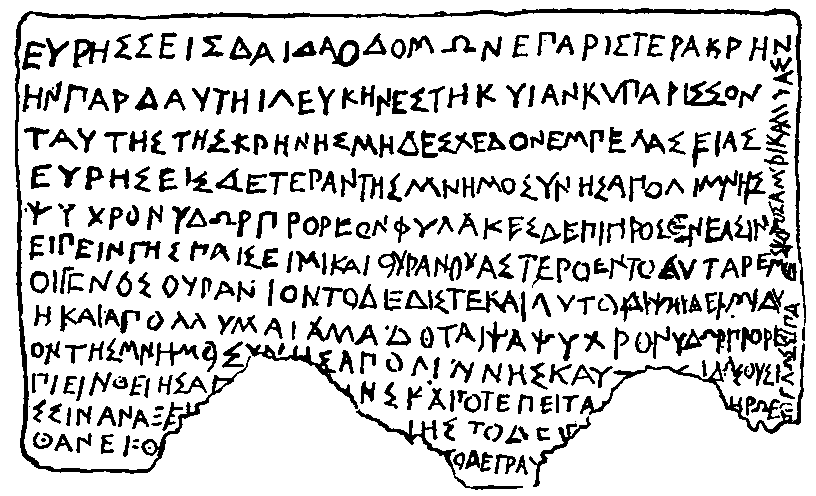
Orphic Tablet from Petelia, Italy (in Harrison, Prolegomena, p. 573)
Something about how my girlfriend said this statement really resonated with me, because it’s so true. I truly believe that the Lore of any Tradition speaks volumes about how an initiate can learn to interact with the Deathless Ones, because these Myths are the stories of our Ways, our People, our Ancestors, our Dances. We can leave the nuances of thealogical discourse for those outside of our Ways, but for the paths which call to us, it is not what we walk away with that matters, but the experiences in that very moment which speak beyond anything we can touch or sense. Because when we walk away, our analysis begins, and ever afterwards we wonder if we are the round hole or the square peg?
When you are called by the Gods of a particular Tradition, you need to know that you are being called to dance a particular rhythm with the Cosmos. You are being called to sing a specific tune, to harmonize with a specific vibration, to play a particular instrument. It’s a gift exchange, this calling: the Ancient Ones want to hear your aria in concert with your fellow chorus, while you are given a skill/talent/gift to in turn become something most excellent!
Yes, the Theoi (or insert your pantheon here) want to hear your serenade, because that’s what your worship is to Them. They are hungry for attention, which can baffle many of us because why should something as awesome and mega-powerful as a God need attention?
Simply put: ask Them.
Gods are not Gods because They are pure or omni-anything. They are Gods because They are Gods. No mystery needed. But in Their Godhood, They are in a symbiotic cycle with us mortals which comes from Laws more ancient than even Them. Call it Ananke, Wyrd, Themis, Ma’at, what-have-you. But at the core of nearly all of our Polytheistic religion expressions is our return to our Dances.
So if you don’t have a living Mythos while you are building something for Them, then write it. Write down your experiences. Write down your Visions. Look to the past at what has survived, and if it’s been broken: then write new ones. Don’t be afraid to create a new Dance for Them, because at some point that’s what the ancients did. You’ll find out what works and what doesn’t as you keep trying. Keep working. Keep dancing. Keep serenading. Because in the end, the living Mythos that is weaved with pen, tongue, instrument, and heart will beat within the Soul of those who come after you. And then we will all look forward to an eternal chorus hearing the music that was born from Love.
The following is based upon a combination of research and personal gnosis.
The Starry Bull of Heaven.
The Sacred Moon-Child of the Moon and Sea.
Half-Bull, Half-Man, All Hero.
He is the Sacred King who sits within the center of the Labyrinth.
The Labyrinth: the spiral dance of the Sun Bull, the House of the Double-Axe, the fylfot womb which nurtured the Beloved Child. He is Taurus, the Starry Bull of the Equinox that marked the New Year. His sacrifice maintained the Law of Themis, the covenant between the Deathless Ones and the mortal realm. His death was the expiation for the world to maintain its harmony. He is simultaneously father and son. He is the light that perpetually shines in the Underworld as He walks the veil above. He is Zagreus: the torn child whose seven separate limbs became the Seven Planets, His heart remaining to birth forth humanity. Order from Chaos.
He is the apotheosis of the Labyrinth mandala – the place to which we all aspire to travel, and come forth back again. I desire for the Bull to eat and ravage me into pieces, for I desire rebirth into His world. I desire to be eaten, to be separated, and to be brought back together within His body. I desire to know the pain of omophagia that I might truly live in wonder, and behold the Starry world which is hidden from all but those courageous enough to walk the darkness of the spiral.
I am His sacrifice. I am His propitiation. I am His expiation. I am His and I am not my own.
I am the sweat of the stars made flesh. I am the incarnation of His form above. I am the spilled semen, the joy of His ejaculate, the ekstasis of His guttural cries, the bliss of His little death (or is He the bliss of mine?). Where does He begin and I end? Where do I end and He begins?
He is my Psychopomp, guiding my soul to reunion with the stars. As the light penetrates the entrance to the cavernous womb in Knossos, might He be its very manifestation, come to awaken us to Truth?
Our traditions may have been broken, but our Visions are renewed.
Our ways may have become historically lost, but our Memory is strong.
Our customs may have become nearly eradicated, but our Spirit is eternal.
Our languages may have become dead, but our Tongue can still speak the Sacred Names.
Polytheism is not just a return to plurality. It is not limited to reconstructionism, revivalism, or solitary devotees of any path. It is a word which encapsulates the responsibility and obligations with which our Elders are returning from their home in the stars to come down in flesh and bring back the worship and cultus of the Old Gods and Heroes. Many years ago as I sat in contemplation, I was granted a Vision by my Queen, Hekate, as She began to open the Gate of Souls and allowed the Souls of Old to come and walk among us again.
Yes, we Europeans, North Africans and Middle Easterners have our own Elders, our own Ways, our own Tribes, Temples, Gods and spirits that we once served. And with the Old Ones crying out for Their sacred fires to be lit once more, we have mistaken many times that the Gods and spirits call whom They will. Perhaps They do…but I’d like to think that They touch the ones who knew Them, who adored Them of Old, and who were teachers, priests, iatromantoi, magoi, strixoi, backkhai and more.
What does this mean for us? For you?
It means that you have the Power of Memory. Memory is palpable, tangible. Memory is your lifeline to the Gods and Spirits. Memory becomes manifest in your rites and cultus. Memory is what you carry deep within the constellation of your soul, proof that you have tasted the Well of Memory. But you thought you would stay among the Stars forever? You thought you would remain in eternal joy with nectar and ambrosia?
No, my friend, my brother, my sister, myself.
You must return. You must come back, because we need you. We need our Elders to teach the young of the world again. We need our stars to be clothed in flesh, to remind us of the Once Ways in which we walked one with our Gods of place and temple. Because our Gods need us, though They exist beyond our own confines or imagination. They exist, yet Their Fates are tied to the world in which we exist. And so it is that as the world needs us, it is our Gods who need us too. We cannot exist one without the Other. This is the Law of Ma’at, of Themis, of the Pax Deorum. This is the Sacred Exchange between the Golden Deathless Ones and the mortal world. This is the sustenance which drives all of our known existence within our purview to continue as we know it.
The Elders are returning. They are becoming reborn and walking among us, forged in the fires of trauma and pain so that They might have the mettle and fortitude to go past their ordeals to rise and fight for the preservation of our Ancient Ways. They are here to remind us of the paths we once knew, of the glades we once worshipped and frolicked, of the spirits whom we once touched.
Last night I performed a midnight devotional to Dionysus. I poured libations to the dead, blessed the wine, and began a sacred dance in my backyard to him. All I had on was a red scarf while I was nude, the wind and the stars witnessing my ode. Oh how I reveled in ekstasis! I danced my love, my worship, crying glossolalia. My body was His, IS His, and as I drank within the sacred precinct of my Temple-Not-Made-With-Hands, I became inexorably possessed:
I began to fall on my hands and knees, raved like a mad bull in heat, bellowed out gutteral ties. I was possessed! Oh yes, my sweet delicious Intoxicant bestowed His mercy and grace to come down and inhabit my body. I won’t go into the rest of the details, as they are extremely private, but an oracle did pour forth as I lay panting after seizing. Here it is, both the Vision and the Voice:
I saw His infant form torn apart, blood splattered with tendons, bones and meat everywhere. His ichor stained the earthen cave; you could smell the iron. When the white-chalk Titans had finished their course, the blast of a thousand million volts came and sizzled the very cavern. Where once lay the mighty, now they had fallen so low. Nothing but post-apocalyptic ash remained, mixing with the ichor of the God babe. It was then that I heard a voice,
“From my suffering, I gave you life. From my blood, I gave you thought. From Myself, came forth You, In all your perfected Glory. Your kind is My kind: mortality, suffering, and death. And so it was My joy to come among you long ago, And bestow the salvation to your suffering – Pleasure. Undeniable pleasure. The grace of wine, The nectar of sex, The ambrosia of freedom, The ointment of laughter, The weapons of peace, The promise of a shared concord with the Immortal Ones. This was my Gift, This was my Joy, To teach you rites to touch the breath of the Mighty Ones. To show you rituals whereby you may engage with the Shining Ones. Indeed, it is within your nature to be violent, to suffer. It is your doom that you share the flesh of the Strugglers. And so it is your doom, too, that within you flows My blood. This is the salvation you seek. This is the purpose you long for. It is not that evil shall be taken away, But that you are given the choice to engage with Pleasure, That with it, your suffering might me eased, And your Memory, your Soul, shall be set free. Set free…”
“Cultivated hemp. Cannabis (some call it Cannabion, some Schoinstrophon, some Asterion) is a plant of much use in this life for the twisting of very strong ropes. It bears leaves like to the Ash, of a bad scent, long stalks, empty, a round seed, which being eaten of much doth quench geniture, but being juiced when green is good for pain of the ears.” (Russo, E.B., MD. Cannabis and Cannabinoids: Pharmacology, Toxicology, and Therapeutic Potential)
“Pausanias continues that above the Argive Heraion flowed the river Asterion, on whose banks grew the asterion plant. The vines and leaves were woven into garlands for the statue of Hera, and the plant was made an offering to Her. Asterion was one of the ancient names for cannabis, according to the first century C.E. Greek physician named Dioscurides.” (Rigoglioso, M. The Cult of Divine Birth in Ancient Greece)
Note: the following blog post in no way reflects the teachings of the Minoan Brotherhood. It is a result of my own independent research into entheogens. NO secret teachings of the Brotherhood are held within this post.
Cannabis Cannabis has been a psychotropic drug, otherwise known as an entheogen, since ancient times. The origin of the plant is thought to have come from Central Asia (Rudgley, R. The Lost Civilizations of the Stone Age). Its use for twine is well-known, but braziers were also discovered as far west as Romania showing evidence that the seeds were burnt for ritual purposes (and I suspect the use of cannabis may have lead to big munchies which nearly killed of the Mammoths, but just my morbid speculation). These discoveries date back to the Neolithic Era. Cannabis, along with opium, were venerated in places like Minoan Crete for their properties as mind-altering substances which opened up the portals to the spirit realm. It’s a well-known fact that many spirit walkers in indigenous societies use entheogens in order to connect with the spirit realm. Central Asia, as the ancient home of cannabis, is also conjectured to be the source of Pythagoras’ teacher Abaris (Kingsley, P. A Story Waiting to Pierce You). It wouldn’t be too much of a leap in logic to suggest that wherever a spirit-walker went, his psychotropic drugs went with them.
Connecting to the Spirits
This fact makes the illegal status of marijuana even more of a travesty, since it is forbidding us from engaging with the Gods in ways our ancestors would have known. Many realms, I believe, remain untapped due to the non-use of this potent drug, and it has also diluted the essential power of the Craft (in my opinion). To be a spirit walker, an iatromantis, a shaman, or what-have-you, is to have an alliance with the realms of the plant and animal spirits. It means to remember the time of the Sacred Ancestors and join in the Sun Dance of the Labyrinth. It means to open ourselves up to the spirits themselves and use their connection as a authentication of our power. Without that connection, a spirit walker is nothing. Although the use of drugs is not necessary, it is also not forbidden. I think the Mysteries, missing this ingredient, are robbed in some way of their true essence. These plants had a meaning that was more than the average street user or the “War on Drugs” politician could ever imagine. They were the lifeline our ancestors relied on for a purpose. Opium was sacred to the Goddess Rhea for a reason. Cannabis was labeled Asterion for a reason.
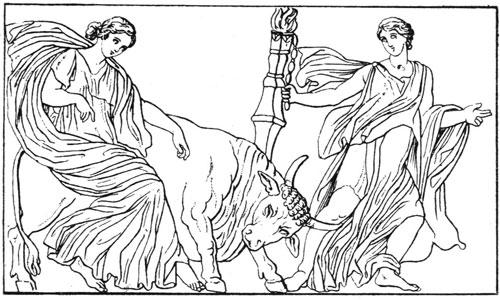
Europa taken by the White Bull
The White Bull and the Western Cow
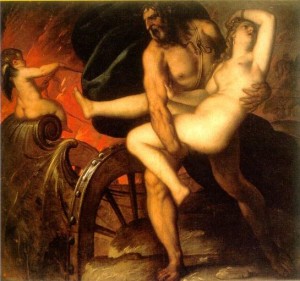
As I wrote in another post, the public name of the God in the Minoan Brotherhood is Asterion. The mythology we have available states that Asterion was the name of two sacred kings in Minoan Crete: the first was a Cretan King who reared the children of Zeus and Europa. Europa was a Phoenician princess (hinting at the cultural relationship between the Minoans and the Phoenicians), kidnapped by Zeus in the form of a white bull. The etymology of Europa means “wide-eyed,” and hints that she was possibly a Cow Goddess. The abduction story of Europa is very similar to the kidnapping of Kore by Hades:
“Zeus saw Europa the daughter of Phoenix gathering flowers in a meadow with some nymphs and fell in love with her. So he came down and changed himself into a bull and breathed from his mouth a crocus.18 In this way he deceived Europa, carried her off and crossed the sea to Crete where he had intercourse with her. Then in this condition he made her live with Asterion the king of the Cretans. There she conceived and bore three sons, Minos, Sarpedon and Rhadamanthys. The tale is in Hesiod and Bacchylides.” (The Catalogues of Women by Hesiod).
All three sons were raised by Asterion, who wed Europa. After their marriage, Zeus transformed the White Bull into the constellation Taurus. Two of the sons, Minos and Rhadamanthys, became Judges of the Underworld. Sarpedon became a long-lived king (some say he died in the Trojan War, and Philostratus mentions that he, too, became Judge in the Underworld with his brothers). This is quite the story, and holds a lot of interest to me because of the early relationship, as I previously pointed out, about the kidnapping of the Maiden to become a Queen of a rich land.
Attic Kylic depicting Pasiphae and Her baby Minotaur
The Star of the Labyrinth
The second Asterion is the Minotaur of the Labyrinth. Asterion was the Son of Poseidon (the Zeus of the Sea) and Pasiphae, daughter of the Sun God, sister of the sorceress Kirke, and wife of Minos (son of Zeus). Pasiphae was considered to be a Goddess in Her own right. Plutarch mentions:
“Now there was a temple and much respected oracle of Pasiphae at Thalamae.” (Plutarch on Sparta, p. 60).
Pasiphae possessed the ability of Witchcraft, which was to say she was a skilled pharmakos. I personally would LOVE to know how she had her husband ejaculate scorpions, millipedes and snakes into women she hated. Talk about some jacked up shit! That makes for a great anime!
Anyway, Pasiphae and Poseidon’s child was at the center of the Labyrinth. For now we’re ignoring the Greek telling, because it was full of political claptrap that made the Athenians look good and the Minoans very evil. Theseus, the hero, was the legendary founder of Athens (and Athenian democracy which subjugated women as chattels and property). What a piece of shit. Ignoring the political veneer, the Minotaur is shown in the Attic Kylix just like the classic Mother-Child motif found with Aset (Isis) and Heru (Horus), Parvarti and Ganesha, and Mary with Jesus.
R.F. Willetts speculates that the Labyrinth design was based on an ancient sun dance (Ancient Crete: From Early Times Until the Roman Occupation). The ancient mimetic dance was probably used to honor the Sun Bull, the Cretan Zeus, who was represented in the person of the Minoan King. The journey into the Labyrinth and from it was probably a rite of Initiation, whereby the person was led by the Priestess (Ariadne, the Spider Weaver who used the scarlet cord to lead them to the center). At the very heart, the initiate became the Man-Bull: the union of Divinity and Mortality.
Reefer Madness!
Cannabis was identified as being called Asterion, the gift of Poseidon. His mother was a pharmakoi Goddess, Pasiphae. The ritual use of cannabis was the catalyst of Enlightenment (or, as I call it, Gnosis). The prototype for Dionysus from Crete, then, is the jewel Cannabis: the Son of the pre-Olympian Poseidon who is the Sacred Bull. That’s right peoples: reefer madness of Dionysus! Pipe it up, inhale, and enjoy the effects. In fact, cannabis enjoys and interesting piece of warning which the United States slapped on it much like the Romans did on the Bacchic revels in 186 BCE:
“Marihuana is that drug – a violent narcotic – an unspeakable scourge – The Real Public Enemy Number 1! It’s first effect is sudden, violent, uncontrollable laughter; then come dangerous hallucinations – space expands – time slows down, almost stands still…fixed ideas come next, conjuring up monstrous extravagances – followed by emotional disturbances, the total inability to direct thoughts, the loss of all power to resist physical emotions…leading finally to acts of shocking violence…ending often in incurable insanity.”
Eirene kai Hugieia!
(Peace and Health!)
~Oracle~
Sources:
Hunter, R. (Ed.)(2008). The Hesiodic Catalogue of Women: Constructions and Reconstructions.
Kingsley, P. (2010). A Story Waiting to Pierce You: Mongolia, Tibet, and the Destiny of the Western World.
Rigoglioso, M. (2009). The Cult of Divine Birth in Ancient Greece.
Rudgely, R. (1999). The Lost Civilizations of the Stone Age.
Russo, E.B., MD. (2002). Cannabis and Cannabinoids: Pharmacology, Toxicology, and Therapeutic Potential.
Talbert, R.J.A. (Transl.) (1988). Plutarch on Sparta.
Willetts, R.F. (1965). Ancient Crete: From Early Times Until the Roman Occupation.
Cave painting from Chauvet Cave, France (c. 30,000 BCE). The Man-Bull and the vagina of the Woman.
The sanctity of the Bull as a symbol for the Sacred Masculine can be found as early as the Paleolithic cave paintings of Lascaux, Livernon and Chauvet in France. During the Bronze Age (4000 – 1700 BCE) the Spring Equinox occurred during the constellation Taurus due to the Precession of the Equinoxes[i]. Currently it occurs in the constellation Aries (the Sacred Ram). During the Age of Taurus the Myths of many cultures personified the life forces as a Bull that needed to be slain so that the Cosmos would continue. As a result, many cultures and religions celebrated their New Year on the Spring Equinox. The New Year would entail the sacrifice of an actual bull, reenacting the First Sacrifice that made the Cosmos possible, as everything that exists was said to be made from parts of the Bull. Cultures and religions that had these mythic motifs included the Persians, the Mesopotamians, the Minoans, Eastern Anatolia (where Phrygia was located), the Indus Valley, the Gaulish Celts, the Canaanites, and the Thracians. Interestingly, the Sacred Bull was also linked to the Goddess Hekate. In the Greek Magical Papyri, a collection of texts with spells and incantations dated from the 2nd century BCE – 5th century CE, Hekate is addressed in the Prayer to Selene as “O Night Bellower, Lover of Solitude, Bull-Faced and Bull-Headed One,” and “Bull-Eyed, Horned, Mother of Gods and Men.”
Dionysus and the Bull
Dionysus was also described as being “bull-horned.” In the Orphic Hymn to the God of the Triennial Feasts[ii], the hymnist writes, “I call upon you, blessed, many-named and frenzied Bacchos, bull-horned Nysian redeemer, god of the wine-press, conceived in fire.” Other hymns go on to say that He is “bull-faced.” Dionysus may have had origins in Crete, where the Sacred Bull was especially venerated. The Sacred Bull was linked to the symbolism of the Moon. A Zoroastrian prayer says that the “Moon is the Seed of the Bull.” Apis, an Egyptian God who is another form of the Sacred Bull, was illustrated with the Moon between his horns. Shiva is linked to the Sacred Bull, and drawings often show him with a Crescent Moon on His brow resembling horns. The Minoan Horns of Consecration sculpted to represent the horns of the Sacred Bull, I believe symbolize the powers of the Moon. The Egyptian God Ptah was said to incarnate as a black bull created by moonbeams. This connection of the Sacred Masculine to the Moon may be rather startling to find since many modern Pagans, familiar with Wicca, have come to symbolize the Moon as a solely female. As we are seeing, the ancient world was not so easily divided.
Horns of Consecration (restored) in Knossos, Crete.
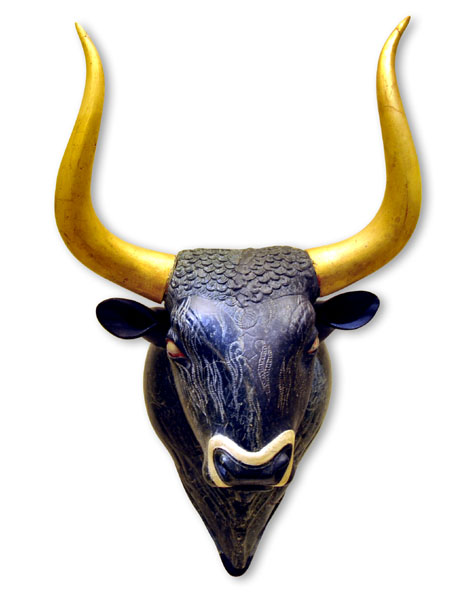
Minoan Sacred Bull
The Sacred Bull was particularly venerated in Crete, where representations of Sacred Bulls can be found everywhere. According to the Orphic Hymns, Dionysus was born in Crete. The name itself, Dionysus, was first found in Mycenaean fragments known as Linear B. The Linear B alphabet predates Greek by several centuries, and was found mostly in the Minoan capital city of Knossos. It is descended from the older Linear A alphabet spoken by the Minoans, and as of this writing remains undeciphered. This language was formed after the language found in Linear A, confirming the Orphic Hymns that Dionysus may have originated from the Minoan Civilization. Or, perhaps an archetypal Deity like this has always existed in various forms in various cultures? What we do know is that in Minoan Crete He was given the name Zagreus, a title for a hunter who captured live animals. As Zagreus, He was identified as the Cretan Zeus. Carl Kerenyi[iii] stated that the title was rooted in Minoan Mythology.
Bakkhoi women leading a bull to the altar.
The Sacrifice of the Bull
Rites depicting the Sacred Bull would always recreate the creation of the Cosmos and humanity by sacrificing a bull. The sacrificial death of the Sacred Bull was seen as a dismemberment of the God Himself. His flesh and blood, eaten by His worshippers, would be viewed as the God investing His very Presence into the bodies of His followers, granting them a portion of His Divinity (known as theophagy, or “God-Eating”). This omophagia (eating raw flesh) would ensure immortality. Such a sacrifice occurred among raucous festivals on the island of Crete every two years. At the height of the ritual when the Bull was killed, a basket would be held aloft showing the survival of the heart[iv]. In Orphic Myth, seven Titans sought to dismember the infant God. In order to escape, Dionysus shape-shifted into various animals, the last being a young Bull. They tore Him into seven pieces (diasparagmos) and ate His flesh. They were killed by Zeus, and the only surviving piece of flesh was His heart.
Cakes and Ale
The reenactment of the sacrifice of the God lives on today in the Cakes and Ale portion of many Pagan rituals, although many usually just see it as the “grounding” portion after performing a ceremony. Between the main part of the ritual and the end when announcements are made, Cakes and Ale are usually handled as a brief “snack break” that is there just because. I wonder how many realize the significance of Cakes and Ale as the modern Pagan continuation of the ancient custom of the Sacrifice? To simply view the Cakes and Ale as a mere “add-on” in ritual removes the importance of the Cakes and Ale from its origins as the very embodiment of the Divine into humanity. In ancient times the animals that were sacrificed were very often shared among the ritual participants. This was viewed as partaking of the essence of the God. This part of the ancient rituals was often the most important, because it symbolized the reciprocity between the Gods and mortals. The sacrifice itself was a gift of thanksgiving to the Gods so that Their essence was fed by hymns, prayers, worship and offerings. In turn, the Gods would bless the worshippers and renew their life force through the medium of the animal that was the God Incarnate. The cakes are the flesh of the God, and the ale is the blood of the God. What we have here is a return to our Classical Pagan roots in the Eucharist symbolism of the Cakes and Ale. In Roman Catholicism, the Eucharist (or Communion) is the belief that the wafer and wine literally become the flesh and blood of Jesus Christ. This is merely a Christian adoption of what once was a Pagan ritual. In the third century CE, beneath St. Peter’s Basilica in the Vatican[v], a fresco of Jesus shows him with symbols from both Apollo and Dionysus. In this syncretic mosaic are written the words:
“I am the True Vine.”
Dionysus
In our Temple, our religious calendar places the New Year celebrations to take place at the Full Moon closest to the Spring Equinox for a public celebration, and a more private celebration typically for Temple members only held during the Spring Equinox itself. The Sacrifice of the Bull is very important, as in so doing we are reweaving the energies throughout the land itself, and we are participating in the First Sacrifice. We are also remembering that it was by Sacrifice that humans were created: from the ashes of the Titans and the blood of Dionysus Zagreus. Thus, by blood and ash we are ever participating within ourselves the suffering of the sacrifice. Our lives are a gift from tragedy, something that a God had endured, but we were the result.
Ritual is Memory: it is reentering the Sacred Dance and Rites given to us by Dionysus. In ritual we touch the very core of our inner being, bringing forward from the past the power we need to engage the present and ensure the continued existence of the future. That’s what sacrifice is all about: legacy. A legacy built on a continuous gift exchange which was first bestowed upon us. And we have that opportunity to always return it to Them.
Thank you, Dionysus.
Eirene kai Hugieia!
(Peace and Health!)
~Oracle~
Footnotes and Sources:
[i] As the Earth revolves and rotates, it also “wobbles” like a spinning top. This wobble causes the constellation that the Spring Equinox occurs in to change. Because there are 12 constellations, it takes 2167 years (1/12) for the Spring Equinox to rise in each constellation. A complete rotation = 1 Platonic Year (26,000 years).
[ii]The Orphic Hymns translated by Apostolos N. Athanassakis.
[iii] Kerenyi, Carl. (1976). Dionysus: Archetypal Image of Indestructible Life. UK: Princeton University Press.
[iv] Albinus, L. (2000). The House of Hades: Studies in Ancient Greek Eschatology. Aarhus, Denmark: Aarhus University Press.
[v] Morford, M.P.O., & Lenardon, R. (1999). Classical Mythology (6th Ed.).NY: Oxford University Press.
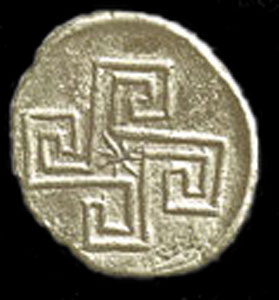
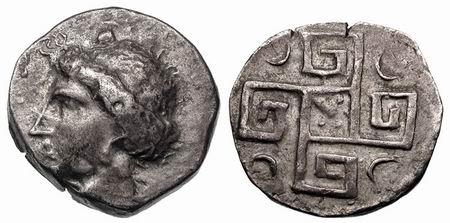
Ancient Cretan coin. (Left) Head of Pasiphae/Ariadne. (Right) Swastika Labyrinth with four crescents between arms, five pellets in center.
I happen to be an initiate Witch of the Minoan Brotherhood, a men’s Mystery Tradition for gay, bisexual and hetero-comfortable-with-their-sexuality-and-willing-to-engage-with-other-men-erotically men. (I know a mouthful. Get it? Mouth.Full.? Never mind). Being a Mystery Tradition, there isn’t much really I can share about the lore, but what I aim to do is to bring in the Dionysian aspect as I study about Dionysus Zagreus more in His role of Asterion, the Sacred Bull God of the ancient Minoans. Anything I share will already have been published in scholarly books, and the rest is pure guesswork and my own careful navigation of what I can share versus what I feel is very, very private. Sub rosa.
Europa taken by the White Bull
Asterion
Asterion (Gk. “Starry One”) was the name of two kings in ancient Crete, the island-nation that was the seat of the Minoan Civilization. Publicly, it is the also the name of the Bull-Horned Son of the Great Goddess Rhea. As my devotion towards Dionysus continues, I’ll be posting my personal thoughts and research on Asterion, and His connection to my beloved Intoxicant. Asterion was my first cult-image connection to the Raving One, and my spiritual path was all the better for it. He became more real, more sublime, and much more powerful than I could have ever known.
(Roman Motif, 1st Century CE) Grapes being torn apart, much as Zagreus was also torn apart by the Titans.
Zagreus
Zagreus is another cult-image of Dionysus from Crete: the Divine Son of the Dread Queen and Zeus (although sources may differ on whether it was Sky Zeus or Hades). Zagreus is also another face of the Divine Son and Mother motif as recorded from Alkmeonis, an early Greek epic that is now lost, with only fragments quoted here and there. Dating from about the sixth century BCE (about the time when Pythagoras was born), a prayer goes:
“To Mistress Earth and Zagreus who art above all the other Gods.”
(~Alkmeonis)
I’ll be exploring these and other Mysteries during the upcoming week. Maybe longer or shorter, depending on the Serpent-Crowned God Himself and what He wants. Either way, this should be of interest. If to no one else then to at least me.



 The Cave of Oracle