If my family got together and spoke to me once a year and walked away thinking I’m all better for it, they better think again. How do your ancestors feel? Samhain/Shadowfest/Feast of the Dead shouldn’t be the only time we commune with our beloved Dead. They have a right to commune with you, to be fed and honored.
Honor your past so that your present has meaning and your future is blessed.
It’s That Time of Year
This time of year is interesting in the NeoPagan world, because many of the people and groups influenced by Traditional Craft and are DIY Wiccans honor their ancestors on Samhain. By the by, DIY Wiccans is now my term of preference rather than “eclectic Pagans” and “NeoWiccans.” Feel free to use it. Anyway, Samhain is an important part of the NeoPagan Wheel of the Year. If you pick up any 101 book, it’s a night of sorrow and joy to feast with the departed. Many will even state that it’s a wonderful night to divine, and mediumship is popular. Black robes, lit candles, and processional chants with shrines hallowed for passed loved ones (including animals) are the highlight of the festivities. Some folks incorporate what’s known as a “Dumb Supper,” a silent meal shared by the community in honor of the beloved dead.
My quote above is not to go against the Wheel of the Year and be disrespectful towards this sacred day or the people who celebrate it. It is special and very important because it connects the community with the realization of Memory. But if the dead are so powerful and existent, why not continue to celebrate them beyond Samhain/Shadowfest/Feast of the Dead? They subsist as you and I do, but in a different reality than what many of us are used to. In this blog I won’t go into hauntings and my personal take on them. I don’t want to lose the focus here, which is that many modern communities, for the most part, have severed themselves from the living well of Memory. To many the dead aren’t as interactive and alive, or if they are they are not fed to maintain their egregore with the family unit.
The Wellspring of Memory
An abundant stream of consciousness that finds its source in the Underworld cauldron of wells and trees, the Wellspring of Memory is the most powerful contact that a people have with their lineage. It is something within our very DNA that births and links generations upon generations with their past, so that they might carry on the continued work of their ancestors. We honor the past by being alive, by overcoming the odds and becoming more than what we are on a daily basis. Each time we grow into self actualization, we are culminating into the peak of what our ancestors have fought and conquered so much for. Memory is a living fabric connected to the strings of Ananke, of Fate: a golden thread which connects all people. But in a family unit, a specific clan within a tribe within a nation, the clan is banded together with their own stories and songs which may be similar or different than the tribe and nation they belong to. And these stories and songs of the ancestors were passed down to succeeding generations at one time. People were proud of their heritage, and some still are. My own family is just discovering our lineage through mementos and photographs. We are informing one another, thanks to my mom who set the whole thing up, about our family histories. Knowing these informs me of my own spiritual practices. Why? Because I believe that blood and bone never die.
The Body of Memory
The immense information held deep within the blood and bones of who we are, the Body of Memory is the vessel that is evidence of the past succeeding into the present. It is the caricature of triumph held within our very flesh. Like I said above, if my family all spoke with me once a year and thought that was okay, they better think again. Many of us hate to be disconnected and feel alone. Loneliness is the requiem of companionship, and humans are nothing if not social creatures. We evolved that way. It’s how we’ve been able to thrive for hundreds of millennia. It’s not enough to know you meet someone and you have similar tastes in music, art, films, drinks, food, etc. It’s not enough to simply have a family or even friends around us, because loneliness is a disassociation of the soul: the soul has forgotten why the connection to the living exists in the first place. It has forgotten the message of Memory, the stream of consciousness connected to Ananke that underlies all of us. There is no clan, no Mythos, no tribe, no rites of passage to pass on the past to the present and give us hope for the future. We have forgotten that our bodies are a living testimony.
The Shrine of Memory
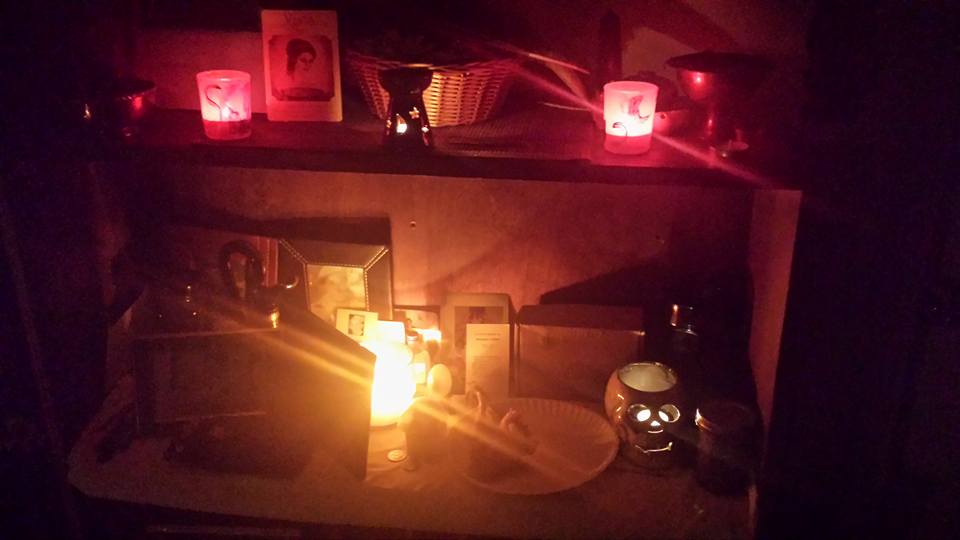
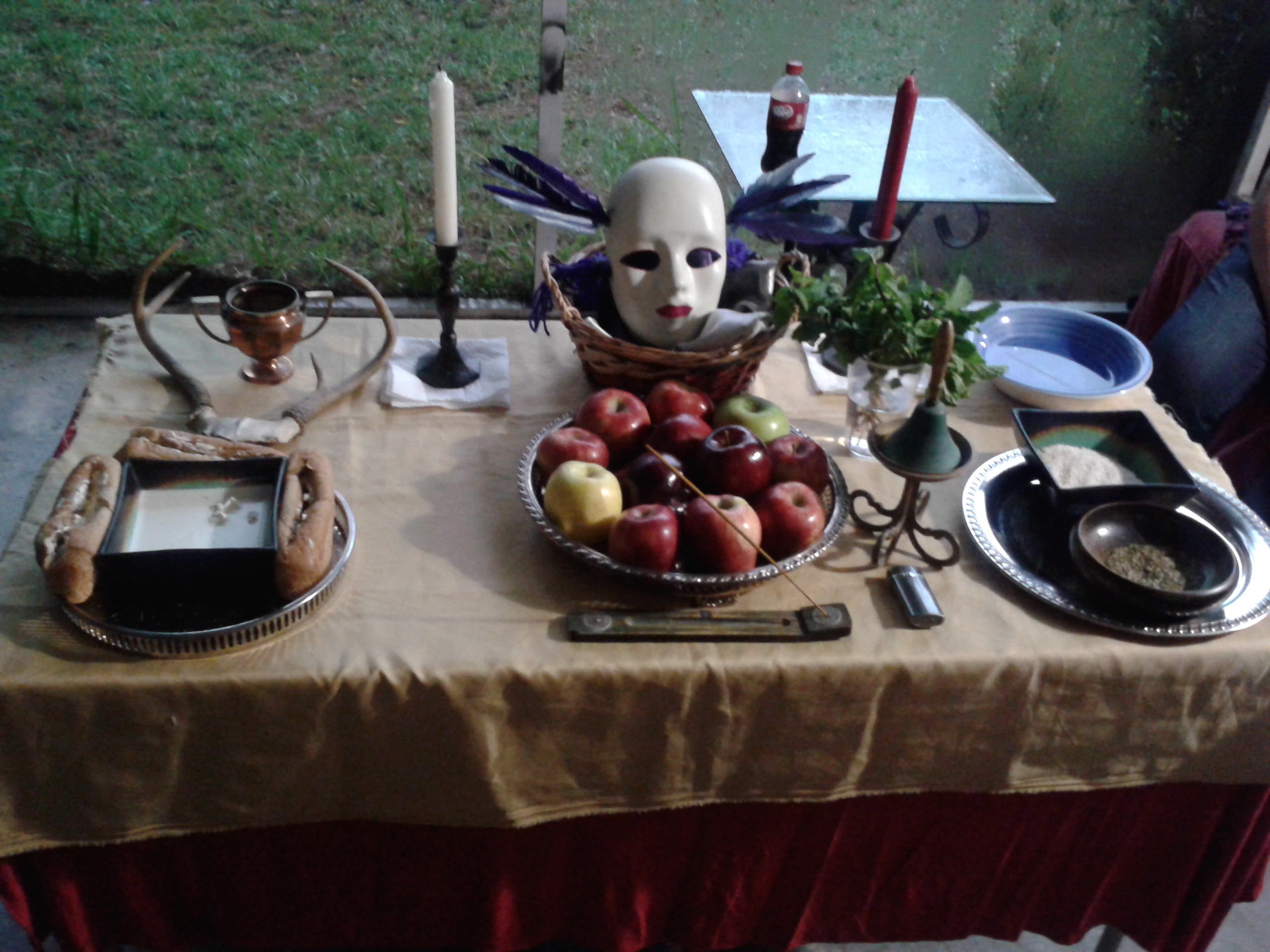
As the living are lonely, so are the dead. They aren’t frightening, just sad. Many folks have a shelf or several in their homes that has photos of the their departed loved ones. They frequently look at them and smile, saying, “Happy birthday dad” or “I miss you brother.” Today lots of folks also have Facebook pages up to memorialize the deceased. This is commendable, because it demonstrates that within our very being we are desiring to acknowledge that our bodies are the central whirlpools of energy within the stream of Memory: in other words, we are desperate to remember and keep something alive within us. The only way to be truly alive is to maintain the shrine of Memory. A shrine is a shelf or flat surface that acts as a house. This “house” has photographs and mementos of the beloved dead. Candles may be lit and offering bowls may be present. This shrine is the external manifestation of the internal stream. This is the central point that our inner energies are connected to. The building and maintaining of a shrine to the dead is not only ancient, but it is where we actually weave the strings of Memory and Ananke to tie us always to the spirits. We establish the foundation for an egregore. After that, it is up to us to continue to remember the dead not just by being alive, but by helping them to not be lonely. We need to acknowledge them all of the time. We need to feed them, care for them, and speak with them. They are desperate to speak and help us. Many, myself included, are learning or have learned to ask them for assistance rather than a Deity because the ancestors are closer to us. In my temple, we honor the dead before we call on the Gods, because it was our ancestors who taught us the stories of the people. They revealed the spirits and Gods. They contacted the Old Ones and shared these so that we might be able to have an identity and be a part of something greater than ourselves: to bring honor to them. Honoring ourselves is honoring them.
I wrote a little bit about karma here. I touched on it briefly while attempting to communicate what I believe, based on the given research I had studied and continue to study, about the 3fold law. I have not backtracked from my commentary on the 3fold law in any way. However, karma is a different thing altogether, and here you will read that I have had to amend some things.
Late last year I began to study karma as it pertained to various sects of Buddhism and Sanatana Dharma (what many Westerners erroneously refer to as Hinduism). The sources are located at the end of this article, but I started with “The Vedic Origins of Karma” by H. W. Tull. Afterwards anything on Vedic Hinduism and from thence Buddhism drew my attention. What I came to realize (and am continuing to do so) is that there is an attempt at taking a borrowed word from a different religious mindframe and plug it into the English vernacular so it can be a justified term to skeptics. “Oh but karma is scientific and real: it just means action.” I’m guilty of this mistake.
Karma is moral causation. The actions and intents of those activities are at a precise level of propriety that dictates not only do our deeds affect others (which I still cling to: see the link above for the part on the “ripple effect”), but suddenly there is a morality clause. If I go out of my way to give some money to a homeless man, then that principled behavior ricochets good unto me, either in this life or the one to come. It is not enough to be kind, but the kindness itself has divine currency stamped onto it to ensure my virtuous account has positive transactions. Looking back over my life and examining it more thoroughly, however, here is my current thesis:
It’s bullshit.
I don’t believe in karmic cycles because, honestly, the philosophy (in whatever school of thought) deals with the consequences of one’s actions which are rooted in both intent and behavior. But is it that simple? Does good make good and bad make bad? What if a person who has good intentions sets out to do a good deed, but it’s met with disastrous results? Or a person who has bad intentions and sets out to commit a societal wrong yet due to variables becomes successful in their venture at the expense of another? In my opinion, the underlying variables which are responsible for defining just what karma does and how it works cause the entire notion to be moot.
I know many folks who have attempted to redefine the word “karma” and make it part of Newton’s Third Law which is always summed up simply as:
For every action there is an equal and opposite reaction.
I have a brain injury but I’m ready to give myself another one when righteousness – not ethics – is trying to infiltrate science. That’s the same kind of nonsensical trappings which the Religious Right are attempting – and rather successfully in some parts of the States I might add – to subvert science curriculums by having intelligent design added. It’s rubbish.
Karma has little to do with questions of right and wrong and causality in the human experience, and it certainly has no equivalency to Newton’s Third Law. The mechanics of pushing a chair won’t determine you will become rewarded with winning the lottery. My coined phrase of “slingshot morality” is a form of narcissism in which our egocentrism demands to be given attention by the cosmos. In a universe where billions of planets and stars are being extinguished every hour (some perhaps with life on them) it makes no sense in the grand scheme of things. Barring factors which may influence our full capacity to execute behavior and personal ethical comprehension such as culture, mental illness, etc., the one fact remains that we are truly indeed responsible for ourselves. But we must keep in mind that bad things do happen to good people and vice versa.
The link above directs you to an article where I have used the imagery of a pond with ripples in an attempt to communicate the poetic essence of the number 3 in the 3fold law. If you have not yet done so, I encourage you to look back on that post first before continuing so you have a better grasp of where I am going.
Or just keep reading. That’s fine too.
The ripples magnify, but they also thin as they spread out further away from the source. So while my behaviors may have a more immediate impact on those close to me, it will begin having a negligible effect beyond my immediate circle. Which makes sense.
And then there are the unfortunate times when our personal choices are taken away from us: H.H. Holmes made decisions for dozens of women who wanted nothing better than to improve their lives. (Yes I am using serial killers and will be using third world countries as example: let’s keep it real). Those women did not deserve their suffering. Neither did the victims of John Wayne Gacy, Ed Gein, Jeffrey Dahmer, Ted Bundy, Hitler or Stalin. Rwandan women and children hacked alive have nothing to do with karma or the moral and ethical necessity of bringing their killers to justice. And no one deserves to lose their pensions or jobs because of corpotate greed at the top.
The natural world and karma are antithetical. It is not the karma of the deer to be kind to the wolf so that it can be spared. A wolf is a wolf and they make no apologies for their behavior. Our own actions are better predicated on the fact that we are evolved social primates with a larger stake within our smaller communities. It’s natural human behavior, and we should start calling it what it is, rather than falsely extrapolating a word to become a synonym in our vernacular and lose the attachments which originally and continue to define this word in a specific context for millions of people. This as opposed to some invisible thread that ties our decisions to have a cup of coffee on the morning after having a raunchy Dionysian orgy with a sex worker and worried that this will impact whether we get a Bentley or not. (And, for the record, that sounds like a good morning). Quantum interconnectedness is one thing (wyrd, ananke, etc), but moral absolutism in there is not gospel.
Supporters of karmic doctrine attempt to say that we have past lives that affect us, or that we all have lessons to learn. Really? Because I have enough problems in this life to concern myself about. The past is the past. It’s gone. Attempting to find the source for my love of chocolate from 5 lives ago as a Spanish monarch is ludicrous. Why can’t I just love chocolate? Why can’t I just have problems and learn to deal with them? That’s taking responsibility for my behavior through and through. For example, what lessons did Nepal and the people who live there need to learn? What past life sins did they commit? Has not that area and the people suffered enough under totalitarian regimes, poverty, famine, disease, war, and human trafficking.
I often wonder if karma – as defined by New Agers and other Westerners – is still a remnant of Christian ideology for a reward system based on behavior, like we desperately need for people to see us and pat our head to reassure us. Oy.
Eirene kai Hugieia!
(Peace and Health!)
~Oracle~
Sources:
Tull, H.W. (1989). The Vedic Origins of Karma: Cosmos as Man in Ancient Indian Myth and Ritual.
Egge, J. (2013). Religious Giving and the Invention of Karma in Theravada Buddhism.
Richman, P.H. (2010). Karma and the Rise of Buddhism in the West.
Doniger, W. (1980). Karma and Rebirth in Classical Indian Traditions.
She awoke, alone and unsure, in the vast void which cloaked Hir flesh. The Night Mother yawned within the gaping void and began singing a mournful song of loneliness and abandonment. And it is why to this day the people feel pain when in the dark and alone within.
She traveled until at last She could no further and came to the very edge of the Cosmos. Watching the mirror of pristine wonder, She suddenly saw Hirself in all of Her glory! Straightaway She was taken with craving and began to masturbate in pleasure at the fullness of what She was seeing. This was the First Gnosis and First Desire. At the burst of Hir orgasm emerged the billions of stars and rocks which swirled about the body of the Mother. Hir momentary brush with Death (the First Death) in orgasm gave birth to Eros and Thanatos: the sacred twins of the First Mother, the genesis of linked souls: male, female and neither.
At once the potential of life had burst forth from joy and pleasure, sex unhinged. And it is why to this day the people experience transcendent ecstasy when reaching orgasm: the twins meet again. In lust She craved to know Hirself once more, and immediately metamorphosed and surrendered Hir nature to the impulses of yearning love. It is why to this day when people feel the stirrings of painful love and longing, often their nature is surrendered to obtain that which they desperately desire.
Thus the suns, gravity, light, speed, sounds, music, sacred harmony and planets with life were made. Life forms evolved; the dance of Eros and Thanatos for survival within the peoples brought joy, suffering, hope, healing and pain. Grief, anger, and other spirits were made.
All this is so the Great Night Mother would know Hirself. She desires nothing more. And when that time comes for our own world when She is satisfied, She will retake the body of the Earth Mother and all Her siblings, and they will return to the bosom of Nyx, where all souls become part of a Greater Cycle still to come, and the threads of Ananke never tear us apart.
“In the shadowed den I wandered,
searching, seeking, ever I pondered.
Her beauty veiled in Starry Night,
Hallowed Shadows dance in the Light.
Bounteous Mother, Ebony Queen,
Flowing with Grace, Thy face Unseen.
Honorable Nyx, from Thy Throne Above,
Dost Thou lavish Wisdom, Faith and Love.
From the World Below, Fire gives birth,
Virtue flows, healing the earth.”
In Darkness is where Wisdom and Knowledge can be found. In the things we choose to ignore and not give any attention to – those are the very things that we should face and find the answers we always search for. We cannot runaway from the inevitable. Hekate teaches us to face the Dark and, not to confront it, but to embrace it. To unite and become integrated with our shadows, our fears, and ourselves.
In ancient times, Nyx was not only the personification of Night. She has a wealth of importance in the Witchcraft Traditions that are influenced by the Samothrakian and Orphic Mysteries. She is the First Mother, the Hermaphroditic Demiurge that masturbates to bring about the origins of the macrocosm. She is also the First Oracle, pronouncing Her utterances from Her Cave that exists at the very edge of the Kosmos. She is heavily linked to Underworld Deities such as Hekate and Persephone. But what does this mean? It means She is there to teach us to dance to the rhythms of the universe as it whirls, that She is there to teach us that things in the background are ever-present. We transcend from Hekate teaching us to embrace the Darkness, to Nyx teaching us to live without fear and understand that the Darkness itself is Divine. Every part of us is Divine, and everything that we face, no matter how difficult and fearful, is something we must endure. Here is the pronouncement of the Nyx Oracle:
“I am the First Mother, the Dreamer whose Dreams weave the fabric of the Kosmos.
Raise your eyes and look into the Stars; My Body, My Being, is always Watching.
Out of Love I bore you, and out of Love I watch and embrace all that you are.
Raise your eyes and look into the Stars; I embrace you, hold you, always Watching.
I hold all things in Harmony, for Themis is my Daughter.
Raise your eyes and look into the Stars; they are my Light reflecting back to you.
In the Darkness Hope shines, patiently, from life unto life.
Raise your eyes and look into the Stars; Harmony and Balance burn and decay – to which shall you hold onto?
I am the Constant Void, the Eternal Dance, the Whirling Mother.
I am the Night that Breathes, and you, My Children, are My faces that shine from My dreams.”
People have often wondered what exactly my temple teaches. Our temple, the Temple of Hekate: Ordo Sacra Strix (Sacred Order of the Owl), is the only existing temple thus far of the Ophic Strix Tradition. In Traditional Initiatory Wicca, the word “Tradition” when pertaining to a specific lineage or group, is only used if that branch survives at least 3 generations. For example, if High Priestess Willowroot founds a coven and it is called “Coven of the Sacred Flame,” and her coven begins to combine aspects of Celtic Reconstructionism with their mother Tradition of Gardnerian Witchcraft, then this is something new. From there, if a daughter coven hives off, and then another hives off from theirs, it can be said by those members that “Coven of the Sacred Flame” is a candidate for a new lineage or even Tradition in its own right. The oral customs and values passed on have a different meaning than the core of Gardnerian Witchcraft. This doesn’t make it greater or worse, it simply is. That is how Traditions work: they evolve and aren’t stiff and stagnant, contrary to popular belief. A NeoWiccan group composed of Intrapersonal Students who weave together a coherent system that works and branches 3 more covens successfully can also use the word “Tradition” in this way.
Our temple uses the term in a slightly different way, since we have only one existing sanctuary. I will add that our temple is not in any way affiliated with Traditional Wicca or Hellenismos. We are an independent entity in our own right. Our students have studied Greek lore and history in-depth, along with Hellenic Reconstructionism. We have also researched the various Mystery Traditions and oracular practices of the ancient Hellenes: Pythagorean, Apollonian, Dionysian, Orphic, Eleusinian, Samothrakian, the neckromanteions, Delphic Oracle, etc. Included in our explorations are ancient Greek folklore, folk magic, goetia, sibyls, ancestral veneration, healers, philosopher prophets, Thessalian strixoi, and the powerful female figures of Myth. But, our emphasis lies not in Classical Athens but in the customs and observances of Southern Italy, Sicily, the Near East and Anatolia (modern day Turkey). While academic in nature, much of our praxis is a careful harmonious dance between these and our own personal experiences. We carefully record and converse on these as a group to discuss whether these encounters are relevant or not (as classical Occultists once taught: approach it like science). By doing so, we have successfully arrived at a pragmatic spiritual juncture where we honor our flesh and spirit ancestors, and we tap into an Occult current known as the Ogdoadic Tradition. The Ogdoadic Tradition is the other half of the Western Mysteries, with roots in the Mediterranean, the Near East, Arabic mysticism, the Italian Renaissance, and from thence to Greece as well as north to England via Spain. The rituals and stories reflect these influences. Our temple found this a perfect complementary fit for the folkish magical practices (thaumaturgy), the lore of the Evil Eye (Gk. “Kako Mati”) and bewitchment (Gk. “Vaskania”).
We are a living Tradition, a child of the Ogdoadic and Hellenic occult currents. We adhere to the philosophies of the pre-Socratics, along with the Underworld, Dionysian and Orphic Mysteries. We practice ancestral veneration and nekromancy traced from the Nekromanteion in Baia, Italy. We dance beneath the full moon pasted in white with our tribal symbols, calling inward the frenzied possessions of Dionysus and the various spirits conjured. We keep the Greater and Minor Festivals to pray, give honor, and worship our Gods and spirits, who keep our system alive. We participate in the 3 Hearth Feasts of the Deipnon, Noumenia and Agathos Daimon. We are the children of Hekate, the cattle of the Raving One, and the progeny of our temple’s pantheon of Gods and spirits. Spirit alliances and contracts are seriously taken, as are initiations. Our ways are both written and oral, and we have an extensive Mythos that pertains to us and us alone.
Thusly in our own right we are a Tradition. Nyx is the Mother of All, the androgyne Star Goddess. Her firstborn are the sacred twins of Eros and Thanatos, Desire and Death. They were born in sexual embrace, becoming the First Order of the Cosmos, which is the very flesh of Nyx. Evolution is the great love story of Nyx as She attempts to reach Attainment within Hirself by continuously evolving, changing, bringing chaos and order within Hirself. We exist, and one day we will collectively return to the flesh of Nyx, our atoms and dispersed, our energies taking root elsewhere. Our hope lies in the life we fully live here and now. We are the people of the Serpent and the Owl. We are Strixoi, and we praise the Gods!
I hate being on a hiatus, especially due to unpredictable circumstances such as my health. Since my last post nearly 7 months ago, I have battled my way through increased seizures, anxiety, depression, and bipolar mood swings. Thanks to new medications, however, at the very least I am able to sleep somewhat and have some kind of routine. I have Asperger’s, the behavioral characteristics being exacerbated by the brain injury. Over the past several months so much has occurred that I might as well inform you of what and how.
I began a fundraiser so I could collect my necessary medical records and send them to my lawyers for my disability case. My disability case was on February 5th, 1 day after my birthday. Nearly every medical record was in but I started seeing a psychiatrist beginning on December 31st, 2014. My lawyers needed those records and anything up-to-date. They asked me if I was ever Baker Acted and I replied no (although I came very close a couple of times). The reason I wasn’t was due to my partners being scared that such a drastic action would have made things worse on me: due to my injury and mood I would have become more combative, and perhaps they would restrain me, and then it might lead to increased anxiety and fright: the stress of it leading to a seizure. A vicious cycle to be sure. No one is positive on how the inpatient care works, so they thought better cautious than sorry for me. After the hearing case, my lawyer informed me it would go 50/50: my youth was a critical factor for denial. In spite of my disabilities, I could possibly be denied because I am young. What the fuck? But okay.
Months past, and I wanted to get better. I was happy. I was looking forward to positive results, because how could they deny me? The records and my recorded speech were enough I thought. Looking at my evaluations from just after my car accident in August 2012 until the present, my results would surely demonstrate how, after 2 1/2 years my mental and emotional conditions had not drastically improved, even with medications. My seizures still had increased and I began to be prescribed psych medications for bipolar mood swings. And then in late March I received the results: I was denied. I was denied for the dumbest reasons.
1. If I could be around 5 people, I can be in a quiet environment and work. Problem? I can invite people to my house (which I said), which means I control my environment and how many I can tolerate. 5 is the most, and no more than 8, for ritual. After ritual is over and everyone is chatting I usually sit alone with my phone to concentrate because it can be overwhelming. My partners entertain everyone. I have even stepped back from leading rituals, allowing my temple to take over and be empowered. They are doing me proud as I prepare to follow another path.
2. I can do a quiet job like a parking attendant. Oh sure, especially because I can’t medically and legally drive due to new seizure medications and vertigo.
3. I am on medication, which means I am improving. Because, you, know, everyone on medication means they’re functional and normal.
4. My partner who has been with me for 16 years was given a questionnaire on what he saw and how much I had changed. The result? The judge dismissed his testimony because, well, he had no medical experience and he was being biased. What a fuckwit.
5. Finally, my age. Although people above the age of 50 years old with the same disabilities would be awarded, my youth means I have time to get a job.
Sigh. Seriously? So this is what I have been dealing with. Now it’s time for the appeal process to begin. And now that you know what has been going on with me mundanely, I’ll shortly inform you of the spiritual side.
Facts are stubborn things; and whatever may be our wishes, our inclinations, or the dictates of our passion, they cannot alter the state of facts and evidence.
-John Adams, 1770
President John Adams was correct: facts are stubborn things. Of course his quote is extracted from the speech that he gave while defending the British soldiers that shot people during what Americans now tout as the “Boston Massacre.” But let’s leave that bit of American History for another forum, shall we? What concerns me here is the legitimacy of what President Adams spoke, and how this statement continues to be true even today. One of the arenas I frequently encounter this issue of facts vs. wishes is on many NeoPagan and Witchcraft forums. Whether it is the origins of Traditional Wicca (another blog post) or the someone’s “grandmother” stories about being trained in Irish Witchcraft called Witta, many times I find that people eschew critical thinking skills in favor of some fantastical idea about their romantic notion of Witchcraft. Why lack of critical thinking skills seems to be rampant in the modern Pagan Community is beyond my thinking, because these same people by and large will turn around and attack Christians and Political Conservatives for being “sheeple.” They’ll accuse them of following pastors and evangelists blindly. They’ll howl and rave about how the “Christians stole our holidays” and other such nonsense. In short, they’ll point a finger at everybody, but forget that while they are doing that three fingers are pointing back at them. Nowhere is this hypocritical cognitive dissonance and lack of respect about their faith more evident than when it comes to the nature of the Gods and Goddesses of our ancestors.
Robert Graves
In 1948, a former Oxford English and Literature professor by the name of Robert von Ranke Graves published The White Goddess (formerly titled The Roebuck in the Thicket). The third son of Irish poet and Gaelic scholar Alfred Perceval Graves, Robert had quite an upbringing in a scholastic-oriented family. An educated man, Graves also had quite the passion for poetry and story-telling, as exemplified in his books such as I, Claudius, King Jesus, and The Penny Fiddle: Poems for Children to name a few among the dozens of works and collaborations in his name. Graves’ works on Mythology were also essential in the revival of modern Wicca and Paganism, laying the groundwork for much of the schema many groups today still have. One of the best known works, of course, is The White Goddess. Perhaps no other poetic interpretation of Myth has had such a substantial impact on modern Wiccan and Pagan thealogy as this one. While writing some works on Greek Myth, Graves was instantly seized with inspiration and worship of what he called his Muse. Professor Hazel Hunley from the University of Omaha in her studies of Graves writes:
Ironically, Graves’ research as a novelist led him to his poetic truth and the White Goddess or Mother-Muse…On retracing the journey of Jason and Argonauts, he noted that Goddess worship was prevalent throughout the ancient Mediterranean world in many cults. The Goddess was already familiar, at least, intellectually to Graves, the classical scholar, from the Homeric epics, Sir James Frazer’s The Golden Bough, Apuleius’ The Golden Ass, and the anthropological findings of Jane Harrison and J.J. Bachofen.
Professor Hunley continues that while charting Jason’s journey, Graves had a sudden epiphany to read the Welsh tale of The Battle of the Trees. This epiphany is what fueled his comparative Mythos studies, finding a bizarre underlying unity evident only to him between Insular Celtic and Greek Myths. This quite unorthodox pairing was explained by Graves as him simply paying homage as a true poet to his Muse Goddess, whom he believed in objectively. As a poet, Graves felt he was qualified to recount the connections since the poet was the receiver of the Mysteries. No matter where he looked, Graves inevitably wrote feverishly that, buried within the Myths he studied and wrote, lay the matriarchal White Goddess to whom a passionate love affair should be kindled by Her devoted poets: seers of Her choosing. This is important to take into account, that while Graves was indeed a scholar in his own right, he was also at heart a poet who took lavish license with his writings. They were never meant to be taken scholastically.
The Modern Triple Goddess
One of the most iconic forms that Graves gave to the modern world was the revivification of the Triple Goddess caricature. In his works, Graves outlines the Triple Goddess forms as:
Graves’ poetic correspondences to the Triple Goddess include “the birth, life, death and resurrection of the God of thee Waxing Year; the central chapters concern the God’s losing battle with the God of the Waning Year for love of the capricious and all-powerful Threefold Goddess, their mother, bride and layer-out.” He continues:
As Goddess of the Underworld she was concerned with Birth, Procreation and Death. As Goddess of the Earth she was concerned with the three season of Spring, Summer and Winter: she animated trees and plants and ruled all living creatures. As Goddess of the Sky she was the Moon, in her three phases of New Moon, Full Moon, and Waning Moon. […] As the New Moon or Spring she was a girl; as the Full Moon or Summer she was woman; as the Old Moon or Winter she was hag.
This Mythos, or poetic interpretation rather of Mythos, can be found readily in any book you pick up on these days. His schema of the Sacrificed King devoted to the beloved Triple Goddess of Maiden/Mother/Crone is found in many of his works including King Jesus. Graves cites sources for evidence of the Triple Goddess in antiquity, but unfortunately his citations and subsequent interpretations are two very different things. This is something that many today do not take into account.
The Parcae
The Ancient Triple Goddess
I wrote in another blog post that among Indo-Europeans, “3” was a sacred number. In many Indo-European cultures such as India, Greece, Rome, the Arabian Middle East and Ireland, the motif of Triple Gods and Goddesses can readily be found. For example, we have the Goddess Brighid who is the Triple Goddess of the Smiths, the Bards and the Healers. Greece had the Three Sons of Kronos, the Three Consorts of Poseidon, the Three-Headed Kerberos, and the Three Muses. More examples can be given but I think you get the idea. The presence of the number 3 in the various Mythologies of our ancestors is very prevalent. But the evidence for the Triple Goddess does not automatically mean that the theme of the Maiden/Mother/Crone (from here on shortened to MMC) is applicable. A famous modern example that is given for the MMC in ancient times is that of the Three Fates: Klotho, Lakhesis, amd Atropos. While not specifically named as MMC, respectively, nonetheless some descriptions are pulled to assert that the Three Fates embody an ancient concept of the MMC. It is believed that because Klotho rules over birth, Lakhesis over life, and Atropos over death, that these are a perfect embodiment of the MMC caricature. Nothing, however, could be further from the truth. The ancient world was much more complex than we care to admit, and it is perhaps our Linnaeun efforts at over-analyzing and attempting to neatly create a Holy Trinity of Pagandom that perhaps is the reason for the modern Pagan Community’s stubbornness. In essence, I guess we also want a very neat “Father/Son/Holy Spirit” equivalent.
The Three Fates, or Moirae, weren’t always three in number. We have to keep into account that there was never such a thing as a pan-Hellenic Mythos. Ever. Mythologies differed from cultus to cultus and region to region. This may be a shock to many who have studied Classical Greek and Latin literature, for example. But, bear in mind there existed other Hellenic regions besides Athens. Pausanias, for example, states that at Delphi only Two Moirae existed, which was odd to him since he knew that elsewhere the Fates could be counted as Three:
In the temple has been built an altar of Poseidon, because Poseidon too possessed in part the most ancient oracle. There are also images of two Fates; but in place of the third Fate there stand by their side Zeus, Guide of Fate, and Apollo, Guide of Fate. (Pausanias, Descriptions of Greece, Book XIV, circa 2nd century CE).
Ovid wrote that, rather than the Moirae (Parcae in Latin) being separated into three functions, all three shared in one function – that of spinning and cutting the thread of life:
You, too, dear father [Chiron], immortal now and by the law of your birth created to live forever: A time will come when you will be in agony from the poisonous blood of the vicious Hydra that has entered your body through a wound, and you’ll wish that you could die; and then the Gods will release you from divinity and give you death, and the Three Fates will cut the threads of your life. (Ovid, The Metamorphoses, circa 1st century CE)
And still earlier than these sources Plato writes that the Moirae each shared in the spindle:
The Moirai, daughters of Ananke, clad in white vestments with filleted heads, Lakhesis, and Klotho, and Atropos, who sang in unison with the music of the Seirenes: Lakhesis singing the things that were, Klotho the things that are, and Atropos the things that are to be. And Klotho with the touch of her right hand helped to turn the outer circumference of the spindle, pausing from time to time. Atropos with her left hand in like manner helped to turn the inner circles, and Lakhesis alternately with either hand lent a hand to each. (Plato, The Republic, circa 4th century BCE).
The descriptions of the Moirae are also contradictory of the MMC motif. A Latin poet by the name of Catullus writes that the Parcae (Latin equivalent of the Greek Moirae) are all aged:
Then the Gods seated Their limbs at the white benches, at tables richly heaped with various foods, while, moving their bodies in trembling dance, the Fates (Parcae) began to utter their prophetic song. Quivering seized their bodies, their white ankles wholly covered by the red hem of their dresses, and a red headband circling their white hair, and their hands were busy, as ever, at their eternal work. (Catullus, The Complete Poems: Poem 64, circa 1st century BCE).
UPG
It has often been stated by many people within the modern Pagan Community that our Mythic images are “evolving,” in the sense that somehow the purview of the ancients is less developed than us more advanced and enlightened folks. This progressive hubris – for that’s what it is – demeans the very Souls and Songs of the ancestors whom we claim our Mythic heritage from in the first place. It is almost as if we have grafted our consciousness onto the Christian-infused mentality that “primitive peoples” knew nothing about the world they inhabit, and instead we must rely on our Pagan Colonialism to impart the Unverified Personal Gnosis of the Gods as we individually see Them. Let’s forget for a moment that important word: unverified. Let’s forget that other important word: personal. Let’s instead focus on the third word: gnosis, which I think hearing in conversations about UPG makes me want to give myself another brain injury by slamming my head onto a hard wooden surface because the sheer overwhelming use of the word escapes the user. I feel like Inigo Montoya: “That word, I do not think it means what you think it means.” (If you don’t get the reference you need a life).
The word Gnosis is used in common parlance in these kinds of topics (such as UPG) that it is equivalent to the phrase, “I go by what I feel.” The person who states this many times loudly proclaims that they eschew Traditions, Lineages and even the knowledge of our ancestors in an attempt to reinvent the Mythic Wheel. They tout that no one can tell them what to do, that it doesn’t matter how they practice. Why, if they want to have Hekate or Persephone as a Crone, then by golly that’s what they’ll do. If they want to cast a square and mix Kali-Ma with Herne, then there you go. If they want to call the Morrighan a War Goddess capable of kicking ass and helping them deal with their low self-esteem, then that’s alright too. It’s “gnosis,” after all: you can’t be authoritative and tell them how to worship and what to do. … In a way, they’re right: no one has the right to tell others how to believe or be dictators of conscience. But, on the obverse, when you enter the world of Myth and the faith of our ancestors and you eschew the Gods and spirits for poetic licensing because you just want to be an anarchist in the wrong sense of the word, you and I will have words.
Gnosis, if you do your research, is actually rooted in tradition. The various Gnostics in the early centuries of the Christian Era wrote down their sacred scriptures and built on the spiritual traditions that were flooding the Near East at the time (the discovery of the Nag Hammadi library confirms this, as well as other Gnostic works such as the Corpus Hermeticum). Rather than a discombobulated movement, the Gnosticism which is portrayed by writings and archaeological evidence supports the assertion that it was a much more unified movement that reacted against the growing orthodoxy and establishment of the Early Church. The main goal of the teachings within Gnosticism was to break from the need to join an institution to find salvation and instead look within to attain Enlightenment. Thus, it was a complete system that was workable and made sense: it wasn’t just an eclectic mishmash of whims and fancies. It was a careful and select synthesis. Although there were and are various schools of thought within Gnosticism, nonetheless a coherency and thread can be traced. (For further information as a starting point I encourage Gnosis: The Nature and History of Gnosticism by Kurt Rudolph).
In this rationale, UPG makes no sense. Gnosis is the equivalent of Enlightenment: liberation by finding Unity. It is a process that takes discipline and intense training to gain a “Holy Fuck!” moment that can neither be described nor transcribed. It is unique to the oriental systems which pollinated into the West. So with that being said, I repeat: the term UPG makes no sense. None. Gnosis is a spiritual experience rooted in a cohesive system designed to kick the living shit out of you in order to laboriously push through the suffering in this world and the illusion of matter and achieve the long sought for Unity of Self with Godhood. That’s bullshit when it comes to viewing Hekate as a Crone. You know what that is? That’s spiritual laziness. That’s slothfulness. That’s disrespect, pure and simple.
Entropy
The MMC motif as proscribed by Robert Graves was his own poetic reinterpretation of the Myths that he studied. Graves was a poet at heart, and this is important to keep in mind in order to separate his classical scholarly studies with his poetry. Although his poetry is beautiful, it isn’t Myth. Myth, or Mythos, is a sacred story traditionally passed on from one generation to another. It is rooted in the collective consciousness and morphogenetic fields of a clan, a tribe, a people. The Myths teach and impart to the people how to become better human beings, how to link with the Gods and spirits of their culture, and preserve the sacred identity that is inherent within their community. The Gods and spirits of our own ancestors are complex in nature, and are like the proverbial square peg in the round hole when it comes to the MMC images. For example, the Goddess Persephone is not only the Maiden Kore, but She is also Queen and Nymph in Her cult at Lokri. Demeter is both Mother of both the Earth Harvest as well as possessing chthonic qualities. Hekate is always a Maiden. Selene is a Maiden. Artemis is a Maiden. All of these Goddesses that people try and fit into MMC are robbing these Deities of their own Personalities and Characters in order for them to make some sense of Them that fits into their narrow mindsets. Do you know what this reveals? It’s not about the Gods; it’s about them. It’s not about accepting Them, it’s about changing Them to fit a mortal’s paradigm. Hence, it’s a form of hubris, and it’s no wonder these are the sorts of people that have little value of knowledge and would rather remain stuck in their ways. They don’t critically think and examine. They sloppily eat up and then regurgitate what everyone else has written. They claim that they are evolving, when in fact they are entropic to the core.
It’s interesting what Dionysus blesses you with, because unless you come to grips with His notion of Reality, everyone is liable to view His blessings as a curse. Or a series of curses. That’s why His calling isn’t for everyone. If it were, this world would be more fucked up than it already is. Even Dionysus, in His place among the Olympians, has to give way to Order and Civilization. Or some semblance of it.
The journey of my Blessing begins on August 21, 2012. If you’re interested in the entire story, you can read it here. In short, I was involved in a serious car accident in which I drowned. I also came away with a traumatic brain injury to my right side, frontal and temporal lobes. I have had a lot of negative affects from it to say the least: chronic depression, anxiety, memory loss, slower processing speed, epilepsy, an inability to distinguish certain types of pain levels and temperature changes, abnormal proprioception, some slight asphasia, mood swings, ADHD, and exacerbated behavior on the Autism Spectrum. These are just some that I can currently recall. I am continuing cognitive rehabilitation and neurological visits, and various medicinal cocktails to try and help me live as much of a normal life as I can. Or at least functional.
How is all of this a Blessing? I’ve had many people tell me:
-It happened for a reason.
-Be thankful for the little things.
-God has a plan.
-You now know about the important things in life.
Do you know what my answers to these are?
Fuck you.
That’s right, fuck you and you’re philosophies. No, that’s not what I mean by a Blessing. As I said earlier, if you’re not Dionysian, then you’re looking at His Blessing as a curse.
The Dionysian Blessing Dionysus bestows two kinds of madness: Lyssa and Mania.
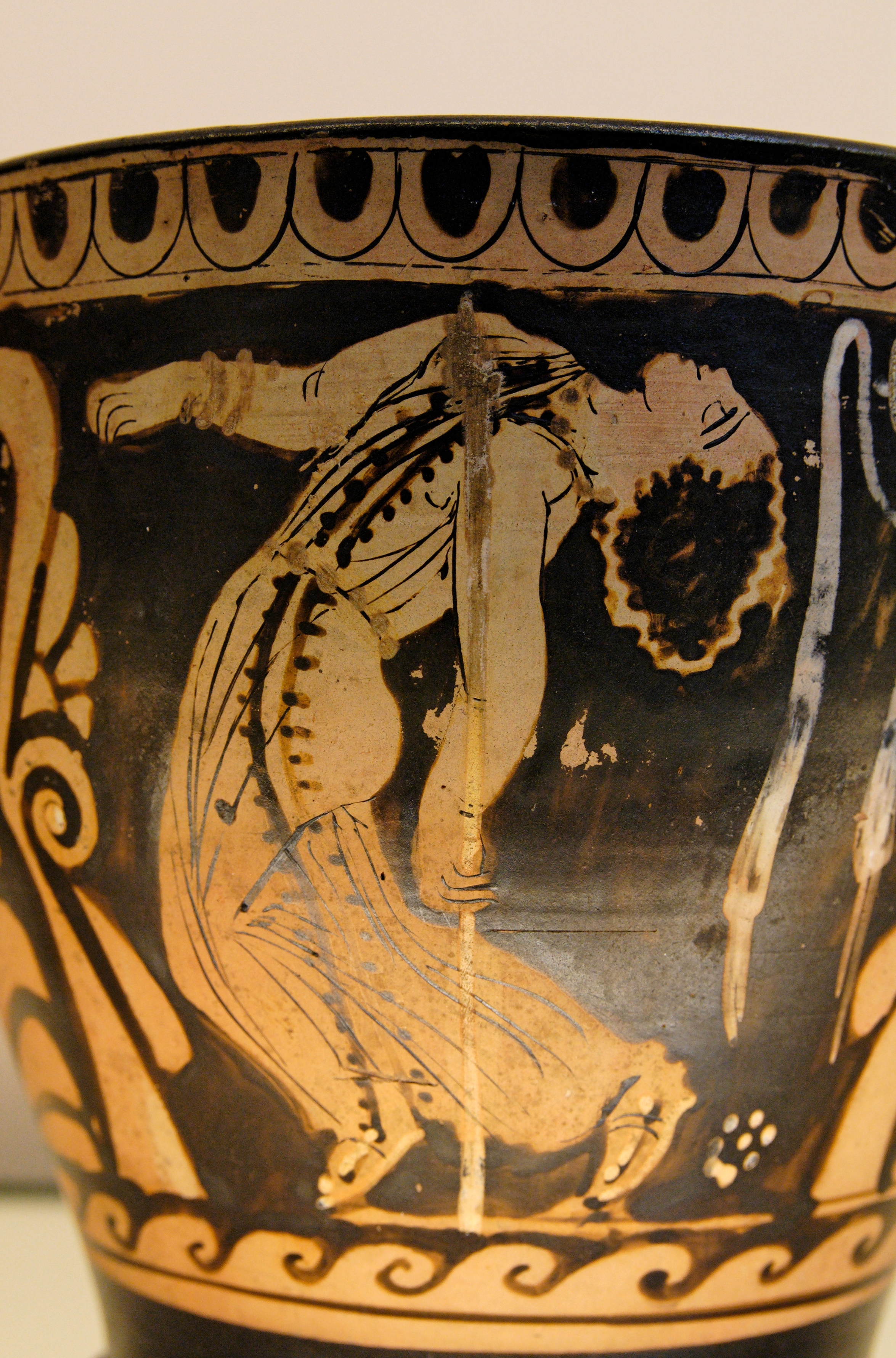
Dionysus (left) watches on as King Lykourgos of Thrake attacks his wife (center). The winged daimon Lyssa hovers above.
Lyssa is related to the Greek word leukos, which means “white.” Lyssa was personified as a daimon of rage and rabid frenzy; it was sometimes used as a synonym for rabies. Lyssa was the daimon sent by Herakles to curse him into a fit of rage when he killed his family. This tragedy led to his Twelve Labors. Upon the impious Dionysus sent Lyssa, and the onset of the affliction is described by the winged spirit herself as a “scorpion’s sting.” (Aeschylus, Fragment 85 Xantriae (from Photius, Lexicon 326. 22) (trans. Weir Smyth) ).
The madness I am referring to is Mania. The Greek word mania is related to the Greek word mainesthai, which means literally “to go mad.” Mania itself is considered to be a type of otherness that is bestowed by a Deity upon a vessel. Four types of mania (theia mania) were outlined by Plato in his Phaedrus:
1) Mantic Mania (Mediumship): Apollon
2) Telestic Mania (Ritual Trance): Dionysus
3) Poetic Mania (Musical Passion): Muses
4) Erotic Mania (Passion, Love): Aphrodite, Eros
In regards to mania, Plato wrote:
…our greatest blessing comes to us by way of mania, which indeed is a Divine Gift.
Shamanic Mania Enthusiasmos – literally, having the God within you – was a state of intoxication in which Dionysus revealed Himself in such a manner that it was overwhelming. A Dionysian broke free from the societal norms of the time to enjoy a liberated life, and that taste of liberation continued even after the ritual state was over. A Manic Dionysian – for one cannot have the God without being Manic – was a prey by choice, hunted to the brink where his sanity was captured and brought down by the God. Sanity is the sacrificial offering that the God takes when He anoints you. Sanity is the balanced state of the Ego when the Self is attempting to harmonize with the Greater Community that the Self is a part of. It is attempting to reach self-actualization by identifying with the Community one is a part of. Humans, being primates, have evolved to be social creatures. In order to maintain that social order, we have developed complex rules of behavior and hierarchy. And, no matter how many rebellions occur or anarchic movements occur, inevitably we come back to our natural instinctual behavior of social rule.
But a Dionysian is a type of shaman who lives in miasmic territory. Miasma was considered impurity by the ancient Greeks, and many things were done to ensure that such impurity was always cleansed. But a Dionysian, based on my personal experience, lives in miasma. We’re rule breakers. We dwell in the tombs and caves. We wander about the lands, with sacred sex polluting the people. We’re not fit to be part of the social order. Why? Agents of chaos. We remind society of its ills, its forgotten people. Dionysus is nothing if not a God who takes the oppressed and empowers them. Women, bound to serve their fathers or husbands in a man-ruled society, left the confines of the polis and found refuge in the remote forests and mountains to experience the ekstasis of the Raving One. Liberation came not through wars or laws, but by the God within.
The Brain-Injured Blessing My brain injury, as I said before, brought me a lot of weaknesses that keep me from being in pace with the world around me. People have to slow down for my sake in many ways. But, the brain injury also exacerbated my behavior on the Autism Spectrum: thus, when I speak to someone, I pay very close attention to their body language and nonverbal nuances. I also log discrepancies and contradictions in their speech and behavior, something that most people do everyday without awareness. The Mania that was bestowed upon me in this net of mental illness is that I am actually more sane than the rest of the world. Watching at a slower pace, I can pay more close attention the details that escape the observations of others in our increasingly fast-paced world. This condition has enlightened me to the depths of my core, shattering the notion of Self I was attempting to build up through my identity with my job and my friends rather than my identity with the God within. It is Dionysus who defines me – no one else. It is Dionysus who shapes me, molds me, and gives me the lens by which I can view the insanity of the world. People do the strangest things to achieve their lives: this is Lyssa in action. People are enraged, rabid and hostile, ready for conflict at anytime. I don’t move at society’s leisure; my whirlwind dance is in keeping with the cyclical rhythm of the Cosmos. But while I dance, I am not paying attention and knocking everything over into a sordid mess. But how can creation occur if destruction does not happen first?
The Manic Jester
I’ve often bemoaned the fact that I am a Heirophant and Kurios (High Priest and Guardian) of my Tradition, because I think a Dionysian Jester is absolutely the worst kind of leader in many respects. I don’t even follow my own rules half the time, because some things are changeable. I dispense advice to my members that I don’t even go by, because I live in a different dimension. But an Oracle, such as I am, ironically is of help in a manic state. Plato wrote of the Pythia that she was not helpful to anyone when she came to her senses; it was her induced mania – taking leave of her senses – when she was able to help out world events. It’s for this reason I can also be viewed as a trouble maker, because I just tend to have that personality clash with people who like a certain type of order to look at me and say, “Yep, you’ll be trouble.” Whether it’s self-inflicted or not, the end result is that trouble follows me. For many people who are in power positions, they view this kind of aura as antithetical to their visions. And, they would be right. However, it has been my experience that what people in power need is a Jester, an appointed Fool that will mock the hierarchy. That was the position of the Jester after all – to help the Powers that Be not take themselves so seriously, and point out the flaws in their otherwise self-centered egos.
Having a brain injury (and I can only speak for myself here) on the day of my accident conferred a type of spontaneous trance-like state that brought on a crisis in my life. Crisis, in Greek, has several meanings, including: selection, judgement, to be separated, to be decided upon, an election. The term is a legal one that spoke of a decision reached by a tribunal whose judgement would affect a person’s place within that society. It was usually used in the sense of a punishment and condemnation. But for a Dionysian, what society deems a punishment, I see as a gateway to enlightenment. The Fool, after all, is perhaps the one who is more at peace than everyone else.
I may not be able to walk with my community how others do. I may not be as fast in processing as everyone else. I may need to use communication and sentences, breaking them down into minute building blocks that may form a different message than the sender intended (or am I reading something hidden that shouldn’t be revealed?). But a krisis is exactly that – a separation unto the Lord of the Vineyard. A turning point when I become His Wine and Intoxicant. So many people think that Dionysian mania is rooted in being drunk and horny. Oh, my friend, if you only knew the real conveyance of the unction of the Bull-Horned Liberator.
This blog has been quiet for awhile, and I’d like to apologize to all of my readers for that. It’s been a tough few months for myself, both financially, spiritually, and physically. Just as a reminder, I suffer with a traumatic right brain injury and all of the side effects that come with it, including epilepsy. I was on one medication, but it seemed to have exacerbated some nasty stuff like vivid hallucinations. In addition, I had 2 or 3 episodes. So now I am weaning off of that one and starting on a new one. Taking both are currently affecting my energy levels, but still I intend to restart my blogging. I need to. Writing is my creative and cathartic outlet for many things, and also my way of remaining in touch with the goings-on of the blog-o-sphere. In addition, I get to share any major events happening in my side of the country as well as with my Temple.
For starters, the Summer Solstice came and went. It was magnificent. Our Temple honored Dionysus Dendritos and the Nymphai. The Solstice is significant in that it signals in our Calendar the end of the Bull Half of the Year and the start of the Wolf Half. That is, the Great Festivals give way from cultus to Dionysus to Hekate. Our Temple is named after Her, after all: Temple of Hekate: Ordo Sacra Strix. So I’ll be writing more about Hekate and how we at the Temple honor cultus to Her in forthcoming blogs.
Our Bomos during our Summer Solstice Festivities.
Polytheist Leadership Conference
Now, as some of you may recall, I was trying to attend the Polytheist Leadership Conference which took place this past July 11 – 13. I missed out on it and told Sannion as such that I would. Sadly, I had other things to attend to. It would have wonderful had I been able to join this historic Inaugural setting, but I’ll work on ensuring that attend future conferences as best as I am able. In the meantime I have this blog. But from what I’ve been reading, it was excellent. You can read about the goings-on in the following areas:
Sannion doesn’t talk about any specific details of the Conference as of yet, but there are some tidbits in a question raised by someone following the Conference. You can read it here.
Galina Krasskova kept some continuous updates at her blog here. Just scroll down and take your pick, folks. There’s a lot to take in, as there should be. I’m jealous.
The Thracian will have some follow-ups coming along at his blog here.
PSLV (aka Lupus), as always, has detailed journalistic entries here. As with Galina’s, scroll down and take your pick. I’m salivating and very sad that I couldn’t attend. “Next time,” I keep telling myself. “Next time.”
Finally, Ruadhan McElroy pens some interesting experiences here and here.
I’m positive there are many more links and blogs talking about the Conference, but since these I follow I figure I’ll post them here. Like you all, I will be following in the days to come.
Impact
What are the ramifications from the Conference? What is it that we, as a people, are being asked to do? What have those who have gone and set themselves up as leaders of Polytheism planning to come forth with in the coming days, months and years? What are the plans for our respective Communities? Do we who did not attend agree on major points, or are there points to disagree on? Now, with the latter questions I tend to try and be careful on, because I’ve had my fair share of criticisms with people who are “armchair debaters.” They feel it is their task to not do anything at all while others do a lot of hard work. And then, they sit back and critique everything down to the last iota. Yet they never contributed anything. I’d hate to be viewed as one of those people, because I didn’t attend. But, we all have voices, and I take a small comfort in that my Work here with my Temple may be enough to let me have some allowance. I also consider myself pretty objective, yet passionate about my views. I don’t tend to take sides in debates very easily, but neither do I make the mistake of always seeing a “third road.” Sometimes the middle way is no way at all, and a side must be taken. Anyway, enough said. I say all of that to say this:
Lupus brought up something interesting, which I’ll quote some of it here. Hopefully it will not be taken out of context. For the full blog, please go here, where he posts a follow-up regarding the Thracian’s appearance on Wyrd Ways Radio. Here’s the issue/question/matter:
And the question is this: have we created a “polytheist echo chamber”? Despite our many disagreements, there is a great deal that we do agree on, and that we have found “unity” of purpose over as a result of all this. That’s a great and powerful thing, and in fact it’s the origin of the term “syncretism,” which I’m unsurprisingly in favor of heavily–!?!–and yet, Fox News is an echo chamber, and various other groups that are not looked on very charitably (with good reason!) are also echo chambers.
Are we at all in danger of becoming an echo chamber? While I don’t think so, realistically, I know that our newfound sense of common purpose and our enjoyment at having had such a great experience will likely prompt those of our critics who already find us distasteful and erroneous for various reasons to say that we’re only interested in our own opinions and hearing them agreed with and supported by like-minded folks. (And that makes us different to EVERYONE ELSE how, exactly?)
I’m beginning to move to the point of thinking that Wicca, Christianity, and all of these other things are perfectly fine for themselves, because they’re entirely different religions than our own. That is obvious, needless to say. I think that it might be more necessary, though, for us as modern polytheists to withdraw from the wider pagan community and umbrella in various ways because our religion and theological viewpoints are so vastly different to most of those, which will then allow us to preserve our autonomy and not be interfered with by their wishes for our conformity. If they can begin to see us as different religions, rather than as being under their umbrella, then there will be no reason for them to try and regulate our rhetoric, our practices, or anything else, in the same way that Hindus don’t do that and pagans don’t do it to Hindus, Buddhists don’t do that and pagans don’t do it to Buddhists, and some Christians don’t do that and pagans don’t (usually) do it to Christians, even though some of them do and would like to on both sides of that issue…
I don’t know…what do you all think?
Polytheist Religions I don’t think there is any one simple response to this, as I don’t think there should be. What Lupus is asking is very relevant, and something that everyone should be careful of: the dreaded Group Think. Everyone starts to feel like they are so like-minded that suddenly the group becomes a place where ideas and innovations stagnate in the face of hardened dogma, and there lies a potential danger even for historically reconstructed Polytheist groups. Thankfully there are questioning Dionysians like myself who love nothing more than to enter an echo chamber and cause a little mayhem and chaos in order for people to see the systems which they have in place will always contain a flaw of some kind, and it’s necessary at times to ensure especially when Old Systems need to die for New Systems to arise. That’s just the cycle of energy: evolution and entropy. In my Temple, our teachings tend to illustrate this cycle between the Forces of Aphrodite and Ares: Love and Strife. In order for Creation to occur, Aphrodite brings forth Desire for the Four Elements to dance in rhythmic Harmony. This rhythmic Harmony is at the heart of all things. But lest matter implode upon itself, Ares must come forth and wield His weapon to separate the Elements into their pure states. However, by separating them into their pure states, destruction of matter occurs. It’s a constant flux and flow dance.
I say all of that to say this: I think there’s a flaw. Lupus groups all Polytheist religions beneath one umbrella in and of itself, when in reality that isn’t very simple. For example, taking the term by itself, Polytheism can be found among Christians and Wiccans. But I guess since most official denominations regard themselves as monotheist, perhaps we can’t include them? I don’t know. It seems weird that we ourselves (or perhaps me) can’t study some Christian denominations like Mormonism and Catholicism and say, “Yeah, despite what they say they are Polytheist.” I mean, we study other cultural faiths and do it all of the time. I don’t think Western religions should be exempt just because they try and say otherwise. Traditional Wicca, for the record, isn’t a religion. It’s a priesthood of initiates dedicated to specific tribal Gods and spirits of those Traditions. Neo-Wicca is a vastly different creature, but I don’t think I have space for that right now. I’m trying to focus on Lupus’ question, and giving an answer that I’m sure plenty will disagree with. Honestly, I’m okay with that! I really hope people do, because we need honest dialogue about these kinds of things. Now, while perhaps the vast majority (I’m guessing) of Polytheist-labeled faiths group themselves as “historically accurate,” there may be Temples and groups which will rise up and revive the worship of the Old Gods in their own way. There may not be any historical precedent for what they do, but they may claim to be Polytheist nonetheless.
As an example, many cults and groups of Sanatana Dharma (or what we Westerners call “Hinduism”) are considered more orthodox in their approach to the Vedas and other Scriptures. But there are cults and groups that fall under the umbrella of polytheism, henotheism, etc. within Hinduism and yet may not be considered “orthodox” by the majority. There may be gurus or saints that have their own revelations about the Gods, their own teachings about how they approach them, and so forth. (I need to stop here and say I honestly hope I am making sense and that I didn’t make a mistake in my insomnia to type this at 4am and it’s all gibberish). I guess what I’m trying to say is that I think rather than pull completely away from Neo-Paganism, we should find ways to have our own dialogues with our local Communities which may include Neo-Pagans. The problem I think is that Neo-Pagans have had a start since the 1960s, so inevitably now they are going to host gatherings under their label, whether large or small. But as Polytheist-labeled groups can start their own momentum, we need not exclude anyone. We can have our Conferences, Festivals and Workshops and be inclusive as well. We’re siblings anyway, worshiping the same or similar Gods but perhaps in vastly different ways. Not all Neo-Pagans are Deists, just as not all Polytheists are historically accurate. There are still some people, such as myself, who hold the label of a Neo-Pagan and a Polytheist. My Temple is labeled as Polytheist, however, because it’s important to distinguish that unlike the Neo-Wiccan groups in the area that are a venerable free-for-all, we carry structure, hierarchy and dogma. We even have our own set of sacred Scriptures that detail our own Mythology unique to our Temple. Thus, we are very different.
Getting Out from under the Umbrella
But just to make sure I’m saying something correct and not misreading, I agree with Lupus that insofar as the Greater Pagan Communities are concerned, there are organizations that tend to speak for the Communities as best as they are able (i.e. Pagan Pride, Cherry Hill Seminary, Circle Sanctuary, etc.), and they don’t speak for us. Or, speaking for myself, they don’t speak for me (I apologize to any Polytheist who enjoys those organizations and feels they do speak for them). We just need to be careful, I think, that again while having our own gatherings that we do not totally separate. It’s a precarious dance. Some of us, like I said, will walk in both worlds at the same time, being neither here nor there. Lupus in a blog entry described a brief presentation by the Thracian in which the latter spoke about regional cultus in modern polytheism. According to what I can gather (I’m sure more details will come later), the viewpoint that modern Polytheists can do is to look at different people, cults and Temples from how they worship Deities and if their approach to similar/same Deities are different, it’s because of regional variation. No one can speak for anyone. That’s how the ancient world practiced. We must keep in mind that Polytheism means plurality: a kaleidoscope worldview that makes room for many different universes and possibilities. For every fragment of the ancient world that has survived, perhaps hundreds are lost that we may never know of. We can never be truly sure how one person or group approaches the Gods is not an approved way. Neither can we speak for the Gods. Well, I can’t, short of blasphemy going on. Even though as an Oracle They choose to speak through me, I can’t just assume something. It doesn’t Work that way. I hate that.
Why All the Fuss?
If the aforementioned is true, then why all the fuss about rituals in Pagan Pride Day events? Why all of the kerfuffle when it comes to the differences between Polytheists and some Neo-Pagans? Here’s my honest answer, for what it’s worth: it’s because our ways are being questioned and threatened with exclusion, not the other way around. It’s because many Neo-Pagans desire Magick and to walk with the Gods, and yet when it’s in front of them, they fucking stomp on it because it doesn’t mesh with their semblance of reality. They only recognize it when they see pseudo-shamans who charge exorbitant amounts of cash for a weekend retreat to pound a few drums, paint their faces, find their Wolf/Bear/Eagle totem, and then suddenly they think they’re a fucking shaman. It’s because they don’t know the meaning of sacrifice – only reward. It’s because they think all rituals are the same, and everyone is the same, and we’re homogenized with them against our wishes. It’s because no one wants any controversy in the Pan-Pagan Movement. Traditional Wiccans get enough flack for being secretive and keeping their Mysteries to themselves. People want to come in, be a 3rd degree without any sincere training of what it means to touch the spirit world, and then claim a title without knowing just what that title entails. They see the gold tiara, not the thorns. They see the shiny fetishes as an excuse for their hoarding problem. They disrespect themselves, so how can they possibly respect the Unseen Powers they desire to know so much?
That’s why there is a fuss. I’ve said it once, and I’ll say it again: we are different cultures, different tribes, different peoples. We’re not all the same, and that’s okay. We need to have:




 The Cave of Oracle